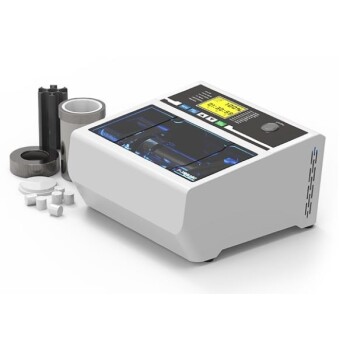
Precision dripping systems and syringes serve as critical molding tools that regulate the pressure and flow rate when injecting a mixture solution into a cross-linking agent like calcium chloride. By maintaining a steady injection rate, these devices control the formation of liquid droplets, ensuring they undergo rapid ionic cross-linking immediately upon contact with the solution to form stable composite adsorbent beads.
By balancing gravity and surface tension, precision dripping ensures every bead is identical in size and shape. This physical uniformity is not just an aesthetic goal; it is a scientific requirement for generating reliable data in adsorption kinetics experiments.
The Mechanics of Bead Formation
Controlling Injection Pressure
The primary function of a syringe or precision dripping system is to act as a stable delivery mechanism. By controlling the pressure applied to the mixture solution, the system ensures a steady, non-pulsing rate of flow.
Utilizing Physical Forces
These systems rely on a delicate interaction between physics and chemistry. They utilize the balance between gravity and surface tension to form the droplet at the needle tip.
Triggering Rapid Cross-Linking
Once the droplet falls, it enters the calcium chloride solution. The precision of the delivery ensures the droplet remains intact, allowing for rapid ionic cross-linking the moment it submerges.
Why Morphology Matters
Achieving Uniform Particle Size
The consistency provided by automated or precision tools eliminates the variability found in manual methods. This results in composite particles that are virtually identical in mass and diameter.
Ensuring Excellent Sphericity
Droplets formed under controlled tension and gravity naturally assume a spherical shape. Maintaining this "excellent sphericity" is vital for the structural integrity of the final adsorbent bead.
The Link to Experimental Data
The physical shape of the bead directly impacts scientific results. Uniform size and sphericity ensure consistent contact areas across all samples. This consistency is essential for accuracy when conducting subsequent adsorption kinetics experiments.
Understanding the Trade-offs
Equipment Dependence
While precision systems yield superior beads, they introduce a dependency on mechanical calibration. If the pressure control wavers or the nozzle clogs, the balance between gravity and surface tension is disrupted, immediately compromising bead uniformity.
Complexity vs. Quality
Using a simple syringe is accessible, but achieving the "steady rate" required for perfect sphericity manually is difficult. A precision dripping system automates this but adds complexity to the experimental setup.
Making the Right Choice for Your Goal
To maximize the quality of your sodium alginate-based beads, align your tooling with your experimental needs:
- If your primary focus is Adsorption Kinetics: Prioritize high-precision dripping systems to guarantee uniform contact areas, which acts as a control variable in your data.
- If your primary focus is Initial Prototyping: A standard syringe may suffice for checking gelation capabilities, but be aware that the lack of sphericity will skew kinetic data.
Precision in the dripping process is the single most important factor in transitioning from a liquid mixture to a scientifically valid solid adsorbent.
Summary Table:
| Feature | Manual Syringe | Precision Dripping System | Impact on Result |
|---|---|---|---|
| Flow Rate Control | Variable/Manual | Automated/Steady | Ensures consistent bead mass |
| Droplet Formation | Inconsistent | Controlled Gravity/Tension | Achieves excellent sphericity |
| Cross-linking | Irregular | Rapid & Uniform | Stable structural integrity |
| Data Reliability | Lower (due to size variance) | High (uniform contact area) | Essential for adsorption kinetics |
Elevate Your Material Research with KINTEK Precision Solutions
Don't let manual variability compromise your experimental data. At KINTEK, we specialize in providing high-performance laboratory equipment designed for the most demanding research applications. Whether you are developing sodium alginate-based composite adsorbents, exploring battery research, or utilizing our high-temperature furnaces and precision reactors, we offer the tools necessary to ensure repeatability and scientific excellence.
From advanced crushing and milling systems to essential PTFE and ceramic consumables, KINTEK is your partner in laboratory precision.
Ready to optimize your bead formation and adsorption kinetics? Contact us today to discover our full range of solutions!
References
- Jie Qi, Fang Guo. Biopolymer Meets Nanoclay: Rational Fabrication of Superb Adsorption Beads from Green Precursors for Efficient Capture of Pb(II) and Dyes. DOI: 10.3390/nano14090766
This article is also based on technical information from Kintek Solution Knowledge Base .
Related Products
- Laboratory Micro Horizontal Jar Mill for Precision Sample Preparation in Research and Analysis
- Chemical Vapor Deposition CVD Equipment System Chamber Slide PECVD Tube Furnace with Liquid Gasifier PECVD Machine
People Also Ask
- What are the different types of laboratory mills? Choose the Right Grinder for Your Sample Material
- What is use for grinding in the laboratory? Select the Right Mill for Accurate Sample Prep
- What is the function of laboratory mills? Achieve Precise Particle Size Control for Accurate Analysis
- What is the use of a laboratory mill? Achieve Accurate Sample Homogenization for Reliable Results
- What is the purpose of sample preparation? Ensure Accurate & Reliable Analytical Results