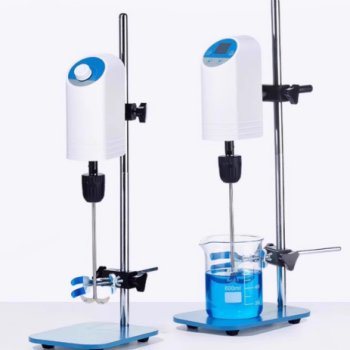
Stirring systems are the critical control point for determining the uniformity and quality of synthesized oligosaccharides. Devices such as Rushton turbines or paddle stirrers drive the process by generating strong radial or axial flow fields, which are essential for enhancing mass and heat transfer between solid lignocellulosic materials and the liquid reactant phase.
Core Takeaway efficient mixing prevents uneven reaction zones by eliminating local hot spots and chemical concentration gradients. This consistency allows for synchronous depolymerization, directly resulting in high-quality oligosaccharides with a narrow molecular weight distribution.
Mechanisms of Action
Creating Effective Flow Fields
Stirring systems operate by mechanically forcing the movement of fluids and solids. They generate strong radial or axial flow fields depending on the specific geometry of the blade, such as the Rushton turbine.
This movement is not merely about agitation; it is about contact efficiency. The flow ensures continuous interaction between the solid lignocellulosic biomass and the liquid phase.
Enhancing Transfer Rates
The primary physical barrier in this synthesis is the interface between solid and liquid. Efficient stirring systems significantly enhance mass and heat transfer across this boundary.
By constantly refreshing the fluid in contact with the solid particles, the system ensures that reactants reach the substrate and heat is supplied or removed rapidly.
Achieving Reaction Uniformity
Eliminating Local Hot Spots
In a static or poorly mixed reactor, temperature variations are inevitable. Efficient devices like Rushton turbines ensure a uniform distribution of heat throughout the vessel.
This thermal homogeneity is vital. It eliminates local "hot spots" that could lead to thermal degradation or uncontrolled side reactions.
Synchronous Depolymerization
When heat and chemical components are distributed evenly, the reaction conditions are identical at every point in the reactor.
This allows the depolymerization of hemicellulose or pectin to occur synchronously. Rather than some particles breaking down faster than others, the entire batch reacts at the same rate.
Impact on Product Quality
Controlling Molecular Weight
The synchronization of the reaction has a direct impact on the final product structure.
Because the depolymerization happens evenly, the resulting oligosaccharide chains are of consistent length. This produces a product with a narrow molecular weight distribution.
Defining High Quality
In oligosaccharide synthesis, quality is often defined by purity and consistency. By preventing over-reaction or under-reaction through uniform mixing, the system yields high-quality oligosaccharides suitable for precise applications.
Understanding the Trade-offs
Mechanical Shear vs. Material Integrity
While strong flow fields are necessary for transfer, they induce shear stress. Devices like Rushton turbines are high-shear impellers.
You must ensure that the mechanical force applied does not physically pulverize the solid material in a way that complicates downstream separation, even though it aids in mass transfer.
Energy Consumption
Creating strong radial flows to move heavy solid suspensions requires significant power.
There is a balance to be struck between achieving perfect homogeneity and the energy cost required to drive the impeller at the necessary speeds.
Making the Right Choice for Your Reactor
To optimize your oligosaccharide synthesis, align your stirring strategy with your specific quality targets.
- If your primary focus is Product Consistency: Prioritize high-efficiency impellers like Rushton turbines to ensure synchronous depolymerization and a narrow molecular weight distribution.
- If your primary focus is Process Safety: Ensure your stirring system is calibrated to eliminate local hot spots, preventing thermal runaway or product degradation.
Ultimately, the uniformity of your mixing environment dictates the uniformity of your final chemical product.
Summary Table:
| Feature | Rushton Turbine | Four-Blade Paddle | Impact on Synthesis |
|---|---|---|---|
| Flow Pattern | Primarily Radial | Primarily Axial | Determines contact efficiency between solids and liquids |
| Shear Intensity | High Shear | Medium/Low Shear | Influences mass transfer vs. physical material integrity |
| Heat Transfer | Exceptional | Moderate | Eliminates local hot spots for thermal homogeneity |
| Product Outcome | Narrow MW distribution | Broad MW distribution | Affects the consistency and purity of oligosaccharides |
Elevate Your Chemical Synthesis with KINTEK Precision
Achieving the perfect molecular weight distribution in oligosaccharide synthesis requires more than just chemistry—it requires the right hardware. KINTEK specializes in advanced laboratory equipment designed for the most demanding research environments. From high-performance stirring systems and reactors to our specialized high-temperature high-pressure reactors and autoclaves, we provide the tools necessary to eliminate thermal gradients and ensure synchronous depolymerization.
Whether you are working with crushing and milling systems for biomass preparation or require precise cooling solutions like ULT freezers and freeze dryers for product stabilization, KINTEK is your partner in laboratory excellence. Contact us today to optimize your reactor configuration and enhance your synthesis quality!
References
- Ramachandran Chelliah, Deog‐Hwan Oh. Revolutionizing Renewable Resources: Cutting-Edge Trends and Future Prospects in the Valorization of Oligosaccharides. DOI: 10.3390/fermentation10040195
This article is also based on technical information from Kintek Solution Knowledge Base .
Related Products
- High Performance Laboratory Stirrers for Diverse Applications
- Laboratory Small Constant Temperature Heated Magnetic Stirrer Heater and Stirrer
- High Pressure Laboratory Autoclave Reactor for Hydrothermal Synthesis
- High Temperature Constant Temperature Heating Circulator Water Bath Chiller Circulator for Reaction Bath
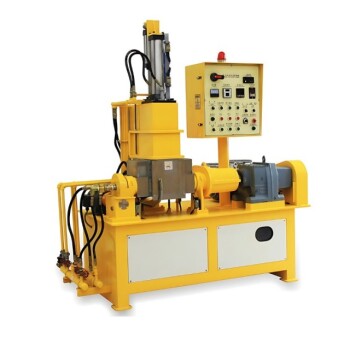
- Lab Internal Rubber Mixer Rubber Kneader Machine for Mixing and Kneading
People Also Ask
- How does a laboratory stirrer influence MOF product quality? Master Precision in Non-Solvothermal Synthesis
- What critical role does a Laboratory Stirrer play during leaching? Enhance Titanium-Magnesium Waste Recovery
- What is the primary function of laboratory stirring equipment in the preparation of compost leachate? Optimize Extraction
- What is a laboratory mixer? A Guide to Achieving Perfect Sample Homogeneity
- What is a laboratory mixer used for? Choose the Right Tool for Liquids or Solids