Knowledge How do you calculate sieve mesh size? Use Official Standards for Accurate Particle Analysis
Author avatar

Tech Team · Kintek Solution

Updated 6 days ago

How do you calculate sieve mesh size? Use Official Standards for Accurate Particle Analysis


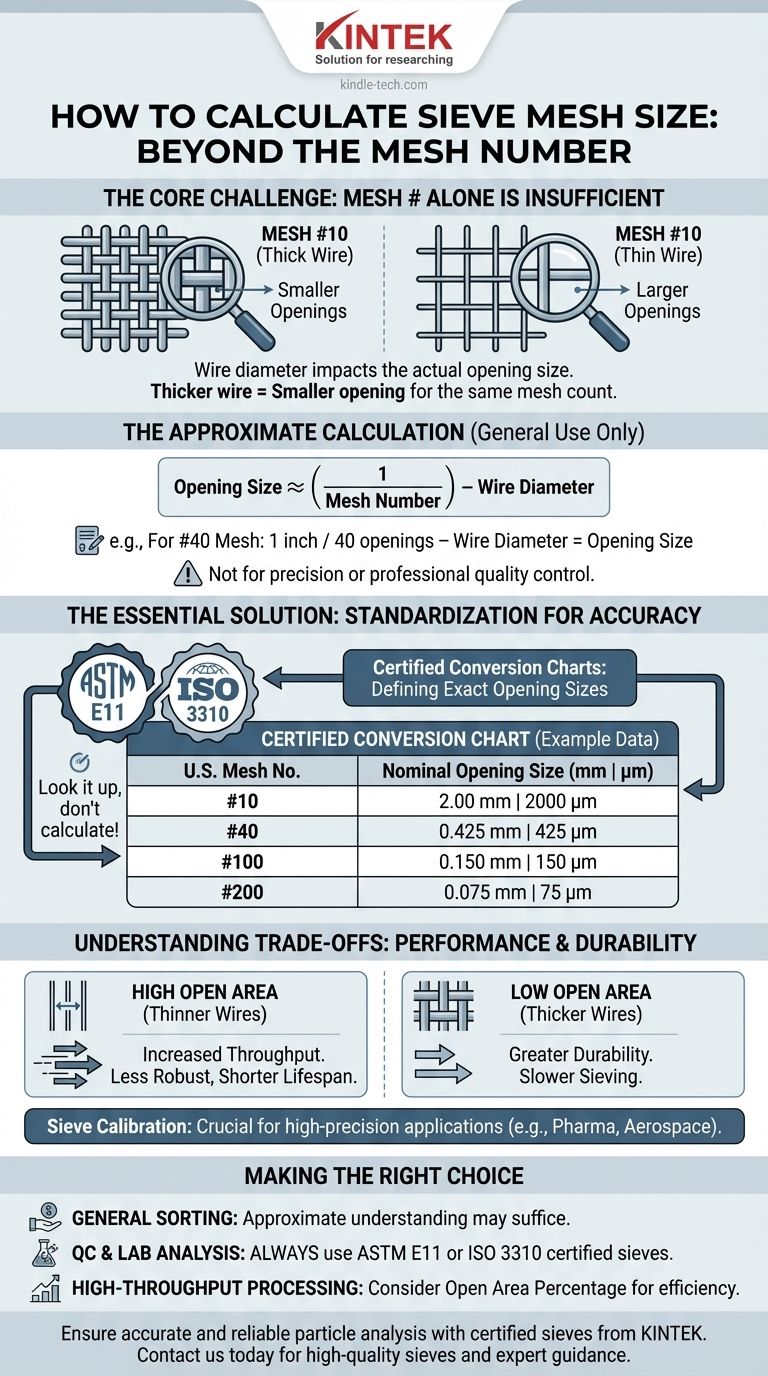
Calculating sieve mesh size is not done with a single, universal formula because the mesh number alone is insufficient. The mesh number tells you the number of openings per linear inch, but the actual size of each opening depends on the diameter of the wire used to weave the sieve. A thicker wire results in a smaller opening for the same mesh number.

The core principle is that a sieve's opening size is determined by the inverse of its mesh number, minus the space taken up by the wires. For any precise or professional work, you do not calculate this; you refer to official conversion charts from standards like ASTM E11 or ISO 3310, which specify the exact opening size for each certified mesh designation.
How do you calculate sieve mesh size? Use Official Standards for Accurate Particle Analysis

The Fundamentals of Sieve Mesh

To select the correct sieve, you must understand the relationship between its three core properties: the mesh number, the wire diameter, and the resulting opening size.

What is "Mesh Number"?

The mesh number (or mesh count) is a simple measure of how fine a woven wire mesh is. It represents the number of openings you can count across one linear inch of the screen.

For example, a sieve with a #10 mesh has 10 openings per inch. A much finer #200 mesh sieve has 200 openings per inch.

The Critical Role of Wire Diameter

The wires themselves take up space. For a given mesh number, using a thicker, more durable wire will necessarily create smaller openings. Conversely, a thinner wire will create larger openings.

This is why you cannot accurately determine the opening size from the mesh number alone.

The Approximate Calculation

If you know the wire diameter, you can estimate the opening size with a simple formula:

Opening Size ≈ (1 / Mesh Number) - Wire Diameter

For example, for a #40 mesh sieve, there are 40 openings and 40 wires per inch. If you do not know the wire diameter, you cannot solve for the opening size. This approximation is useful for general understanding but not for scientific or quality control applications.

Why Standardization is Essential

In any technical field, repeatable results are paramount. Relying on an approximate calculation introduces unacceptable variability, which is solved by using internationally recognized standards.

The Problem with Uncertified Sieves

If two #100 mesh sieves from different manufacturers use different wire diameters, they will separate particles differently. This makes it impossible to compare test results or ensure consistent product quality.

Introducing ASTM E11 and ISO 3310

To solve this, organizations developed standards that rigidly define sieve specifications. The most common are ASTM E11 (in the United States) and ISO 3310 (internationally).

These standards prescribe the nominal opening size for each standard mesh number. They also specify the required wire diameter and the permissible manufacturing tolerances to ensure global uniformity.

How to Use a Standard Conversion Chart

For any professional application, you do not calculate the opening size—you look it up on a certified conversion chart. These charts directly link the mesh number to its official opening size in millimeters (mm) or micrometers (microns).

U.S. Mesh No. Nominal Sieve Opening (mm) Nominal Sieve Opening (microns, μm)
#10 2.00 2000
#40 0.425 425
#100 0.150 150
#200 0.075 75

Understanding the Trade-offs

Choosing a sieve involves more than just the opening size. The physical construction of the mesh creates important performance trade-offs.

Open Area Percentage

The open area is the ratio of the area of the openings to the total area of the sieve. It is influenced by the wire diameter.

A sieve with a higher open area (thinner wires) allows particles to pass through more quickly, increasing throughput. However, it may be less robust and have a shorter lifespan. A lower open area offers greater durability at the cost of slower sieving.

Woven Wire vs. Perforated Plate

While woven wire mesh is most common, some sieves are made from a perforated plate—a solid sheet of metal with fixed-size holes. These are typically used for larger particle sizes (>4 mm) and offer superior durability, but they cannot achieve the fine separations of a woven wire sieve.

The Importance of Sieve Calibration

Even certified sieves have manufacturing tolerances. For high-precision applications, such as in the pharmaceutical or aerospace industries, sieves must be periodically calibrated using traceable glass beads or an optical comparator to verify that the openings remain within specification.

Making the Right Choice for Your Goal

Your application dictates how you should approach sieve selection. Use the official standards as your definitive guide for any task that requires accuracy and repeatability.

  • If your primary focus is general, non-critical sorting: An approximate understanding of the relationship between mesh number and opening size may be sufficient.
  • If your primary focus is quality control, lab analysis, or scientific research: Always use sieves certified to ASTM E11 or ISO 3310 and refer to their official conversion charts for opening sizes.
  • If your primary focus is high-throughput industrial processing: Pay close attention to the open area percentage, as it directly impacts sieving efficiency and equipment wear.

By moving beyond simple calculation and leveraging industry standards, you ensure your particle analysis is both accurate and reliable.

Summary Table:

U.S. Mesh No. Nominal Opening (mm) Nominal Opening (μm)
#10 2.00 2000
#40 0.425 425
#100 0.150 150
#200 0.075 75

Ensure your particle analysis is accurate and reliable with certified sieves from KINTEK.

As a leading supplier of laboratory equipment, KINTEK provides high-quality sieves that meet ASTM E11 and ISO 3310 standards, guaranteeing precise opening sizes and consistent results for your quality control, research, or industrial processes. Our experts can help you select the right sieves for your specific application, whether you're in pharmaceuticals, materials science, or food processing.

Contact our team today to discuss your sieve requirements and elevate your particle analysis workflow. Get in touch via our contact form for a personalized consultation.

Visual Guide
How do you calculate sieve mesh size? Use Official Standards for Accurate Particle Analysis Visual Guide

Related Products

People Also Ask

Related Products

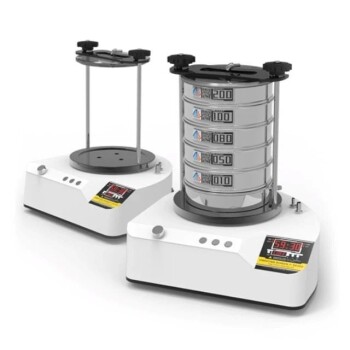
Laboratory Test Sieves and Vibratory Sieve Shaker Machine

Laboratory Test Sieves and Vibratory Sieve Shaker Machine

Efficiently process powders, granules, and small blocks with a high-frequency vibration sieve. Control vibration frequency, screen continuously or intermittently, and achieve accurate particle size determination, separation, and classification.

Three-dimensional electromagnetic sieving instrument

Three-dimensional electromagnetic sieving instrument

KT-VT150 is a desktop sample processing instrument for both sieving and grinding. Grinding and sieving can be used both dry and wet. The vibration amplitude is 5mm and the vibration frequency is 3000-3600 times/min.

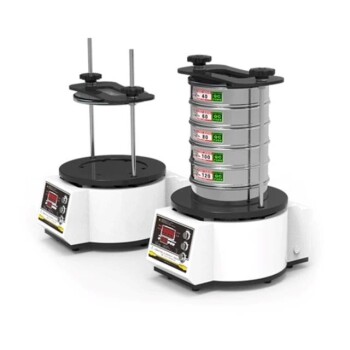
Laboratory Vibratory Sieve Shaker Machine for Dry and Wet Three-Dimensional Sieving

Laboratory Vibratory Sieve Shaker Machine for Dry and Wet Three-Dimensional Sieving

KT-VD200 can be used for sieving tasks of dry and wet samples in the laboratory. The screening quality is 20g-3kg. The product is designed with a unique mechanical structure and an electromagnetic vibrating body with a vibration frequency of 3000 times per minute.

Laboratory Vibratory Sieve Shaker Machine Slap Vibrating Sieve

Laboratory Vibratory Sieve Shaker Machine Slap Vibrating Sieve

KT-T200TAP is a slapping and oscillating sieving instrument for laboratory desktop use, with 300 rpm horizontal circular motion and 300 vertical slapping motions to simulate manual sieving to help sample particles pass through better.

Laboratory Wet Three-Dimensional Vibratory Sieve Shaker Machine

Laboratory Wet Three-Dimensional Vibratory Sieve Shaker Machine

The wet three-dimensional vibrating sieving instrument focuses on solving the sieving tasks of dry and wet samples in the laboratory. It is suitable for sieving 20g - 3kg dry, wet or liquid samples.

Custom PTFE Teflon Parts Manufacturer for PTFE Mesh F4 Sieve

Custom PTFE Teflon Parts Manufacturer for PTFE Mesh F4 Sieve

PTFE mesh sieve is a specialized test sieve designed for particle analysis in various industries, featuring a non-metallic mesh woven from PTFE filament. This synthetic mesh is ideal for applications where metal contamination is a concern . PTFE sieves are crucial for maintaining the integrity of samples in sensitive environments, ensuring accurate and reliable results in particle size distribution analysis.

Laboratory Vortex Mixer Orbital Shaker Multifunctional Rotation Oscillation Mixer

Laboratory Vortex Mixer Orbital Shaker Multifunctional Rotation Oscillation Mixer

The inching mixer is small in size, mixes quickly and thoroughly, and the liquid is in a vortex shape, which can mix all the test solutions attached to the tube wall.

Small Lab Rubber Calendering Machine

Small Lab Rubber Calendering Machine

Small lab rubber calendering machine is used for producing thin, continuous sheets of plastic or rubber materials. It is commonly employed in laboratories, small-scale production facilities, and prototyping environments to create films, coatings, and laminates with precise thickness and surface finish.

Automatic Laboratory Heat Press Machine

Automatic Laboratory Heat Press Machine

Precision automatic heat press machines for labs—ideal for material testing, composites, and R&D. Customizable, safe, and efficient. Contact KINTEK today!

Lab Internal Rubber Mixer Rubber Kneader Machine for Mixing and Kneading

Lab Internal Rubber Mixer Rubber Kneader Machine for Mixing and Kneading

Lab internal rubber mixer is suitable for mixing, kneading and dispersing various chemical raw materials such as plastics, rubber, synthetic rubber, hot melt adhesive and various low-viscosity materials.

Double Plate Heating Press Mold for Lab

Double Plate Heating Press Mold for Lab

Discover precision in heating with our Double Plate Heating Mold, featuring high-quality steel and uniform temperature control for efficient lab processes. Ideal for various thermal applications.

Lab Plastic PVC Calender Stretch Film Casting Machine for Film Testing

Lab Plastic PVC Calender Stretch Film Casting Machine for Film Testing

The cast film machine is designed for the molding of polymer cast film products and has multiple processing functions such as casting, extrusion, stretching, and compounding.

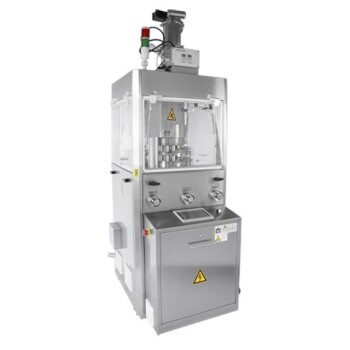
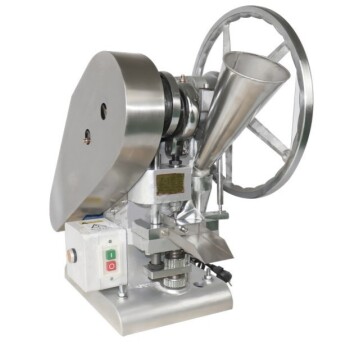
Single Punch Tablet Press Machine and Mass Production Rotary Tablet Punching Machine for TDP

Single Punch Tablet Press Machine and Mass Production Rotary Tablet Punching Machine for TDP

Rotary tablet punching machine is an automatic rotating and continuous tableting machine. It is mainly used for tablet manufacturing in the pharmaceutical industry, and is also suitable for industrial sectors such as food, chemicals, batteries, electronics, ceramics, etc. to compress granular raw materials into tablets.

Single Punch Electric Tablet Press Machine TDP Tablet Punching Machine

Single Punch Electric Tablet Press Machine TDP Tablet Punching Machine

The electric tablet punching machine is a laboratory equipment designed for pressing various granular and powdery raw materials into discs and other geometric shapes. It is commonly used in pharmaceutical, healthcare products, food, and other industries for small batch production and processing. The machine is compact, lightweight, and easy to operate, making it suitable for use in clinics, schools, laboratories, and research units.

Desktop Fast Laboratory Autoclave Sterilizer 35L 50L 90L for Lab Use

Desktop Fast Laboratory Autoclave Sterilizer 35L 50L 90L for Lab Use

The desktop fast steam sterilizer is a compact and reliable device used for rapid sterilization of medical, pharmaceutical, and research items. It efficiently sterilizes surgical instruments, glassware, medicines, and resistant materials, making it suitable for various applications.

Precision Wire Saw Laboratory Cutting Machine with 800mm x 800mm Workbench for Diamond Single Wire Circular Small Cutting

Precision Wire Saw Laboratory Cutting Machine with 800mm x 800mm Workbench for Diamond Single Wire Circular Small Cutting

Diamond wire cutting machines are mainly used for precision cutting of ceramics, crystals, glass, metals, rocks, thermoelectric materials, infrared optical materials, composite materials, biomedical materials and other material analysis samples. Especially suitable for precision cutting of ultra-thin plates with thickness up to 0.2mm.

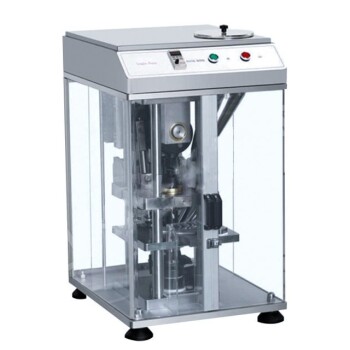
Single Punch Electric Tablet Press Machine Laboratory Powder Tablet Punching TDP Tablet Press

Single Punch Electric Tablet Press Machine Laboratory Powder Tablet Punching TDP Tablet Press

The single-punch electric tablet press is a laboratory-scale tablet press suitable for corporate laboratories in pharmaceutical, chemical, food, metallurgical and other industries.

Heated Hydraulic Press Machine with Integrated Manual Heated Plates for Lab Use

Heated Hydraulic Press Machine with Integrated Manual Heated Plates for Lab Use

Efficiently process heat-pressing samples with our Integrated Manual Heated Lab Press. With a heating range up to 500°C, it's perfect for various industries.

High Energy Planetary Ball Mill Machine for Laboratory Horizontal Tank Type

High Energy Planetary Ball Mill Machine for Laboratory Horizontal Tank Type

The KT-P2000H uses a unique Y-axis planetary trajectory, and utilizes the collision, friction and gravity between the sample and the grinding ball.

Metallographic Specimen Mounting Machine for Laboratory Materials and Analysis

Metallographic Specimen Mounting Machine for Laboratory Materials and Analysis

Precision metallographic mounting machines for labs—automated, versatile, and efficient. Ideal for sample prep in research and quality control. Contact KINTEK today!


Leave Your Message