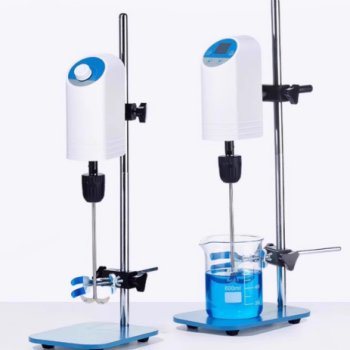
The Continuous Stirred Tank Reactor (CSTR) serves as the foundational mechanism for environmental consistency in ABE fermentation. Through the use of mechanical agitation, it ensures the homogeneity of the fermentation broth, allowing for the rigorous control of variables necessary for biological efficiency. This precise regulation of pH and temperature is the key driver that allows the system to manage the complex metabolic behavior of Clostridia bacteria.
Core Takeaway The success of ABE fermentation hinges on a delicate biological switch from acid production to solvent production. The CSTR’s primary value is its ability to create a mechanically uniform environment, enabling the precise pH and temperature regulation required to stabilize this metabolic transition.
Achieving Homogeneity Through Mechanical Agitation
Uniform Distribution of Components
The CSTR utilizes active mechanical agitation to mix the fermentation broth continuously. This ensures that nutrients, microbial cells, and metabolites are distributed evenly throughout the reactor volume.
Eliminating Gradients
By maintaining constant motion, the reactor prevents the formation of "dead zones" or concentration gradients. This uniformity ensures that the Clostridia cells have consistent access to nutrients regardless of their location in the tank.
Precision Control of Environmental Parameters
Regulating pH Levels
The uniform environment created by the CSTR allows for accurate monitoring and adjustment of pH levels. Constant regulation is essential, as fluctuations in acidity can drastically alter the fermentation pathway.
Temperature Stabilization
Mechanical mixing also facilitates even heat distribution, preventing hot or cold spots within the broth. This allows operators to maintain the strict temperature range required for optimal microbial activity.
Facilitating the Metabolic Switch
Stabilizing Clostridia Activity
The ultimate goal of physical control is to stabilize the metabolic activity of the solvent-producing Clostridia. A consistent environment reduces biological stress, allowing the cells to function efficiently.
The Acidogenic to Solventogenic Transition
ABE fermentation involves a critical phase change from the acidogenic stage (producing acids) to the solventogenic stage (producing acetone, butanol, and ethanol). The CSTR’s ability to strictly regulate pH and temperature facilitates this transition, ensuring the process shifts correctly toward solvent production.
Operational Considerations and Trade-offs
Mechanical Complexity
While mechanical agitation ensures uniformity, it introduces moving parts that require maintenance. Failure of the agitation system can lead to rapid stratification and loss of process control.
Energy Requirements
Achieving perfect homogeneity requires continuous energy input for the motors driving the agitators. This operational cost must be weighed against the benefits of increased yield stability.
Optimizing Your Fermentation Strategy
To maximize the benefits of a CSTR in ABE fermentation, align your operational focus with your specific process goals:
- If your primary focus is process consistency: Prioritize the calibration of mechanical agitation to ensure absolute homogeneity of nutrients and cells.
- If your primary focus is solvent yield: Concentrate on the precise automation of pH and temperature controls to support the transition to the solventogenic stage.
By mastering the mechanical controls of the CSTR, you dictate the biological success of the fermentation process.
Summary Table:
| Feature | Function in ABE Fermentation | Impact on Process Control |
|---|---|---|
| Mechanical Agitation | Ensures broth homogeneity & nutrient distribution | Eliminates gradients and 'dead zones' |
| pH Regulation | Stabilizes the acidogenic-to-solventogenic switch | Prevents pathway shifts and cell stress |
| Temperature Control | Maintains optimal microbial metabolic activity | Ensures consistent Clostridia performance |
| Uniformity | Synchronizes metabolic state across the reactor | Facilitates predictable solvent yields |
Maximize Your Fermentation Efficiency with KINTEK
Precise control is the difference between acid waste and high-yield solvent production. KINTEK specializes in advanced laboratory solutions, offering high-performance high-temperature high-pressure reactors and autoclaves, along with precision homogenizers and shakers designed to maintain the perfect environment for your microbial cultures.
Whether you are optimizing Clostridia metabolic switches or scaling up complex chemical synthesis, our comprehensive range of equipment—from high-temperature furnaces and vacuum systems to PTFE consumables—ensures your research meets the highest standards of accuracy.
Ready to elevate your laboratory process? Contact our experts today to find the ideal equipment for your specific fermentation and research needs!
References
- Sandip B. Bankar, Tom Granström. Biobutanol: the outlook of an academic and industrialist. DOI: 10.1039/c3ra43011a
This article is also based on technical information from Kintek Solution Knowledge Base .
Related Products
- Laboratory Small Constant Temperature Heated Magnetic Stirrer Heater and Stirrer
- Customizable Laboratory High Temperature High Pressure Reactors for Diverse Scientific Applications
- High Performance Laboratory Stirrers for Diverse Applications
- Customizable High Pressure Reactors for Advanced Scientific and Industrial Applications
- High Pressure Laboratory Autoclave Reactor for Hydrothermal Synthesis
People Also Ask
- What role does a magnetic stirrer with heating play in ZnO nanoparticle synthesis? Precision Control for Quality Results
- What role does a constant temperature heating magnetic stirrer play in MFC-HAp synthesis? Achieve Material Homogeneity
- What is the function of a laboratory magnetic stirrer in Ni–Cr–P electrodeposition? Optimize Ion Transport & Coating
- Why is a laboratory magnetic stirrer required for benzoic acid esters? Boost Reaction Speed & Yield with High RPM
- What role does a laboratory magnetic stirrer play in TiO2 and TiO2-Ag sol preparation? Master Chemical Kinetics