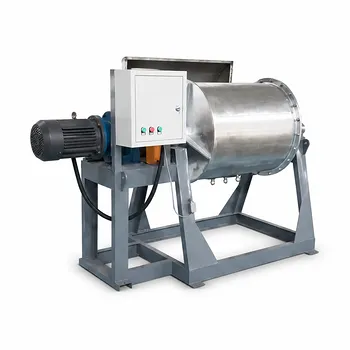
High-energy ball milling facilitates dry electrode preparation by applying intense mechanical shear and impact forces to physically break down the severe agglomeration typical of Carbon Nanotubes (CNTs). This mechanical action creates a uniform dispersion of nanotubes directly onto the active material particles without requiring liquid solvents.
The core challenge in using CNTs for dry electrodes is their natural tendency to clump together. High-energy ball milling overcomes this by physically forcing the nanotubes apart, ensuring the formation of a robust conductive network essential for battery performance.
The Mechanics of De-agglomeration
Overcoming Natural Clustering
Carbon Nanotubes exhibit severe agglomeration in their raw powder state. These tight clusters prevent the nanotubes from functioning effectively as conductors.
Standard mixing methods often lack the force required to separate these bundles. High-energy ball milling introduces the necessary kinetic energy to disrupt these clusters.
Applying Shear and Impact
The process relies on powerful mechanical shear and impact forces. As the milling media collides, it generates intense physical stress on the powder mixture.
This stress acts directly on the CNT agglomerates. It mechanically shreds the clumps, separating the nanotubes into finer, usable units.
Structuring the Conductive Network
Uniform Surface Dispersion
Once the agglomerates are broken, the milling process redistributes the CNTs. The goal is to coat the active material particles evenly.
This uniform dispersion is critical. It ensures that the conductive additive is not isolated in pockets but is in contact with the energy-storage materials.
Enhancing Rate Performance
A dispersed coating of CNTs creates an effective conductive network throughout the electrode mixture. This network creates a clear path for electron flow.
This connectivity directly influences the rate performance of the final electrode. It allows the battery to charge and discharge efficiently, even in a solvent-free system.
Critical Considerations for Dry Processing
The Requirement for Mechanical Intensity
In solvent-based processing, liquids and surfactants help disperse particles. In dry processing, you lose these chemical aids.
Therefore, the mechanical energy input becomes the primary variable for success. You must accept the need for high-energy processing as a substitute for chemical dispersion.
Ensuring Network Integrity
The success of the electrode depends entirely on the quality of the dispersion. If the milling energy is insufficient, the CNTs remain agglomerated.
This results in a poor conductive network. Consequently, the electrode will suffer from lower performance due to high internal resistance.
Making the Right Choice for Your Goal
To effectively utilize high-energy ball milling for your specific electrode requirements:
- If your primary focus is minimizing resistance: Prioritize the milling intensity to fully break down severe CNT agglomerates into a fine dispersion.
- If your primary focus is high-rate capability: Ensure the process duration is sufficient to achieve uniform coverage of the CNTs across the active material surface.
Mastering the mechanical shear forces in your milling process is the definitive key to unlocking high-performance, solvent-free electrode manufacturing.
Summary Table:
| Feature | Impact on Dry Electrode Preparation |
|---|---|
| Mechanism | High-energy shear and impact forces |
| CNT State | Breaks down severe agglomerates into fine units |
| Dispersion | Uniform coating of CNTs onto active material particles |
| Network | Creates a robust conductive network for electron flow |
| Benefit | High-rate performance without liquid solvents |
Elevate Your Battery Research with KINTEK Precision
Unlock the full potential of your dry electrode manufacturing with KINTEK’s high-performance crushing and milling systems. As specialists in laboratory equipment, we understand that achieving a perfect conductive network requires more than just mixing—it requires precise mechanical intensity.
From advanced planetary ball mills to our comprehensive range of hydraulic presses (pellet, hot, isostatic) and high-temperature furnaces, KINTEK provides the end-to-end solutions needed for cutting-edge battery research and material science.
Ready to optimize your CNT dispersion and eliminate solvents? Contact our technical experts today to find the ideal milling and processing equipment for your laboratory.
Related Products
- High Energy Planetary Ball Mill Milling Machine for Laboratory
- High Energy Planetary Ball Mill for Laboratory Horizontal Tank Type Milling Machine
- High-Energy Omnidirectional Planetary Ball Mill Milling Machine for Laboratory
- High Energy Planetary Ball Mill Milling Machine for Laboratory
- High Energy Planetary Ball Mill Machine for Laboratory Horizontal Tank Type
People Also Ask
- How does a planetary ball mill provide mechanical activation for scandium recovery? Maximize Your Leaching Efficiency
- What role do planetary ball mills and zirconia media play in LLZT preparation? Optimize Your Solid Electrolyte Research
- What is the function of a planetary ball mill in the preparation of high-entropy rare earth silicate multi-phase ceramics?
- What is the purpose of using a planetary ball mill for cathode material regeneration? Achieve Atomic-Level Mixing
- What is the primary function of a planetary ball mill? Mastering SiC/Al Composite Mixing for Homogeneity