Knowledge How does a planetary ball mill contribute to the synthesis of Li7La3Zr2O12 powder? Expert Processing Guide
Author avatar

Tech Team · Kintek Solution

Updated 4 days ago

How does a planetary ball mill contribute to the synthesis of Li7La3Zr2O12 powder? Expert Processing Guide


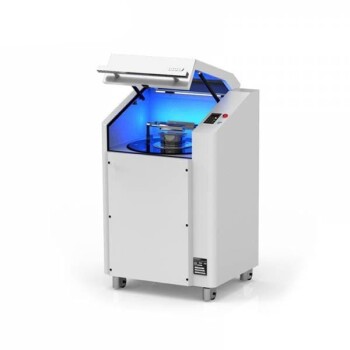
The contribution of a planetary ball mill to Li7La3Zr2O12 synthesis lies in its ability to apply intense mechanical energy to raw chemical precursors. By utilizing high-speed rotation to drive grinding media, the device generates powerful impact and shear forces that refine particle sizes and intimately mix components like Li2CO3, La2O3, ZrO2, and Al2O3. This mechanical processing is a critical prerequisite that ensures the uniformity required for successful material formation.

The planetary ball mill does not merely mix ingredients; it creates the optimal kinetic conditions for synthesis. By reducing particle size and increasing surface area, it enables a smooth and complete solid-state reaction during the subsequent calcination process.

The Mechanics of Particle Refinement

Generating Mechanical Energy

The planetary ball mill operates by subjecting grinding jars to high-speed rotation.

While the jars rotate around a central axis, a sun wheel rotates in the opposite direction. This opposing motion transfers significant kinetic energy to the grinding media inside the jars.

Impact and Shearing Forces

As the grinding media moves, it collides with the chemical raw materials—specifically Lithium Carbonate, Lanthanum Oxide, Zirconium Dioxide, and Aluminum Oxide.

These collisions deliver powerful impact and shearing forces. This mechanical action effectively crushes the raw materials, breaking them down from coarse aggregates into fine powders.

Achieving Microscopic Homogeneity

Standard mixing is often insufficient for complex ceramics like Li7La3Zr2O12.

The planetary ball mill ensures uniform mixing at a microscopic scale. This intimate blending of distinct components prevents localized inconsistencies that could degrade the final material's performance.

Enabling the Solid-State Reaction

Increasing Specific Surface Area

The primary physical result of this high-energy milling is a drastic reduction in particle size.

Smaller particles possess a significantly higher specific surface area. This increased contact area between reactants is vital for facilitating chemical interaction.

Facilitating Smooth Calcination

The milling process itself is a preparation stage for the high-temperature annealing (calcination) that follows.

By providing refined particles and uniform mixtures, the mill ensures the smooth progression of the solid-state reaction. Without this step, the reaction might be incomplete or require excessively high temperatures to drive the phase transformation.

Understanding the Trade-offs

Physical Mixing vs. Chemical Reaction

It is critical to understand the distinction between mechanical activation and chemical synthesis.

While the planetary ball mill effectively reduces particle size and increases surface area, it may not trigger the chemical reaction itself. Under most standard conditions, the milling creates the potential for reaction, but the actual phase transformation usually requires the thermal energy of the subsequent annealing stage.

Managing Energy Input

The grinding results are highly dependent on operational parameters.

Operators must carefully control the speed and movement of the grinding jars and sun wheel. Insufficient energy will lead to poor mixing, while excessive energy could potentially introduce contamination or alter the stoichiometry if not monitored.

Optimizing the Synthesis Process

To ensure the highest quality Li7La3Zr2O12 powder, align your milling strategy with your specific synthesis goals.

  • If your primary focus is phase purity: Prioritize microscopic homogeneity to ensure all precursors (Li, La, Zr, Al) are evenly distributed before heating.
  • If your primary focus is reaction efficiency: Focus on maximizing particle refinement to increase the specific surface area, allowing for lower calcination temperatures or shorter dwell times.

Ultimately, the planetary ball mill acts as the foundational step that dictates the kinetic success of your final ceramic material.

Summary Table:

Key Contribution Mechanism Benefit to LLZO Synthesis
Particle Refinement High-speed impact & shear forces Increases specific surface area for faster reactions
Microscopic Homogeneity High-energy kinetic mixing Ensures uniform distribution of Li, La, Zr, and Al precursors
Mechanical Activation Reduction of particle size Enables smoother solid-state reactions during calcination
Process Optimization Controlled milling parameters Improves phase purity and reduces required annealing temperatures

Elevate Your Battery Research with KINTEK Precision

Precision in Li7La3Zr2O12 synthesis starts with the right mechanical processing. KINTEK specializes in high-performance laboratory equipment designed for the most demanding material science applications. From our advanced planetary ball mills, crushing and milling systems, and sieving equipment to our precision hydraulic presses and high-temperature furnaces, we provide the end-to-end solutions needed for superior ceramic electrolyte production.

Whether you require high-purity crucibles, ceramic consumables, or specialized battery research tools, our team is ready to support your lab's innovation. Contact KINTEK today to optimize your synthesis workflow and achieve the microscopic homogeneity your research demands.

Related Products

People Also Ask

Related Products

Powerful Plastic Crusher Machine

Powerful Plastic Crusher Machine

KINTEK's powerful plastic crusher machines process 60-1350 KG/H of diverse plastics, ideal for labs and recycling. Durable, efficient, and customizable.

Small Lab Rubber Calendering Machine

Small Lab Rubber Calendering Machine

Small lab rubber calendering machine is used for producing thin, continuous sheets of plastic or rubber materials. It is commonly employed in laboratories, small-scale production facilities, and prototyping environments to create films, coatings, and laminates with precise thickness and surface finish.

Single Punch Electric Tablet Press Machine Laboratory Powder Tablet Punching TDP Tablet Press

Single Punch Electric Tablet Press Machine Laboratory Powder Tablet Punching TDP Tablet Press

The single-punch electric tablet press is a laboratory-scale tablet press suitable for corporate laboratories in pharmaceutical, chemical, food, metallurgical and other industries.

Automatic Lab Cold Isostatic Press CIP Machine Cold Isostatic Pressing

Automatic Lab Cold Isostatic Press CIP Machine Cold Isostatic Pressing

Efficiently prepare samples with our Automatic Lab Cold Isostatic Press. Widely used in material research, pharmacy, and electronic industries. Provides greater flexibility and control compared to electric CIPs.

Laboratory Vibratory Sieve Shaker Machine for Dry and Wet Three-Dimensional Sieving

Laboratory Vibratory Sieve Shaker Machine for Dry and Wet Three-Dimensional Sieving

KT-VD200 can be used for sieving tasks of dry and wet samples in the laboratory. The screening quality is 20g-3kg. The product is designed with a unique mechanical structure and an electromagnetic vibrating body with a vibration frequency of 3000 times per minute.

Single Punch Electric Tablet Press Machine TDP Tablet Punching Machine

Single Punch Electric Tablet Press Machine TDP Tablet Punching Machine

The electric tablet punching machine is a laboratory equipment designed for pressing various granular and powdery raw materials into discs and other geometric shapes. It is commonly used in pharmaceutical, healthcare products, food, and other industries for small batch production and processing. The machine is compact, lightweight, and easy to operate, making it suitable for use in clinics, schools, laboratories, and research units.

Laboratory Vibratory Sieve Shaker Machine Slap Vibrating Sieve

Laboratory Vibratory Sieve Shaker Machine Slap Vibrating Sieve

KT-T200TAP is a slapping and oscillating sieving instrument for laboratory desktop use, with 300 rpm horizontal circular motion and 300 vertical slapping motions to simulate manual sieving to help sample particles pass through better.

Electric Split Lab Cold Isostatic Press CIP Machine for Cold Isostatic Pressing

Electric Split Lab Cold Isostatic Press CIP Machine for Cold Isostatic Pressing

Split cold isostatic presses are capable of providing higher pressures, making them suitable for testing applications that require high pressure levels.

Lab Plastic PVC Calender Stretch Film Casting Machine for Film Testing

Lab Plastic PVC Calender Stretch Film Casting Machine for Film Testing

The cast film machine is designed for the molding of polymer cast film products and has multiple processing functions such as casting, extrusion, stretching, and compounding.

Rubber Vulcanizer Vulcanizing Machine Plate Vulcanizing Press for Lab

Rubber Vulcanizer Vulcanizing Machine Plate Vulcanizing Press for Lab

The Plate vulcanizing press is a kind of equipment used in the production of rubber products, mainly used for the vulcanization of rubber products. Vulcanization is a key step in rubber processing.

Single Punch Tablet Press Machine and Mass Production Rotary Tablet Punching Machine for TDP

Single Punch Tablet Press Machine and Mass Production Rotary Tablet Punching Machine for TDP

Rotary tablet punching machine is an automatic rotating and continuous tableting machine. It is mainly used for tablet manufacturing in the pharmaceutical industry, and is also suitable for industrial sectors such as food, chemicals, batteries, electronics, ceramics, etc. to compress granular raw materials into tablets.

Small Injection Molding Machine for Lab Use

Small Injection Molding Machine for Lab Use

The small injection molding machinehas fast and stable movements; good controllability and repeatability, super energy saving; the product can be automatically dropped and formed; the machine body is low, convenient for feeding, easy to maintain, and no height restrictions on the installation site.

Laboratory Test Sieves and Vibratory Sieve Shaker Machine

Laboratory Test Sieves and Vibratory Sieve Shaker Machine

Efficiently process powders, granules, and small blocks with a high-frequency vibration sieve. Control vibration frequency, screen continuously or intermittently, and achieve accurate particle size determination, separation, and classification.

Metallographic Specimen Mounting Machine for Laboratory Materials and Analysis

Metallographic Specimen Mounting Machine for Laboratory Materials and Analysis

Precision metallographic mounting machines for labs—automated, versatile, and efficient. Ideal for sample prep in research and quality control. Contact KINTEK today!

Lab Internal Rubber Mixer Rubber Kneader Machine for Mixing and Kneading

Lab Internal Rubber Mixer Rubber Kneader Machine for Mixing and Kneading

Lab internal rubber mixer is suitable for mixing, kneading and dispersing various chemical raw materials such as plastics, rubber, synthetic rubber, hot melt adhesive and various low-viscosity materials.

Vibratory Sieve Shaker Machine Dry Three-Dimensional Vibrating Sieve

Vibratory Sieve Shaker Machine Dry Three-Dimensional Vibrating Sieve

The KT-V200 product focuses on solving common sieving tasks in the laboratory. It is suitable for sieving 20g-3kg dry samples.

Lab Blown Film Extrusion Three Layer Co-Extrusion Film Blowing Machine

Lab Blown Film Extrusion Three Layer Co-Extrusion Film Blowing Machine

Lab blown film extrusion is mainly used to detect the feasibility of film blowing of polymer materials and the colloid condition in the materials, as well as the dispersion of colored dispersions, controlled mixtures, and extrudates;

Heated Hydraulic Press Machine with Integrated Manual Heated Plates for Lab Use

Heated Hydraulic Press Machine with Integrated Manual Heated Plates for Lab Use

Efficiently process heat-pressing samples with our Integrated Manual Heated Lab Press. With a heating range up to 500°C, it's perfect for various industries.

Precision Wire Saw Laboratory Cutting Machine with 800mm x 800mm Workbench for Diamond Single Wire Circular Small Cutting

Precision Wire Saw Laboratory Cutting Machine with 800mm x 800mm Workbench for Diamond Single Wire Circular Small Cutting

Diamond wire cutting machines are mainly used for precision cutting of ceramics, crystals, glass, metals, rocks, thermoelectric materials, infrared optical materials, composite materials, biomedical materials and other material analysis samples. Especially suitable for precision cutting of ultra-thin plates with thickness up to 0.2mm.

12 Inch 24 Inch High Precision Automatic Diamond Wire Cutting Machine Laboratory Saw Precision Wire EDM Cutting Machine

12 Inch 24 Inch High Precision Automatic Diamond Wire Cutting Machine Laboratory Saw Precision Wire EDM Cutting Machine

The high precision automatic diamond wire cutting machine is a versatile cutting tool that uses a diamond wire to cut through a wide range of materials, including conductive and non-conductive materials, ceramics, glass, rocks, gems, jade, meteorites, monocrystalline silicon, silicon carbide, polycrystalline silicon, refractory bricks, epoxy boards, and ferrite bodies. It is especially suitable for cutting various brittle crystals with high hardness, high value, and easy to break.


Leave Your Message