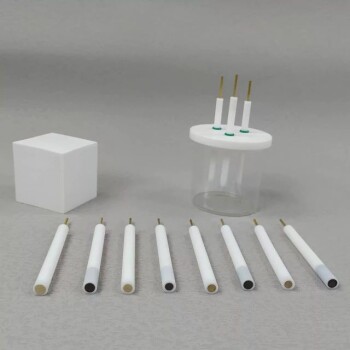
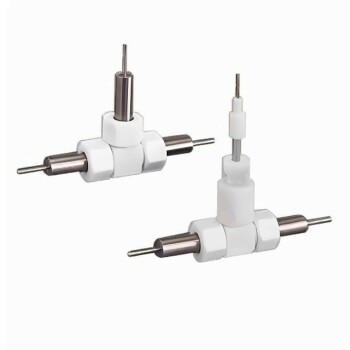
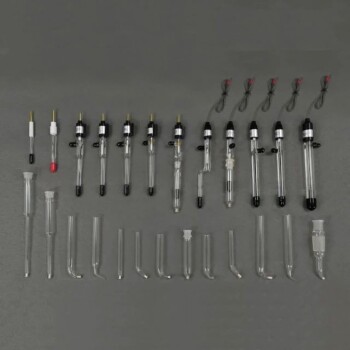
The three-electrode configuration secures accuracy by strictly decoupling potential control from current measurement.
In this setup, the 904L stainless steel acts as the working electrode, while a platinum auxiliary electrode handles the current flow and a saturated calomel electrode provides a stable voltage reference. This isolation ensures that the electrochemical workstation measures the true response of the stainless steel interface, eliminating errors caused by solution resistance or electrode polarization.
Core Takeaway The three-electrode system solves the problem of "measurement interference" by separating the sensing element from the current-carrying element. This allows researchers to isolate the specific behavior of the 904L passivation layer, enabling the precise quantification of corrosion potential, breakdown potential, and polarization resistance.
The Architecture of Precision
Decoupling Current and Potential
In simpler two-electrode systems, the electrode measuring voltage also carries current. This introduces error because the flow of current changes the potential of the reference point itself.
The three-electrode cell assigns these tasks to different components. The auxiliary (counter) electrode conducts the current required to drive the reaction, while the reference electrode remains isolated from current flow.
The Role of the Saturated Calomel Reference
The primary reference highlights the use of a saturated calomel electrode (SCE) as the reference point. Because no significant current flows through the SCE, its potential remains chemically stable and constant.
This provides the "fixed yardstick" against which the 904L stainless steel is measured. Without this stable baseline, minute changes in the corrosion potential of the steel would be indistinguishable from drift in the reference.
The Function of the Platinum Auxiliary
A platinum auxiliary electrode completes the circuit, allowing the electrochemical workstation to inject or draw current.
By utilizing platinum, a highly conductive and inert material, the system ensures that the necessary reactions occur without degrading the counter electrode. This component absorbs the polarization effects that would otherwise distort the measurement of the working electrode.
Isolating 904L Surface Behavior
Determining Critical Parameters
The primary goal of testing 904L stainless steel is to understand its resistance to specific failure modes, such as pitting.
Because the potential is controlled precisely at the working electrode interface, the system can accurately identify the breakdown potential—the specific voltage at which the protective passive layer on the steel fails. It also allows for the calculation of polarization resistance, a direct indicator of general corrosion rates.
Eliminating Signal Interference
As noted in supplementary data, this closed-loop configuration ensures that measured electrochemical signals originate solely from the interface between the 904L steel and the electrolyte.
Any polarization or resistance occurring at the auxiliary electrode is effectively ignored by the measurement circuit. This guarantees that the data reflects the corrosion properties of the steel, not artifacts of the test equipment.
Understanding the Trade-offs
System Complexity and Geometry
While accurate, a three-electrode system is more complex to set up than a two-electrode probe. The physical geometry of the cell matters; the reference electrode must be positioned close to the working electrode to minimize uncompensated solution resistance (IR drop).
Reference Electrode Maintenance
The accuracy of the entire system hinges on the stability of the saturated calomel electrode. If the reference electrode is contaminated or loses electrolyte saturation, the "stable baseline" shifts.
This drift leads to erroneous potential readings, making the 904L steel appear either more noble or more active than it actually is.
Making the Right Choice for Your Goal
When designing your corrosion testing protocol for 904L stainless steel, consider your specific data requirements.
- If your primary focus is defining safety limits: Use this configuration to identify the exact breakdown potential, ensuring the material is not used in environments that exceed this threshold.
- If your primary focus is long-term rate estimation: Rely on the precise polarization resistance data provided by the three-electrode loop to model corrosion rates over time.
- If your primary focus is comparative screening: Ensure the reference electrode is regularly calibrated, as even slight drift will invalidate comparisons between different alloy batches.
By isolating the voltage measurement from the current path, the three-electrode cell transforms a noisy electrical signal into a definitive map of material performance.
Summary Table:
| Component | Role in Configuration | Benefit to 904L Testing |
|---|---|---|
| Working Electrode | 904L Stainless Steel Sample | Direct isolation of surface passivation behavior. |
| Reference Electrode | Voltage Baseline (e.g., SCE) | Provides a stable 'yardstick' by avoiding current flow. |
| Auxiliary Electrode | Platinum Current Carrier | Completes the circuit without interfering with potential. |
| System Result | Signal Decoupling | Accurate identification of breakdown & pitting potential. |
Optimize Your Electrochemical Research with KINTEK
Precision in corrosion analysis requires more than just a configuration—it demands high-quality hardware. KINTEK specializes in advanced laboratory equipment, providing the electrolytic cells and electrodes necessary to achieve stable, noise-free measurements for your most demanding material studies.
From high-performance platinum auxiliary electrodes to specialized reactors and crushing systems, our comprehensive portfolio supports the entire lifecycle of metallurgy and battery research.
Ready to enhance your lab's accuracy? Contact our experts today to find the perfect electrochemical solution for your 904L stainless steel testing and beyond.
References
- Sherief A. Al Kiey, S.S. Abd El Rehim. Electrochemical Investigations on the Corrosion Behavior of 904L Stainless Steel in LiBr Solutions. DOI: 10.1007/s11665-023-08080-4
This article is also based on technical information from Kintek Solution Knowledge Base .
Related Products
- H Type Electrolytic Cell Triple Electrochemical Cell
- Electrolytic Electrochemical Cell Gas Diffusion Liquid Flow Reaction Cell
- Electrolytic Electrochemical Cell with Five-Port
- Electrolytic Electrochemical Cell for Coating Evaluation
- Quartz Electrolytic Electrochemical Cell for Electrochemical Experiments
People Also Ask
- What is a H type cell? A Guide to Divided Electrochemical Cells for Accurate Experiments
- How should the electrolyte be prepared and added to the H-type electrolytic cell? Best Practices for Purity and Safety
- What is the technical necessity of using an H-type electrolytic cell for NO3RR tests? Protect Your Ammonia Yields
- How does the design of an H-type electrolytic cell benefit the neutral water electrolysis process for metal recovery?
- What is the primary function of an H-type electrolytic cell in NitRR? Ensure Accurate Product Yields