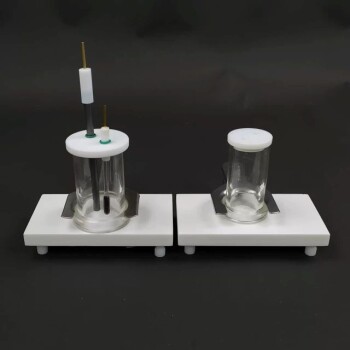
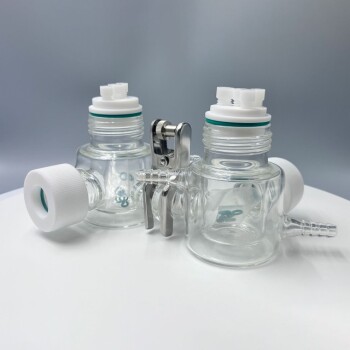
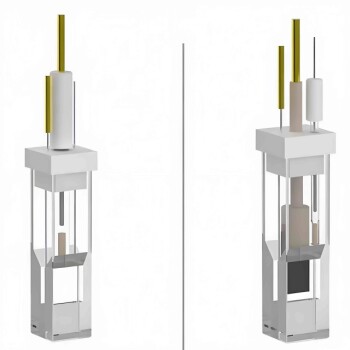
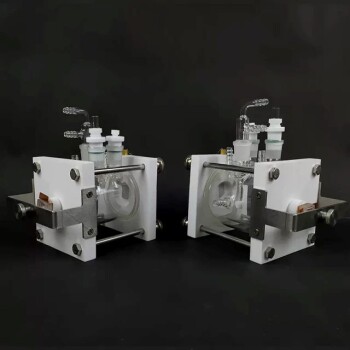
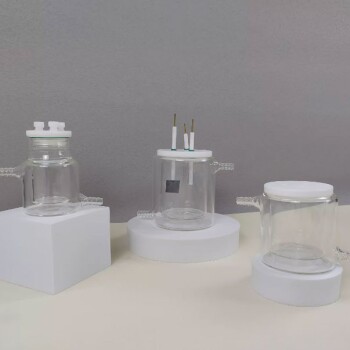
In the context of MoS2 photoanode testing, a three-electrode electrolytic cell functions by isolating the working electrode to measure its intrinsic properties. The setup typically consists of the MoS2 sample on a titanium plate (the photoanode), a platinum sheet (the counter electrode), and a saturated silver/silver chloride (Ag/AgCl) reference electrode. This configuration enables an electrochemical workstation to apply a precise bias voltage, driving the separation of photo-generated electron-hole pairs without interference from the rest of the circuit.
By using a potentiostat to control the potential between the working and reference electrodes, this system allows researchers to exclude overpotential from the counter electrode, ensuring that data such as photocurrent response and conversion efficiency accurately reflect the MoS2 material's performance.
The Role of Each Component
The Working Electrode (Photoanode)
The core of the experiment is the MoS2 sample deposited on a titanium plate.
This electrode absorbs light and generates electron-hole pairs. It is the specific component being "interrogated" by the system to determine its catalytic activity and stability.
The Counter Electrode
A platinum sheet typically serves as the counter electrode.
Its primary function is to complete the electrical circuit, allowing current to flow. Because the three-electrode setup isolates the working electrode, the specific electrochemical properties of the platinum do not skew the measurement of the MoS2.
The Reference Electrode
A saturated Ag/AgCl electrode acts as the stable reference point.
It maintains a constant potential, providing a baseline against which the potential of the MoS2 photoanode is measured and controlled.
The Mechanism of Action
Separating Charge Carriers
When the cell is active, the electrochemical workstation applies a specific bias voltage.
This external voltage provides the necessary force to separate the photo-generated electron-hole pairs created within the MoS2.
Triggering Redox Reactions
Once separated, these carriers migrate to the surface of the electrodes.
This migration triggers reduction and oxidation (redox) reactions at the anode and cathode, generating the measurable photocurrent that indicates performance.
Why Use Three Electrodes?
Precise Potential Control
In a two-electrode system, it is difficult to distinguish how much voltage is dropping across the anode versus the cathode.
The three-electrode system utilizes a potentiostat to control the potential specifically between the working and reference electrodes.
Eliminating Counter Electrode Interference
This configuration effectively removes the counter electrode's overpotential from the measurement.
Consequently, researchers can analyze polarization curves and solar-to-hydrogen (HC-STH) efficiency based solely on the behavior of the single MoS2 photoelectrode.
Understanding the Trade-offs
System Complexity
While accurate, a three-electrode system is more complex to assemble than a two-electrode setup.
It requires precise placement of the reference electrode to minimize uncompensated resistance (IR drop) between it and the working electrode.
Reference Electrode Stability
The accuracy of the entire system relies on the stability of the Ag/AgCl electrode.
If the internal solution of the reference electrode becomes contaminated or depleted, the applied potential will drift, rendering the collected MoS2 performance data inaccurate.
Making the Right Choice for Your Goal
When designing your PEC experiment, consider the specific metrics you need to capture.
- If your primary focus is fundamental material analysis: Use the three-electrode setup to isolate the MoS2 photoanode and obtain intrinsic data like polarization curves and photocurrent response.
- If your primary focus is full device prototyping: You may eventually need to test in a two-electrode configuration to model real-world electrolyzer performance, but only after characterization is complete.
The three-electrode cell is the industry standard for creating a controlled environment that validates the true efficiency of your photocatalytic material.
Summary Table:
| Component | Material Example | Primary Function in PEC Testing |
|---|---|---|
| Working Electrode | MoS2 on Titanium Plate | Generates electron-hole pairs; site of interest for material analysis. |
| Counter Electrode | Platinum (Pt) Sheet | Completes the electrical circuit to allow current flow. |
| Reference Electrode | Saturated Ag/AgCl | Provides a stable baseline potential for precise voltage control. |
| Potentiostat | Electrochemical Workstation | Controls bias voltage and isolates the working electrode's performance. |
Elevate Your Material Research with KINTEK
Precision in photoelectrochemical (PEC) testing starts with high-quality instrumentation. KINTEK specializes in advanced laboratory solutions designed to provide researchers with the accuracy they need. Whether you are characterizing MoS2 photoanodes or developing next-generation energy materials, our comprehensive range of electrolytic cells and electrodes, high-temperature furnaces, and battery research tools ensures reliable results every time.
Our Value to You:
- Precision Engineering: High-stability reference electrodes and platinum counter electrodes for error-free data.
- Versatile Solutions: A full portfolio of PEC cells, autoclaves, and crushing systems for end-to-end material prep.
- Expert Support: Our team understands the complexities of redox reactions and charge carrier separation.
Ready to eliminate overpotential interference and validate your material efficiency? Contact us today to find the perfect cell configuration for your lab!
References
- Yurou Zhou, Jing Zou. Photoelectrocatalytic generation of miscellaneous oxygen-based radicals towards cooperative degradation of multiple organic pollutants in water. DOI: 10.2166/wrd.2021.018
This article is also based on technical information from Kintek Solution Knowledge Base .
Related Products
- H Type Electrolytic Cell Triple Electrochemical Cell
- PTFE Electrolytic Cell Electrochemical Cell Corrosion-Resistant Sealed and Non-Sealed
- Electrolytic Electrochemical Cell Gas Diffusion Liquid Flow Reaction Cell
- Electrolytic Electrochemical Cell with Five-Port
- Customizable PEM Electrolysis Cells for Diverse Research Applications
People Also Ask
- What is a H type cell? A Guide to Divided Electrochemical Cells for Accurate Experiments
- How should the electrolyte be prepared and added to the H-type electrolytic cell? Best Practices for Purity and Safety
- What is the technical necessity of using an H-type electrolytic cell for NO3RR tests? Protect Your Ammonia Yields
- How does the design of an H-type electrolytic cell benefit the neutral water electrolysis process for metal recovery?
- What is the primary function of an H-type electrolytic cell in NitRR? Ensure Accurate Product Yields