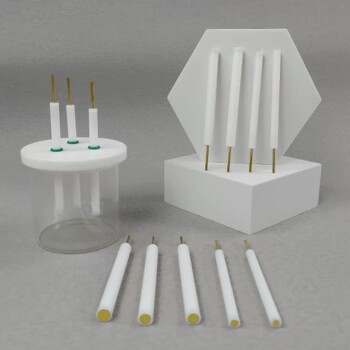
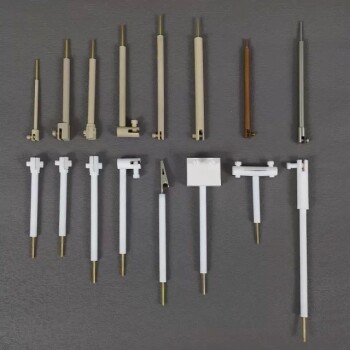
The integration of a Platinum counter electrode and a Saturated Calomel Electrode (SCE) ensures accuracy by decoupling current flow from potential measurement. This configuration allows an electrochemical workstation to maintain precise control over the Working Electrode’s potential while eliminating errors caused by internal resistance (iR drop) and counter electrode polarization.
A three-electrode system achieves experimental precision by using a stable reference point (SCE) and a highly conductive, inert feedback path (Platinum) to isolate the electrochemical reaction of interest from systemic electrical noise and voltage fluctuations.
The Architecture of Independent Control
Eliminating the Potential Drop Error
In a standard two-electrode setup, current flows through the reference, causing polarization and a significant voltage drop. A three-electrode system forces the experimental current to flow between the Working Electrode (WE) and the Counter Electrode (CE) instead.
By keeping the Reference Electrode (RE) in a high-impedance circuit with zero current flow, the system measures the "true" potential at the WE surface. This is critical for obtaining accurate Mott-Schottky analysis and carrier concentration data.
Precision Scanning and Baseline Stability
The Saturated Calomel Electrode provides a constant, known electrical potential that acts as a "voltage anchor." This stability ensures that any change in measured voltage is strictly due to the chemical behavior of the sample, not a shift in the reference point.
Without this stable baseline, researchers cannot accurately identify oxidation potentials or determine the specific overpotentials required for catalytic reactions.
The Role of the Platinum Counter Electrode
Ensuring High-Efficiency Charge Transfer
Platinum (Pt) is chosen for the counter electrode due to its exceptional electrical conductivity and catalytic activity. It facilitates the completion of the electrical circuit by providing an efficient surface for the balancing half-reaction.
Because Pt has a low overpotential for reactions like hydrogen evolution, it can handle large current cycles without requiring excessive voltage. This prevents the counter electrode from becoming a "bottleneck" that distorts the current-voltage (I-V) curves.
Chemical Inertness and Purity
Platinum is highly resistant to corrosion and chemical attack within most electrolytes. This electrochemical stability ensures that no metal ions or impurities leach into the solution during testing.
Maintaining a clean environment is vital for Cyclic Voltammetry (CV) and Galvanostatic Charge-Discharge (GCD). If the counter electrode were to react, the resulting side reactions would produce "ghost peaks" that invalidate the data.
Understanding the Trade-offs
Maintenance and Contamination Risks
While the Saturated Calomel Electrode is highly stable, it relies on a saturated potassium chloride (KCl) filling solution. Over time, chloride ions can leak into the electrolyte through the ceramic frit, potentially poisoning sensitive catalysts or interfering with non-aqueous experiments.
Surface Area and Cost Considerations
For the counter electrode to function effectively, its surface area should ideally be significantly larger than the working electrode. Using large-format platinum (such as plates or meshes) provides the best results but increases the capital cost of the experimental setup.
How to Apply This to Your Project
Making the Right Choice for Your Goal
- If your primary focus is precise kinetic studies (CV/GCD): Use a high-purity platinum mesh counter electrode to maximize surface area and ensure the current response is limited only by your working electrode.
- If your primary focus is semiconductor characterization (Mott-Schottky): Prioritize the stability of the SCE reference electrode and ensure the bridge is positioned close to the working electrode to minimize residual resistance.
- If your primary focus is long-term durability testing: Regularly inspect the platinum electrode for surface deposits and clean it with acid or flame-annealing to maintain its catalytic efficiency.
By strategically leveraging the stability of the SCE and the conductivity of Platinum, you can isolate the specific Faradaic behavior of your material with absolute confidence.
Summary Table:
| Component | Role in System | Key Benefit for Accuracy |
|---|---|---|
| Platinum Counter Electrode | High-efficiency feedback path | High conductivity and inertness prevent current bottlenecks and impurities. |
| SCE Reference Electrode | Stable voltage anchor point | Provides a constant baseline to isolate the chemical behavior of the sample. |
| Three-Electrode Setup | Decouples current from potential | Eliminates iR drop and polarization errors for true potential measurement. |
Elevate Your Electrochemical Precision with KINTEK
Reliable research starts with high-quality instrumentation. KINTEK specializes in professional-grade laboratory equipment designed for accuracy and durability. Our extensive portfolio includes high-purity electrolytic cells and electrodes (including Platinum and SCE), high-temperature high-pressure reactors and autoclaves, and specialized battery research tools.
Whether you are performing Cyclic Voltammetry, Mott-Schottky analysis, or complex material characterization, our precision-engineered systems ensure you eliminate systemic noise and capture "true" chemical data.
Ready to optimize your laboratory setup? Contact our technical experts today to find the perfect electrodes and consumables tailored to your specific research goals.
References
- Siying Lin, Baojiang Jiang. Rod-shaped aggregates of sulfur-doped carbon nitride nanosheets for enhanced photocatalytic hydrogen evolution. DOI: 10.1007/s40843-023-2627-0
This article is also based on technical information from Kintek Solution Knowledge Base .
Related Products
- H Type Electrolytic Cell Triple Electrochemical Cell
- Three-dimensional electromagnetic sieving instrument
- Gold Disc Electrode
- Rotating Platinum Disk Electrode for Electrochemical Applications
- Reference Electrode Calomel Silver Chloride Mercury Sulfate for Laboratory Use
People Also Ask
- What is a H type cell? A Guide to Divided Electrochemical Cells for Accurate Experiments
- How should the electrolyte be prepared and added to the H-type electrolytic cell? Best Practices for Purity and Safety
- What is the technical necessity of using an H-type electrolytic cell for NO3RR tests? Protect Your Ammonia Yields
- How does the design of an H-type electrolytic cell benefit the neutral water electrolysis process for metal recovery?
- What is the primary function of an H-type electrolytic cell in NitRR? Ensure Accurate Product Yields