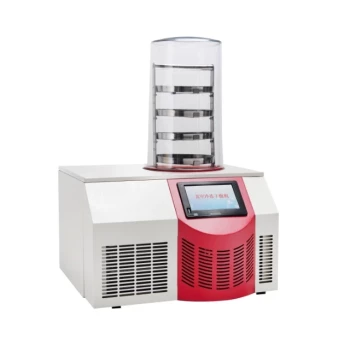
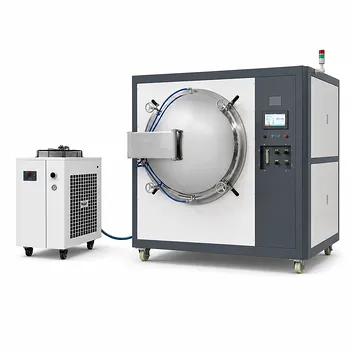
The vacuum drying oven acts as the critical purification and consolidation stage in the fabrication of PEO/LLZTO (polyethylene oxide/lithium lanthanum zirconium tantalum oxide) composite electrolyte membranes. Its primary function is to eliminate organic solvents, such as acetonitrile, from the coated slurry at a controlled, moderate temperature of 45°C.
By lowering the boiling point of solvents through negative pressure, the oven enables rapid, gentle drying. This prevents the formation of structural defects like air bubbles while protecting the heat-sensitive polymer matrix from thermal degradation.
The Mechanics of Defect-Free Formation
The vacuum drying process is not merely about heating; it is about creating an environment where the membrane can solidify without structural interference.
Accelerating Solvent Evaporation
The primary challenge in casting PEO/LLZTO membranes is removing the solvent used to dissolve the polymer.
A vacuum environment significantly lowers the boiling point of organic solvents like acetonitrile. This allows the solvent to evaporate rapidly and completely without requiring excessive heat that could damage the composite.
Eliminating Trapped Gas and Voids
During the slurry coating process, air pockets can easily become trapped within the viscous mixture.
The negative pressure of the vacuum actively extracts these trapped air bubbles. This results in a dense, pore-free membrane, which is essential for consistent ionic conductivity and mechanical strength.
Preserving Chemical and Structural Integrity
Beyond physical structure, the vacuum oven plays a vital role in maintaining the chemical stability of the electrolyte materials.
Preventing Thermal Degradation
PEO-based polymers can be sensitive to high temperatures, losing their structural integrity or undergoing chain scission if overheated.
By operating at a moderate temperature of 45°C, the vacuum oven dries the membrane gently. This ensures the polymer matrix remains intact and retains the flexibility required for effective contact with battery electrodes.
Ensuring Uniform Composition
Rapid, uneven drying can lead to phase separation or the aggregation of LLZTO fillers.
The controlled vacuum environment promotes a steady evaporation rate. This secures a uniform distribution of the ceramic filler (LLZTO) throughout the polymer matrix (PEO), which is critical for preventing "hot spots" of current density during battery operation.
Understanding the Trade-offs
While vacuum drying is essential, improper execution can lead to invisible defects that compromise the final battery cell.
The Risk of Residual Contaminants
If the vacuum pressure is insufficient or the drying time is too short, trace amounts of solvent or moisture may remain.
Residual solvents can narrow the electrochemical stability window, leading to side reactions during cycling. Furthermore, because PEO is hygroscopic, any remaining moisture can react violently with lithium metal anodes, posing a severe safety risk.
Balancing Speed vs. Stability
There is a temptation to increase the temperature to speed up the drying process.
However, exceeding the recommended 45°C range can cause the polymer to flow excessively or degrade. This thermal damage compromises the mechanical strength of the membrane, making it prone to puncture by dendrites.
Making the Right Choice for Your Goal
To maximize the performance of your PEO/LLZTO membranes, adjust your drying protocol based on your specific performance targets.
- If your primary focus is Ion Transport: Prioritize uniformity by maintaining a strictly moderate temperature (45°C) to ensure the LLZTO fillers remain evenly dispersed in the matrix.
- If your primary focus is Electrochemical Stability: Prioritize purity by ensuring the vacuum cycle is long enough to remove every trace of solvent and moisture, preventing side reactions.
Ultimately, the vacuum drying oven transforms a liquid slurry into a robust solid electrolyte by decoupling the drying process from high thermal stress.
Summary Table:
| Feature | Impact on PEO/LLZTO Membrane Formation |
|---|---|
| Temperature (45°C) | Prevents thermal degradation and preserves PEO polymer chain integrity. |
| Negative Pressure | Lowers solvent boiling points for rapid, gentle evaporation without bubbles. |
| Gas Extraction | Eliminates trapped air and voids to create a dense, pore-free structure. |
| Process Control | Ensures uniform LLZTO filler distribution and prevents phase separation. |
| Purity Maintenance | Removes residual moisture/solvents to prevent side reactions with lithium. |
Elevate Your Battery Research with KINTEK Precision
High-performance PEO/LLZTO composite electrolytes require absolute precision in purification and consolidation. KINTEK specializes in advanced laboratory solutions, providing the high-vacuum drying ovens and specialized equipment necessary to achieve defect-free membrane formation.
Our extensive portfolio supports every stage of energy storage R&D, including:
- Vacuum & Atmosphere Furnaces for ceramic filler synthesis.
- Hydraulic Presses (Pellet, Hot, Isostatic) for solid-state electrolyte processing.
- Battery Research Tools and high-purity consumables like crucibles and ceramics.
Don't let residual solvents or thermal degradation compromise your electrochemical stability. Contact KINTEK today to discover how our high-temperature high-pressure reactors, cooling solutions, and specialized lab equipment can optimize your material performance.
Related Products
- 56L Vertical Laboratory Vacuum Drying Oven
- 23L Laboratory Vacuum Drying Oven
- Laboratory Scientific Electric Heating Blast Drying Oven
- Benchtop Laboratory Vacuum Freeze Dryer
- Dental Porcelain Zirconia Sintering Ceramic Vacuum Press Furnace
People Also Ask
- Why is a laboratory vacuum drying oven recommended for rice straw residues? Protect Your Biomass Integrity
- What role does a laboratory vacuum drying oven play in the preparation of modified multi-walled carbon nanotubes?
- What is the importance of using a laboratory vacuum drying oven? Preserving Slow-Release Microcapsule Integrity
- Why is a Laboratory Vacuum Drying Oven recommended for PBAT microspheres? Protect Sensitive Polymer Integrity
- What role does a laboratory vacuum drying oven play in processing nanoparticle powder samples? Protect Sample Integrity