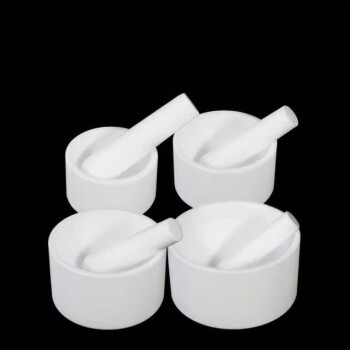
The hardness of your grinding media directly dictates the magnitude of impact energy transferred during mechanochemical processing. Harder materials, such as Tungsten Carbide, facilitate efficient energy transfer, generating the intense forces required to drive reactions with high activation energies. Conversely, softer materials like polytetrafluoroethylene (PTFE) dampen impact forces, creating a lower-energy environment essential for delicate or heat-sensitive transformations.
Core Takeaway Selection of grinding jars and balls is not merely a choice of durability, but a method of tuning reaction thermodynamics. You must choose high-hardness media to overcome high activation energy barriers, or low-hardness media to preserve sensitive compounds and ensure metal-free purity.
The Physics of Hardness and Energy Transfer
High-Hardness Media: Tungsten Carbide
Materials with high hardness ratings act as efficient conduits for kinetic energy. When using Tungsten Carbide, the material resists deformation upon collision.
This resistance ensures that the majority of the mechanical energy is delivered directly to the reactants rather than being absorbed by the grinding media itself.
This results in intense impact energy. This environment is critical for initiating chemical reactions that possess high activation energy barriers, which would otherwise remain inert in lower-energy systems.
Low-Hardness Media: PTFE
Softer materials function as energy dampers. PTFE (Teflon) absorbs a significant portion of the kinetic energy generated during collisions.
This absorption results in lower impact energy applied to the sample. This is not a disadvantage but a strategic feature for specific chemical pathways.
It allows for "mild transformations," where the goal is to induce a change without shattering the molecular structure or degrading the components through excessive force.
Understanding the Trade-offs
Thermal Management and Stability
The energy dissipated in a high-hardness system often manifests as heat.
While Tungsten Carbide drives tough reactions, the associated heat can degrade thermally unstable compounds.
PTFE is ideal for heat-sensitive materials. By limiting the impact energy, it inherently limits the temperature spikes within the jar, preserving the integrity of fragile organic molecules.
Contamination Control
A critical trade-off involves the purity of the final product.
High-hardness metallic media can suffer from microscopic wear, introducing metallic impurities into the sample.
PTFE offers a distinct advantage here. As a polymer, it prevents the introduction of metallic contaminants, making it the standard choice for applications requiring high chemical purity or where metal ions could interfere with the reaction.
Making the Right Choice for Your Goal
To optimize your mechanochemical process, align the material hardness with your specific reaction requirements.
- If your primary focus is overcoming high activation energy: Choose Tungsten Carbide to maximize impact energy and drive difficult chemical reactions.
- If your primary focus is preventing degradation or contamination: Choose PTFE to ensure a mild, metal-free environment suitable for heat-sensitive or high-purity applications.
Ultimately, the "best" material is the one that provides exactly enough energy to trigger your reaction without exceeding the stability limits of your reactants.
Summary Table:
| Material | Hardness Level | Energy Transfer Efficiency | Ideal Applications | Primary Advantage |
|---|---|---|---|---|
| Tungsten Carbide | Very High | High (Direct) | High activation energy reactions | Maximum impact force |
| PTFE (Teflon) | Low | Low (Damped) | Heat-sensitive & high-purity samples | Metal-free & low heat |
| Steel/Ceramic | Medium-High | Moderate | General milling & alloying | Balanced durability |
Elevate Your Material Processing with KINTEK Precision
Choosing the right grinding environment is critical for the success of your mechanochemical reactions. Whether you need the extreme impact energy of Tungsten Carbide to drive complex syntheses or the high-purity, metal-free protection of PTFE for sensitive organic compounds, KINTEK provides the specialized tools your research demands.
Our extensive portfolio includes:
- Crushing & Milling Systems: High-performance planetary ball mills with customizable jars and balls.
- Advanced Reactors: High-temperature high-pressure reactors and autoclaves for demanding chemical environments.
- Specialized Consumables: Premium PTFE products, ceramics, and crucibles designed for zero contamination.
Ready to optimize your reaction outcomes? Contact our laboratory specialists today to find the perfect equipment and consumables tailored to your specific application.
References
- Ophélie Bento, Frédéric Lamaty. Sustainable Mechanosynthesis of Biologically Active Molecules. DOI: 10.1002/ejoc.202101516
This article is also based on technical information from Kintek Solution Knowledge Base .
Related Products
- Laboratory Jar Mill with Agate Grinding Jar and Balls
- Laboratory Ball Mill Jar Mill with Metal Alloy Grinding Jar and Balls
- Laboratory Jar Ball Mill with Alumina Zirconia Grinding Jar and Balls
- Custom PTFE Teflon Parts Manufacturer Grinding Bowl
People Also Ask
- What are the different types of laboratory mills? Choose the Right Grinder for Your Sample Material
- What is use for grinding in the laboratory? Select the Right Mill for Accurate Sample Prep
- What laboratory apparatus is used for grinding? Match the Right Mill to Your Sample Material
- What is the function of a laboratory grinding mill? Achieve Precise Sample Preparation for Accurate Results
- Why are agate milling jars and balls used for Mo-La2O3 powder mixing? Ensure High-Purity Material Dispersion