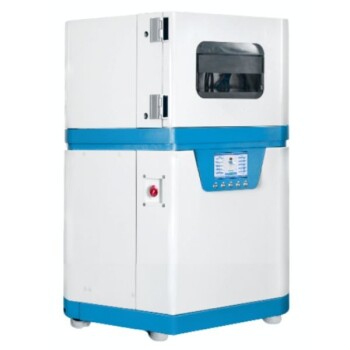
The pressure maintenance function serves as an active mechanical corrective force against the internal stresses inherent in Copper-Carbon Nanotube (Cu-CNT) composites. By applying continuous, stable pressure at specific elevated temperatures (such as 725°C), the vacuum hot press effectively "re-presses" the composite layers. This action physically closes gaps caused by thermal expansion mismatches, healing delamination defects before the material cools and solidifies.
The core value of pressure maintenance is not just densification, but defect repair during the thermal cycle. It counteracts the separation forces caused by the differing physical properties of the copper matrix and the CNT reinforcement, ensuring a cohesive, defect-free bulk material.
The Root Cause: Thermal Mismatch
To understand why pressure maintenance is the solution, you must first understand the mechanic of the failure.
The Conflict Between Matrix and Reinforcement
Copper and Carbon Nanotubes possess vastly different coefficients of thermal expansion (CTE).
When the composite is heated, copper expands significantly, while CNTs remain relatively stable. Conversely, during the cooling phase, the copper matrix attempts to contract rapidly.
The Creation of Internal Stress
Because the CNTs do not shrink at the same rate as the copper, significant internal stress builds up at the interface between the two materials.
Without intervention, this stress exceeds the bonding strength between the layers. The result is delamination—the physical separation of the copper from the nanotubes.
How Pressure Maintenance Resolves the Defect
The vacuum hot press solves this by turning the processing environment into an active repair mechanism.
Continuous Re-pressing
The primary function at play here is stable pressure maintenance. This is not a static hold, but a continuous application of force.
When delamination begins to occur due to thermal stress, the hydraulic system maintains the set pressure (e.g., re-pressing the material). This forces the separating layers back into contact.
The Critical Temperature Window
This re-pressing is most effective at specific temperatures, noted in technical applications around 725°C.
At this temperature, the copper matrix is sufficiently malleable. The maintained pressure can physically push the material to close the voids created by the stress, effectively "healing" the separation.
Promoting Atomic Diffusion
While the primary reference highlights mechanical repair, the physics of hot pressing also relies on atomic diffusion.
By forcing the copper and CNTs into intimate contact under vacuum, the system enables atoms to migrate across the interface. This transforms a mechanical closure into a metallurgical bond, preventing the defect from reopening.
Understanding the Trade-offs
While pressure maintenance is a powerful tool, it is not a cure-all for poor process design.
Pressure vs. Temperature Synchronization
Pressure maintenance is only effective if applied while the matrix is plastic enough to deform.
Applying high pressure after the material has cooled below its plastic range will not repair delamination; it will likely induce cracking or residual stress.
The Wettability Factor
As noted in broader composite processing, the interface between metal powders and nanotubes often suffers from poor wettability.
Pressure maintenance overcomes this by mechanically forcing contact, but it cannot change the chemical affinity. If the pressure is released too early (before the bond stabilizes), non-wetting surfaces may separate again.
Making the Right Choice for Your Goal
To optimize your vacuum hot pressing process for Cu-CNT composites, align your parameters with your specific defect targets.
- If your primary focus is Eliminating Delamination: Prioritize pressure maintenance during the cooling phase. Ensure pressure remains active until the material temperature drops below the point where significant thermal contraction occurs.
- If your primary focus is Maximizing Density: Focus on peak pressure magnitude (e.g., >80 N/mm²) during the holding phase to overcome poor wettability and eliminate inter-particle gaps.
- If your primary focus is Interfacial Bonding: Ensure the vacuum level is high to prevent oxidation, allowing the pressure to facilitate true atomic diffusion between the copper and the CNTs.
Success relies on using pressure not just to squeeze the material, but to physically counteract the thermal forces trying to pull it apart.
Summary Table:
| Feature | Function in Cu-CNT Processing | Benefit for Composite Quality |
|---|---|---|
| Continuous Re-pressing | Physically closes gaps during thermal expansion | Eliminates delamination & voids |
| Thermal Synchronization | Maintains pressure at malleable temperatures (725°C) | Heals defects through plastic deformation |
| Atomic Diffusion | Forces intimate contact under vacuum | Creates strong metallurgical bonds |
| Cooling Phase Stability | Counteracts CTE mismatch between Cu and CNT | Prevents separation during solidification |
Elevate Your Advanced Material Research with KINTEK
Don’t let delamination compromise your high-performance composites. KINTEK specializes in precision laboratory equipment, offering high-performance vacuum hot presses and hydraulic presses designed for the rigorous demands of Cu-CNT and ceramic research.
Our advanced systems provide the precise temperature control and stable pressure maintenance needed to ensure superior density and defect-free bonding in every sample. Beyond hot pressing, we offer a comprehensive range of high-temperature furnaces, crushing and milling systems, and specialized consumables like PTFE and ceramics to support your entire workflow.
Ready to optimize your material properties? Contact our technical experts today to find the perfect solution for your lab!
Related Products
- Vacuum Hot Press Furnace Machine Heated Vacuum Press
- Vacuum Hot Press Furnace Machine for Lamination and Heating
- Vacuum Hot Press Furnace Heated Vacuum Press Machine Tube Furnace
- 600T Vacuum Induction Hot Press Furnace for Heat Treat and Sintering
- Touchscreen Automatic Vacuum Heat Press
People Also Ask
- What advantages does a vacuum hot press furnace provide for LSLBO ceramic electrolytes? Achieve 94% Relative Density
- What role does a Vacuum Hot Press (VHP) furnace play in the densification of austenitic stainless steel 316 composites?
- What are the advantages of using a vacuum hot pressing furnace? Superior Densification for 2024Al/Gr/SiC Composites
- Why is it necessary to maintain a high-vacuum environment within a vacuum hot press furnace? Optimize Cu-SiC Sintering
- What is the purpose of remelting heat treatment in a vacuum hot press for UHMWPE? Ensure Oxidative Stability