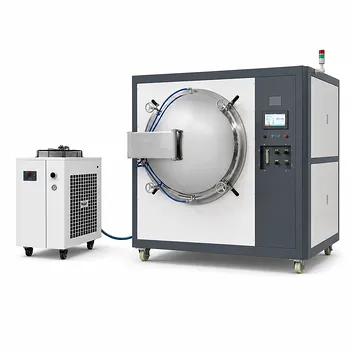
A vacuum hot-pressing furnace is the superior choice for fabricating Carbon Fiber/Silicon Nitride (C_fiber/Si3N4) composites because it simultaneously addresses the inherent sintering resistance of silicon nitride and the chemical vulnerability of carbon fibers. This method applies uniaxial mechanical pressure to force densification at lower temperatures while maintaining a vacuum environment to prevent catastrophic oxidation of the carbon reinforcement.
Core Takeaway Standard atmospheric sintering is often insufficient for this composite because Silicon Nitride is difficult to densify without extreme heat, which would destroy Carbon fibers in an oxygenated environment. Vacuum hot pressing bridges this gap by using mechanical force to achieve high density at manageable temperatures, ensuring the fibers remain intact and the ceramic matrix is structurally sound.
Overcoming the "Sintering Resistance" of Silicon Nitride
Silicon Nitride (Si3N4) is a covalent material known for its low self-diffusion coefficient, making it notoriously difficult to sinter into a dense solid using heat alone.
Lowering Activation Energy
Standard atmospheric sintering relies solely on thermal energy to bond particles. Vacuum hot pressing introduces mechanical pressure, which significantly lowers the activation energy required for densification. This external force drives the process forward more efficiently than heat alone.
Promoting Plastic Flow and Rearrangement
The application of pressure (often uniaxial) physically forces the ceramic particles to rearrange. This induces plastic flow within the material, filling voids and eliminating porosity that standard sintering would leave behind.
Achieving Density at Lower Temperatures
Because mechanical pressure aids the bonding process, the furnace can operate at lower temperatures compared to pressureless sintering. This is critical for composites, as excessive heat can degrade the mechanical properties of the reinforcing fibers.
Preserving Material Integrity via Vacuum
While pressure handles the density, the vacuum environment is essential for chemical stability. Standard atmospheric furnaces introduce oxygen and other gases that are detrimental to this specific composite.
Preventing Carbon Fiber Oxidation
Carbon fibers are highly susceptible to oxidation at elevated temperatures. In a standard atmospheric furnace, the fibers would burn or degrade, ruining the composite's structural integrity. The vacuum environment removes oxygen, preserving the fibers.
Inhibiting Thermal Decomposition
Silicon Nitride can thermally decompose at the high temperatures required for sintering. The vacuum environment, combined with the lower temperature requirements enabled by hot pressing, inhibits this decomposition, ensuring the matrix phase remains pure and stable.
Removing Internal Gases
The vacuum actively pulls gases out of internal pores and powder gaps. This "degassing" prevents the formation of residual micropores that often occur in standard sintering when grains bond too quickly, trapping gas inside.
Understanding the Trade-offs
While vacuum hot pressing is preferred for material quality, it is important to recognize the operational constraints compared to standard furnaces.
Geometric Limitations
Hot pressing typically utilizes uniaxial pressure (pressure from one direction). This limits the production capabilities to simple shapes, such as flat plates, disks, or cylinders, whereas standard sintering can accommodate complex geometries.
Production Efficiency
Vacuum hot pressing is inherently a batch process. It generally yields lower throughput compared to continuous atmospheric sintering furnaces, making it a higher-cost solution reserved for high-performance applications.
Making the Right Choice for Your Goal
The decision to use a vacuum hot-pressing furnace depends on your specific requirements for the final composite material.
- If your primary focus is Maximum Density and Strength: The combination of mechanical pressure and vacuum is non-negotiable to overcome Si3N4's sintering resistance and eliminate porosity.
- If your primary focus is Fiber Protection: A vacuum environment is mandatory to prevent the oxidation and degradation of the carbon fiber reinforcement.
- If your primary focus is Material Purity: The vacuum process ensures the removal of volatile impurities and prevents contamination from atmospheric gases.
For high-performance C_fiber/Si3N4 composites, vacuum hot pressing provides the only reliable path to achieving a dense, oxidation-free structure with optimized mechanical properties.
Summary Table:
| Feature | Vacuum Hot-Pressing Furnace | Standard Atmospheric Furnace |
|---|---|---|
| Densification Mechanism | Thermal energy + Uniaxial mechanical pressure | Thermal energy alone |
| Operating Temperature | Lower (preserves fiber integrity) | Higher (risk of material degradation) |
| Fiber Protection | Vacuum prevents carbon oxidation | Risk of catastrophic fiber oxidation |
| Material Density | High (eliminates porosity through plastic flow) | Lower (limited by Si3N4 sintering resistance) |
| Geometry Support | Simple shapes (disks, plates, cylinders) | Complex geometries |
| Ideal Application | High-performance C_fiber/Si3N4 composites | General ceramic sintering |
Elevate Your Material Research with KINTEK Precision
Fabricating high-performance C_fiber/Si3N4 composites requires precision control over pressure and environment. KINTEK specializes in advanced vacuum hot-pressing furnaces and a comprehensive range of high-temperature furnaces (muffle, tube, rotary, and CVD) designed to meet the rigorous demands of material science.
Whether you need robust crushing and milling systems for powder preparation or isostatic hydraulic presses for uniform densification, KINTEK provides the professional-grade tools and consumables (including PTFE, ceramics, and crucibles) your laboratory needs to succeed.
Ready to achieve superior density and oxidation-free results? Contact our technical experts today to find the perfect sintering solution for your application!
Related Products
- Vacuum Hot Press Furnace Heated Vacuum Press Machine Tube Furnace
- 600T Vacuum Induction Hot Press Furnace for Heat Treat and Sintering
- Vacuum Hot Press Furnace Machine Heated Vacuum Press
- Vacuum Hot Press Furnace Machine for Lamination and Heating
- Vacuum Heat Treat and Pressure Sintering Furnace for High Temperature Applications
People Also Ask
- What advantages does a vacuum hot press furnace provide for LSLBO ceramic electrolytes? Achieve 94% Relative Density
- What role does a Vacuum Hot Press (VHP) furnace play in the densification of austenitic stainless steel 316 composites?
- What are the advantages of using a vacuum hot pressing furnace? Superior Densification for 2024Al/Gr/SiC Composites
- What are the advantages of a vacuum hot press furnace for LTPO solid electrolytes? Boost Density and Conductivity
- What core processing conditions does a vacuum hot press furnace provide? Achieve High-Density Cu-SiC/Diamond Composites