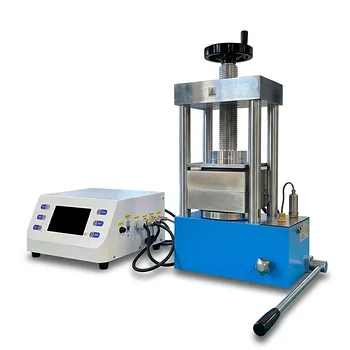
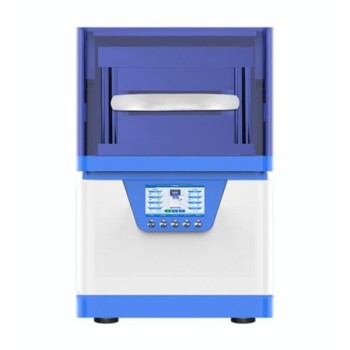
A heated laboratory hydraulic press is strictly necessary because it provides the simultaneous application of uniform heat and continuous pressure required to consolidate composite layers effectively. Without this controlled environment, resin cannot flow sufficiently through complex fiber orientations (such as [0/90/90/0] layouts), which prevents the creation of a solid, void-free structural component.
The primary function of the press is to facilitate tight interlaminar bonding. By eliminating voids through precise temperature and pressure control, the machine ensures the resulting laminate meets the high standards required for complex mechanical load testing.
The Mechanics of Composite Consolidation
Creating a Uniform Environment
To turn prepregs or dry fiber layouts into a useful material, consistency is key. A heated hydraulic press—often referred to as a compression molding machine—envelops the material in a uniform temperature field while applying continuous mechanical pressure.
Facilitating Resin Flow
Complex fiber orientations create a difficult path for resin distribution. The press forces the resin to flow thoroughly through these intricate layers during the curing process.
Ensuring Deep Penetration
This forced flow is particularly critical for specific layups, such as [0/90/90/0] orientations. Without the sustained pressure of the press, the resin may not penetrate these alternating layers evenly.
Achieving Structural Integrity
Eliminating Interlaminar Voids
The most significant threat to composite strength is the presence of air pockets or gaps between layers. The heated press physically compresses the layers to eliminate interlaminar voids entirely.
Achieving Tight Bonding
The combination of heat (to lower resin viscosity) and pressure (to compress fibers) results in tight interlaminar bonding. This fuses individual layers into a single, cohesive structural unit.
Preparing for Mechanical Testing
Laboratory samples are often intended for rigorous analysis. The high-standard components produced by this method are robust enough to withstand complex mechanical load testing without premature failure caused by manufacturing defects.
Understanding the Risks of Improper Curing
The Consequence of Low Pressure
If pressure is not continuous or uniform, the resin will not impregnate the fibers fully. This leads to dry spots within the laminate where the fibers are not supported by the matrix.
The Impact of Uneven Heating
Inconsistent temperature leads to uneven curing rates. This results in internal stresses and potential warping, rendering the laminate unsuitable for precision structural applications.
Making the Right Choice for Your Goal
When determining if a heated hydraulic press is required for your specific application, consider your end goals:
- If your primary focus is Structural Testing: You must use a heated press to eliminate voids and ensure that failure during testing is due to material limits, not manufacturing defects.
- If your primary focus is Complex Layups: You need the continuous pressure to force resin through alternating fiber directions (like [0/90]) to achieve a consolidated part.
Ultimately, the heated press is the standard for transforming loose layers of fiber and resin into a unified, high-performance engineering material.
Summary Table:
| Feature | Function in Composite Preparation | Impact on Quality |
|---|---|---|
| Uniform Heating | Lowers resin viscosity for better flow | Prevents internal stress and warping |
| Continuous Pressure | Forces resin through complex fiber layups | Eliminates interlaminar voids and gaps |
| Simultaneous Action | Consolidates layers during the curing cycle | Ensures a unified, high-performance part |
| Controlled Cooling | Manages the solidification process | Maintains dimensional stability of samples |
Elevate Your Material Research with KINTEK Precision
Don't let manufacturing defects compromise your research data. KINTEK specializes in advanced laboratory hydraulic presses (pellet, hot, isostatic) engineered to provide the precise temperature and pressure control required for high-performance composite laminates.
Whether you are working with complex [0/90] layups or requiring high-standard samples for mechanical load testing, our equipment ensures void-free consolidation and superior interlaminar bonding. Beyond presses, we offer a comprehensive suite of laboratory solutions—from high-temperature furnaces and crushing systems to PTFE consumables and ceramics—designed to support every stage of your material science workflow.
Ready to achieve structural perfection in your composites?
Contact KINTEK today for a customized equipment consultation.
References
- Abdulhammed K. Hamzat, Ramazan Asmatulu. Fiber-reinforced composites for aerospace, energy, and marine applications: an insight into failure mechanisms under chemical, thermal, oxidative, and mechanical load conditions. DOI: 10.1007/s42114-024-01192-y
This article is also based on technical information from Kintek Solution Knowledge Base .
Related Products
- 24T 30T 60T Heated Hydraulic Press Machine with Heated Plates for Laboratory Hot Press
- Heated Hydraulic Press Machine with Integrated Manual Heated Plates for Lab Use
- Automatic Heated Hydraulic Press Machine with Heated Plates for Laboratory Hot Press 25T 30T 50T
- Heated Hydraulic Press Machine with Heated Plates for Vacuum Box Laboratory Hot Press
- Automatic High Temperature Heated Hydraulic Press Machine with Heated Plates for Lab
People Also Ask
- What role does a heated hydraulic press play in Cold Sintering (CSP)? Enhancing LATP-Halide Densification
- Why is the heating function of a laboratory hydraulic press essential for MEA assembly in DEFC? Optimize Cell Bonding
- What technical conditions does a heated hydraulic press provide for PEO batteries? Optimize Solid-State Interfaces
- How is a heated hydraulic press used for Li-LLZO batteries? Optimize Interfacial Bonding with Thermal-Pressure
- What is the core function of a laboratory heated hydraulic press in CSP? Revolutionize Low-Temp Ceramic Sintering