Knowledge How hot can a graphite crucible get? Unlocking its true potential in your furnace.
Author avatar

Tech Team · Kintek Solution

Updated 6 days ago

How hot can a graphite crucible get? Unlocking its true potential in your furnace.


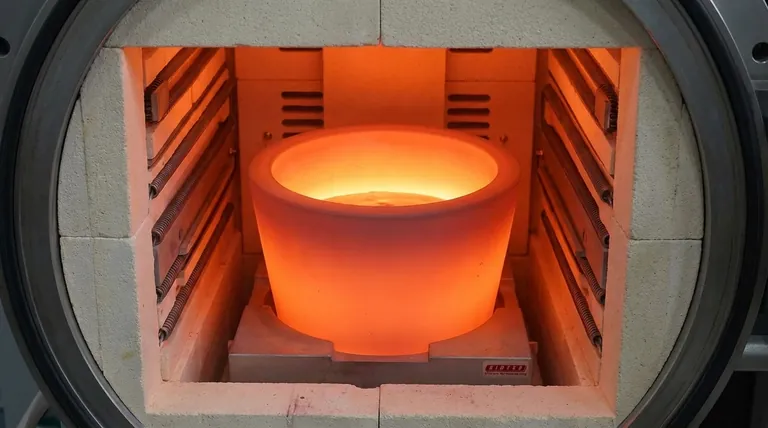
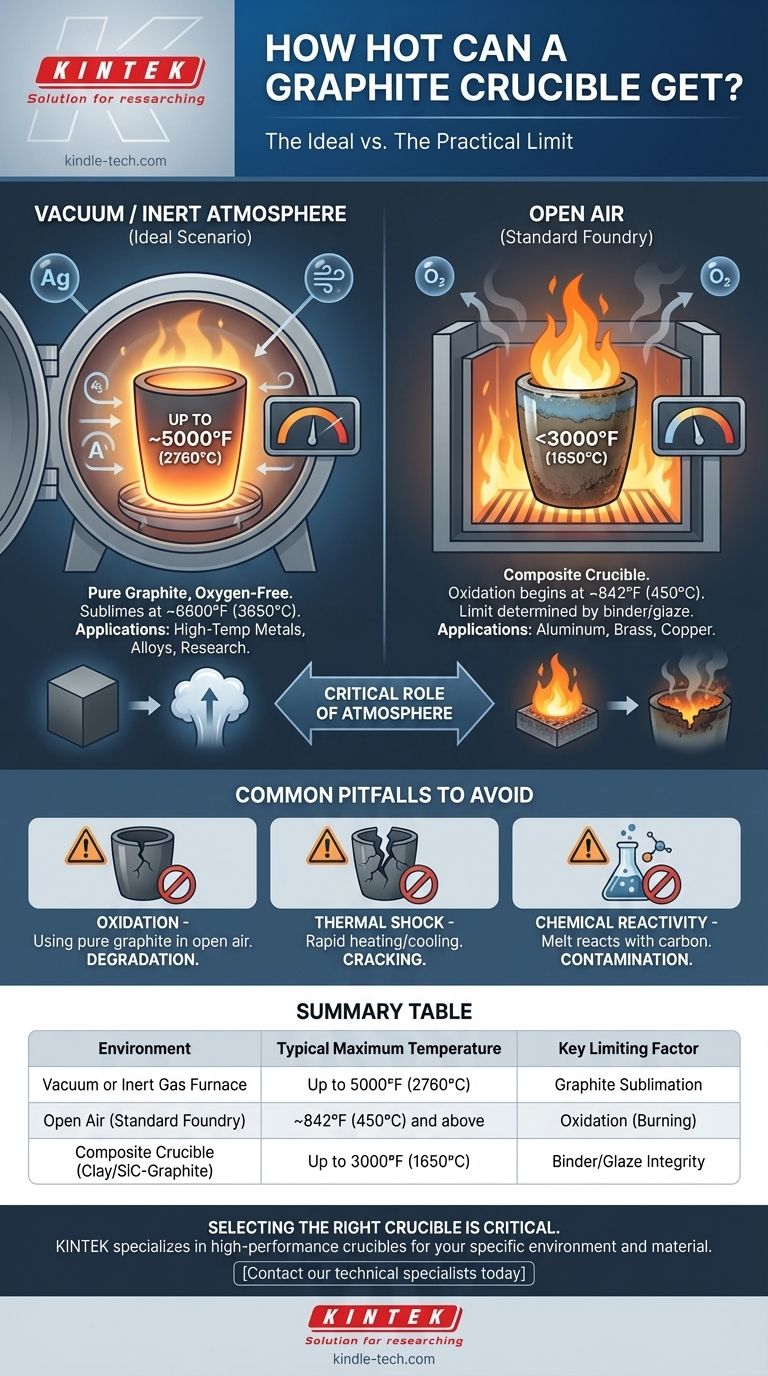
In the right conditions, a pure graphite crucible can withstand temperatures up to approximately 5000°F (about 2760°C). However, this number represents an ideal scenario. The actual, practical temperature limit is dictated almost entirely by the atmosphere in which it is heated.

The theoretical temperature limit of graphite is exceptionally high, but its practical use is a story of two different environments. In open air, oxidation will destroy the crucible at much lower temperatures, while in a vacuum or inert atmosphere, it can approach its true potential.
How hot can a graphite crucible get? Unlocking its true potential in your furnace.

The Two Factors Defining a Crucible's Limit

The maximum temperature a "graphite crucible" can handle isn't a single number. It depends on the material's intrinsic properties and, more importantly, the environment you place it in.

The Intrinsic Limit of Graphite

Graphite does not melt at atmospheric pressure; instead, it sublimes (turns from a solid directly into a gas) at an extremely high temperature, around 6600°F (3650°C).

This is the absolute theoretical ceiling. The 5000°F (2760°C) figure often cited is a more practical upper working limit for pure graphite components in controlled, non-reactive environments.

The Critical Role of Atmosphere

The most significant constraint for graphite is oxidation.

When heated in the presence of oxygen (like in open air), graphite begins to react and burn away at temperatures as low as 842°F (450°C). This process rapidly accelerates as heat increases, destroying the crucible.

To reach the multi-thousand-degree temperatures graphite is known for, you must use it in an oxygen-free environment, such as a vacuum furnace or a furnace flooded with an inert gas like argon.

Understanding Practical Temperature Ranges

Your application and furnace type will determine the effective temperature range of your crucible.

For High-Temperature Furnaces (Inert/Vacuum)

This is where pure graphite shines. In a controlled, oxygen-free environment, pure graphite crucibles can reliably be used for processes reaching up to 2200°C (3992°F) or higher.

These applications include melting high-temperature metals, producing specialized alloys, and various scientific research processes.

For Standard Foundry Furnaces (Open Air)

For melting common metals like aluminum or copper in a typical foundry, you are likely not using a pure graphite crucible. You are using a composite crucible.

These are typically clay-graphite or silicon carbide-graphite crucibles. They contain graphite for its excellent thermal conductivity but are bound with other materials and covered in a protective glaze to resist oxidation in an open-air furnace.

The limit for these crucibles is determined by the binder and the glaze, not the graphite itself, and is typically well below 3000°F (1650°C).

Common Pitfalls to Avoid

Understanding these limitations is key to preventing crucible failure and ensuring safety.

Ignoring Oxidation

The most common mistake is attempting to use a pure graphite crucible in an open-air furnace for high-temperature melts. It will quickly degrade and fail. Always match the crucible type to the furnace atmosphere.

Disregarding Thermal Shock

Graphite and composite crucibles can crack if heated or cooled too quickly. Always follow proper procedures for pre-heating your crucible before introducing a charge and allow for controlled cooling after a pour.

Overlooking Chemical Reactivity

While graphite is relatively inert, some molten materials can react with carbon. This can lead to contamination of your melt or degradation of your crucible over time. Always verify the compatibility of the crucible material with the metal you intend to melt.

Making the Right Choice for Your Goal

Selecting the correct crucible is not about finding the highest temperature rating, but the right tool for your specific environment and material.

  • If your primary focus is melting aluminum, brass, or copper in a standard foundry: You need a clay-graphite or silicon carbide-graphite crucible designed for use in an oxidizing atmosphere.
  • If your primary focus is high-temperature metallurgy or research above 1800°C: You need a pure graphite crucible and a vacuum or inert gas furnace to protect it from oxygen.

Ultimately, your operating atmosphere is the most important factor in determining the true temperature limit and lifespan of your crucible.

Summary Table:

Environment Typical Maximum Temperature Key Limiting Factor
Vacuum or Inert Gas Furnace Up to 5000°F (2760°C) Graphite Sublimation
Open Air (Standard Foundry) ~842°F (450°C) and above Oxidation (Burning)
Composite Crucible (Clay/SiC-Graphite) Up to 3000°F (1650°C) Binder/Glaze Integrity

Selecting the right crucible is critical for safety and performance. KINTEK specializes in high-performance lab equipment, including a full range of graphite and composite crucibles designed for specific furnace atmospheres and materials. Our experts can help you choose the perfect crucible to maximize temperature capability and lifespan in your unique application.

Contact our technical specialists today to discuss your requirements and ensure optimal results for your melting or research process.

Visual Guide
How hot can a graphite crucible get? Unlocking its true potential in your furnace. Visual Guide

Related Products

People Also Ask

Related Products

High Purity Pure Graphite Crucible for Electron Beam Evaporation

High Purity Pure Graphite Crucible for Electron Beam Evaporation

A technology mainly used in the field of power electronics. It is a graphite film made of carbon source material by material deposition using electron beam technology.

High Purity Pure Graphite Crucible for Evaporation

High Purity Pure Graphite Crucible for Evaporation

Vessels for high temperature applications, where materials are kept at extremely high temperatures to evaporate, allowing thin films to be deposited on substrates.

Engineering Advanced Fine Ceramics Alumina Crucibles (Al2O3) for Thermal Analysis TGA DTA

Engineering Advanced Fine Ceramics Alumina Crucibles (Al2O3) for Thermal Analysis TGA DTA

TGA/DTA thermal analysis vessels are made of aluminum oxide (corundum or aluminum oxide). It can withstand high temperature and is suitable for analyzing materials that require high temperature testing.

Arc-Shaped Alumina Ceramic Crucible High Temperature Resistant for Engineering Advanced Fine Ceramics

Arc-Shaped Alumina Ceramic Crucible High Temperature Resistant for Engineering Advanced Fine Ceramics

In the journey of scientific exploration and industrial production, every detail is crucial. Our arc-shaped alumina ceramic crucibles, with their excellent high temperature resistance and stable chemical properties, have become a powerful assistant in laboratories and industrial fields. They are made of high-purity alumina materials and manufactured through precision processes to ensure excellent performance in extreme environments.

Graphite Vacuum Continuous Graphitization Furnace

Graphite Vacuum Continuous Graphitization Furnace

High-temperature graphitization furnace is a professional equipment for graphitization treatment of carbon materials. It is a key equipment for the production of high-quality graphite products. It has high temperature, high efficiency and uniform heating. It is suitable for various high-temperature treatments and graphitization treatments. It is widely used in metallurgy, electronics, aerospace, etc. industry.

Large Vertical Graphite Vacuum Graphitization Furnace

Large Vertical Graphite Vacuum Graphitization Furnace

A large vertical high-temperature graphitization furnace is a type of industrial furnace used for the graphitization of carbon materials, such as carbon fiber and carbon black. It is a high-temperature furnace that can reach temperatures of up to 3100°C.

Engineering Advanced Fine Ceramics Alumina Al2O3 Crucible With Lid Cylindrical Laboratory Crucible

Engineering Advanced Fine Ceramics Alumina Al2O3 Crucible With Lid Cylindrical Laboratory Crucible

Cylindrical Crucibles Cylindrical crucibles are one of the most common crucible shapes, suitable for melting and processing a wide variety of materials, and are easy to handle and clean.

Alumina Al2O3 Ceramic Crucible Semicircle Boat with Lid for Engineering Advanced Fine Ceramics

Alumina Al2O3 Ceramic Crucible Semicircle Boat with Lid for Engineering Advanced Fine Ceramics

Crucibles are containers widely used for melting and processing various materials, and semicircular boat-shaped crucibles are suitable for special smelting and processing requirements. Their types and uses vary by material and shape.

Custom Machined and Molded PTFE Teflon Parts Manufacturer with PTFE Crucible and Lid

Custom Machined and Molded PTFE Teflon Parts Manufacturer with PTFE Crucible and Lid

PTFE crucibles, made from pure Teflon, offer chemical inertness and resistance from -196°C to 280°C, ensuring compatibility with a wide range of temperatures and chemicals. These crucibles feature machine-finished surfaces for easy cleaning and prevention of contamination, making them ideal for precise laboratory applications.

Electron Beam Evaporation Coating Tungsten Crucible and Molybdenum Crucible for High Temperature Applications

Electron Beam Evaporation Coating Tungsten Crucible and Molybdenum Crucible for High Temperature Applications

Tungsten and molybdenum crucibles are commonly used in electron beam evaporation processes due to their excellent thermal and mechanical properties.

Engineering Advanced Fine Alumina Al2O3 Ceramic Crucible for Laboratory Muffle Furnace

Engineering Advanced Fine Alumina Al2O3 Ceramic Crucible for Laboratory Muffle Furnace

Alumina ceramic crucibles are used in some materials and metal melting tools, and flat-bottomed crucibles are suitable for melting and processing larger batches of materials with better stability and uniformity.

Graphite Vacuum Furnace Bottom Discharge Graphitization Furnace for Carbon Materials

Graphite Vacuum Furnace Bottom Discharge Graphitization Furnace for Carbon Materials

Bottom-out graphitization furnace for carbon materials, ultra-high temperature furnace up to 3100°C, suitable for graphitization and sintering of carbon rods and carbon blocks. Vertical design, bottom discharging, convenient feeding and discharging, high temperature uniformity, low energy consumption, good stability, hydraulic lifting system, convenient loading and unloading.

Electron Beam Evaporation Coating Oxygen-Free Copper Crucible and Evaporation Boat

Electron Beam Evaporation Coating Oxygen-Free Copper Crucible and Evaporation Boat

Electron Beam Evaporation Coating Oxygen-Free Copper Crucible enables precise co-deposition of various materials. Its controlled temperature and water-cooled design ensure pure and efficient thin film deposition.

Electron Beam Evaporation Coating Conductive Boron Nitride Crucible BN Crucible

Electron Beam Evaporation Coating Conductive Boron Nitride Crucible BN Crucible

High-purity and smooth conductive boron nitride crucible for electron beam evaporation coating, with high temperature and thermal cycling performance.

E Beam Crucibles Electron Gun Beam Crucible for Evaporation

E Beam Crucibles Electron Gun Beam Crucible for Evaporation

In the context of electron gun beam evaporation, a crucible is a container or source holder used to contain and evaporate the material to be deposited onto a substrate.

Boron Nitride (BN) Crucible for Phosphorous Powder Sintered

Boron Nitride (BN) Crucible for Phosphorous Powder Sintered

Phosphorus powder sintered boron nitride (BN) crucible has a smooth surface, dense, pollution-free and long service life.

Electron Beam Evaporation Coating Gold Plating Tungsten Molybdenum Crucible for Evaporation

Electron Beam Evaporation Coating Gold Plating Tungsten Molybdenum Crucible for Evaporation

These crucibles act as containers for the gold material evaporated by the electron evaporation beam while precisely directing the electron beam for precise deposition.

Bomb Type Probe for Steelmaking Production Process

Bomb Type Probe for Steelmaking Production Process

Bomb-type probe for precise steelmaking control: measures carbon content (±0.02%) and temperature (20℃ accuracy) in 4-8s. Boost efficiency now!

Shaking Incubators for Diverse Laboratory Applications

Shaking Incubators for Diverse Laboratory Applications

Precision lab shaking incubators for cell culture & research. Quiet, reliable, customizable. Get expert advice today!

Lab Internal Rubber Mixer Rubber Kneader Machine for Mixing and Kneading

Lab Internal Rubber Mixer Rubber Kneader Machine for Mixing and Kneading

Lab internal rubber mixer is suitable for mixing, kneading and dispersing various chemical raw materials such as plastics, rubber, synthetic rubber, hot melt adhesive and various low-viscosity materials.


Leave Your Message