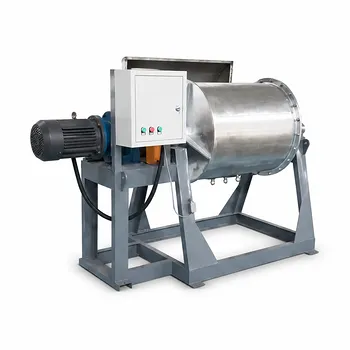
High-energy ball milling serves as the central engine for solvent-free material synthesis in composite electrolyte preparation. By utilizing intense mechanical force, it merges polymers, lithium salts, and ceramic powders into a unified composite. This process eliminates the need for liquid solvents, relying instead on high-intensity impact to physically mix components and engineer the material's microstructure for optimal performance.
Core Takeaway The high-energy ball mill is not merely a mixer; it is a mechanochemical tool that forces physical blending and dispersion without solvents. Its primary function is to establish critical ion transport channels within the material, determining the final electrochemical performance of the electrolyte.
The Mechanics of Dry-Process Preparation
High-Intensity Impact and Mixing
The fundamental mechanism of the high-energy ball mill is the application of brute mechanical force.
The equipment subjects the raw materials—specifically polymers, lithium salts, and ceramic powders—to continuous, high-intensity impact. This kinetic energy forces these distinct components to integrate at a level that simple stirring cannot achieve.
Eliminating Solvents
A defining characteristic of this approach is the exclusion of solvents.
Traditional wet processes require dissolving materials and subsequent drying. High-energy ball milling bypasses this, achieving physical mixing and dispersion entirely in the dry state. This streamlines the process and avoids complications associated with residual solvents.
Impact on Microstructure and Performance
Establishing Ion Transport Channels
The ultimate goal of the milling process is to facilitate the movement of ions.
By thoroughly dispersing the lithium salts and ceramic powders within the polymer matrix, the milling process creates continuous pathways. These pathways, or ion transport channels, are essential for the conductivity of the final composite electrolyte.
Particle Size Reduction
High-energy milling is highly effective at refining material dimensions.
The process can drastically reduce particle sizes, taking materials from a coarse range of 20-50 micrometers down to a fine 1-5 micrometers. This reduction increases the surface area and ensures a more homogeneous mixture.
Enhancing Contact Interfaces
The refinement of particles leads to superior interfacial contact.
As observed in related composite applications, this process improves the contact interface between active materials and solid electrolytes. This intimate contact is critical for maximizing reversible capacity and overall battery efficiency.
Mechanochemical Transformations
The force applied is sufficient to alter the crystalline structure of materials.
Beyond simple size reduction, the energy involved can transform materials from a crystalline to an amorphous state. This structural change can significantly influence the electrochemical properties and stability of the resulting composite.
Understanding the Trade-offs and Considerations
Process Intensity vs. Material Integrity
While high-energy milling is powerful, it is an aggressive process.
The "high-intensity impact" described is a critical tool for evaluation, but it requires precise control. The goal is to evaluate how different processing methods impact performance, implying that variations in milling time or energy input will yield different results.
Specificity of Application
The physical changes induced are significant.
Reducing particles to the 1-5 micrometer range and altering crystallinity are profound changes. One must ensure that these specific microstructural alterations align with the target performance metrics of the specific electrolyte formulation being developed.
Making the Right Choice for Your Goal
To effectively utilize a high-energy ball mill in your process, focus on your specific material objectives:
- If your primary focus is Ion Conductivity: Prioritize the dispersion capability of the mill to ensure uniform distribution of lithium salts, which establishes the necessary ion transport channels.
- If your primary focus is Interfacial Stability: Leverage the particle reduction capabilities to achieve the 1-5 micrometer range, maximizing the contact area between the electrolyte and other components.
Ultimately, the high-energy ball mill allows you to dictate the physical architecture of your electrolyte through mechanical force rather than chemical solvation.
Summary Table:
| Feature | Dry-Process Impact of High-Energy Ball Milling |
|---|---|
| Core Mechanism | Intense mechanical force and high-intensity kinetic impact |
| Solvent Status | 100% Solvent-free (Eliminates liquid processing and drying) |
| Particle Size | Reduction from 20-50 μm down to 1-5 μm for better homogeneity |
| Microstructure | Creates ion transport channels and transforms crystalline to amorphous states |
| Key Benefit | Enhanced interfacial contact and optimized electrochemical performance |
Revolutionize Your Electrolyte Research with KINTEK
Transitioning to dry-process synthesis requires precision and power. KINTEK specializes in high-performance laboratory equipment, providing the advanced crushing and milling systems necessary to engineer the next generation of solid-state batteries.
From achieving perfect 1-5 μm particle dispersion to mastering mechanochemical transformations, our solutions empower researchers to optimize ion conductivity and interfacial stability without the need for solvents. Explore our comprehensive range of high-energy ball mills, planetary mixers, and specialized battery research tools tailored for your lab's success.
Ready to scale your dry-process innovation? Contact our experts today to find the perfect milling solution!
Related Products
- High Energy Planetary Ball Mill Milling Machine for Laboratory
- High-Energy Omnidirectional Planetary Ball Mill Milling Machine for Laboratory
- High Energy Planetary Ball Mill for Laboratory Horizontal Tank Type Milling Machine
- High Energy Planetary Ball Mill Machine for Laboratory Horizontal Tank Type
- High Energy Planetary Ball Mill Milling Machine for Laboratory
People Also Ask
- How does a planetary ball mill provide mechanical activation for scandium recovery? Maximize Your Leaching Efficiency
- What role do planetary ball mills and zirconia media play in LLZT preparation? Optimize Your Solid Electrolyte Research
- What is the function of a planetary ball mill in the preparation of high-entropy rare earth silicate multi-phase ceramics?
- What is the purpose of using a planetary ball mill for cathode material regeneration? Achieve Atomic-Level Mixing
- What is the primary function of a planetary ball mill? Mastering SiC/Al Composite Mixing for Homogeneity