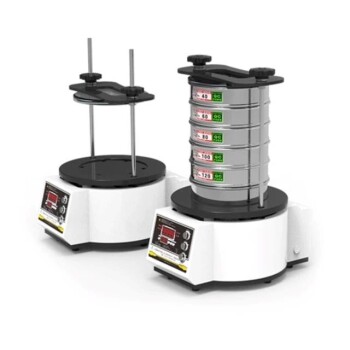
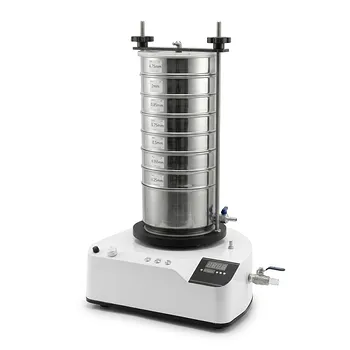
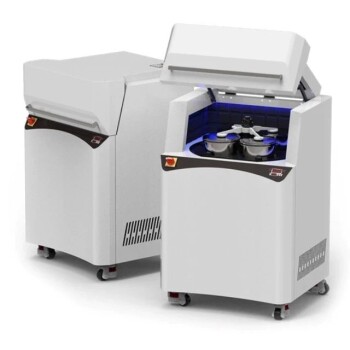
Precision mechanical vibration sieve shakers serve as the technical foundation for particle size classification when analyzing fly ash deposition. By utilizing standard sieves of varying mesh sizes, researchers can isolate specific particle fractions from both original and deposited ash to quantify how size distribution directly influences adhesion rates and physical behavior.
A precision sieve shaker is essential for correlating fly ash particle size with its deposition characteristics, revealing that finer particles (below 30.8 microns) contribute disproportionately to adhesion due to increased specific surface area and aggregation effects.
Quantifying Particle Size Distribution (PSD)
Classification of Original and Deposited Ash
The shaker allows for a comparative analysis between the source material and the ash collected after an experiment. This "before and after" classification identifies which specific particle sizes are most likely to exit the system and which are prone to sticking to surfaces.
Defining Precise Mesh Range Parameters
Researchers typically utilize a stack of sieves to segment fly ash into fractions ranging from 30.8 microns to over 100 microns. This granularity is necessary to map the transition between particles that follow gas flow and those that succumb to inertial or adhesive forces.
Standardizing Experimental Reproducibility
By providing consistent, mechanical physical disturbance, the shaker ensures that particle separation is governed by size rather than random clumping. This consistency is vital for determining equilibrium states and ensuring that data can be replicated across different laboratory environments.
The Physics of Ash Adhesion and Deposition
Impact of Specific Surface Area
Smaller particles isolated by the sieve shaker exhibit a much higher specific surface area relative to their mass. This physical property significantly increases the available contact points for chemical bonding and physical interlocking during the deposition process.
Aggregation Effects in Fine Particles
The equipment helps demonstrate that fine particles are more prone to aggregation, where smaller units clump together to form larger masses. This clustering behavior is a primary driver of ash buildup on heat exchangers and other industrial surfaces.
Interaction with Ammonium Bisulfate (ABS)
In power plant environments, the shaker is used to study how different particle sizes interact with the adhesion rate of ammonium bisulfate. Quantitative analysis reveals a clear physical law: the finer the particle, the more likely it is to be captured by the "sticky" layer of ABS.
Understanding the Trade-offs and Limitations
Mechanical Attrition of Fragile Particles
Prolonged vibration in a mechanical shaker can cause "particle attrition," where larger, fragile ash particles break down into smaller fragments. This can lead to an overestimation of the "fines" fraction if the sieving duration is not strictly controlled.
Static Electricity and Fine Retention
Extremely fine particles often develop a static charge during the shaking process, causing them to cling to the mesh or the sieve walls. This can result in incomplete separation and requires the use of anti-static agents or specialized cleaning protocols to maintain accuracy.
Sieve Blinding and Mesh Obstruction
Particles that are near the size of the mesh opening can become lodged, a phenomenon known as blinding. If the shaker does not provide sufficient vertical displacement or if the mesh is not maintained, the effective screening area decreases, leading to skewed distribution data.
Applying These Insights to Your Research Goal
How to Apply This to Your Project
After establishing your testing parameters, use the following guidelines to optimize your fly ash analysis:
- If your primary focus is determining adhesion rates: Use the shaker to isolate particles below 30 microns, as these are the primary drivers of surface bonding and aggregation.
- If your primary focus is activating pozzolanic properties: Ensure your sieving process confirms a fineness of at least 75 to 150 micrometers to guarantee uniform distribution and chemical reactivity in soil or cement mixtures.
- If your primary focus is studying kinetic models: Utilize continuous physical disturbance to eliminate external mass transfer resistance and increase collision frequency between particles and active sites.
Understanding the precise relationship between particle size and physical behavior is the only way to accurately predict and mitigate the impacts of fly ash deposition.
Summary Table:
| Particle Size Range | Deposition Impact | Key Mechanism |
|---|---|---|
| Fine (< 30.8 μm) | High Adhesion & Aggregation | Increased specific surface area and chemical bonding |
| Medium (30.8 - 100 μm) | Transitional Behavior | Balance between gas flow follow-up and inertial forces |
| Coarse (> 100 μm) | Low Adhesion Rate | Dominated by inertial forces; prone to mechanical bounce-off |
| Fines w/ ABS | Maximum Stickiness | Interaction with ammonium bisulfate creates sticky layers |
Elevate Your Particle Analysis with KINTEK Precision
Achieving accurate, reproducible data in fly ash research requires laboratory equipment that eliminates variables. KINTEK specializes in high-performance sieving equipment, crushing and milling systems, and hydraulic presses designed to provide the granularity your material science demands.
Beyond particle classification, we offer a comprehensive suite of laboratory solutions, including:
- High-Temperature Furnaces: Muffle, tube, and vacuum furnaces for ash fusion and thermal treatment.
- Reactors & Autoclaves: High-pressure systems for complex chemical interactions.
- Advanced Preparation Tools: Pellet presses, homogenizers, and durable ceramic consumables.
Whether you are a researcher optimizing ash deposition models or a distributor seeking reliable laboratory supply chains, KINTEK provides the technical excellence and support you need.
Ready to enhance your lab’s efficiency? Contact our experts today to find the perfect equipment for your project!
References
- Xiaoqiang Chen, Lingling Zhao. Laboratory Study on Adhesive Ash Deposition Characteristics of Ammonium Bisulfate in Conditions Simulating an Air Preheater for Hard Coal Combustion. DOI: 10.3390/en16186513
This article is also based on technical information from Kintek Solution Knowledge Base .
Related Products
- Vibratory Sieve Shaker Machine Dry Three-Dimensional Vibrating Sieve
- Laboratory Vibratory Sieve Shaker Machine for Dry and Wet Three-Dimensional Sieving
- Laboratory Vibratory Sieve Shaker Machine Slap Vibrating Sieve
- Laboratory Test Sieves and Vibratory Sieve Shaker Machine
- Laboratory Wet Three-Dimensional Vibratory Sieve Shaker Machine
People Also Ask
- How is a vibratory sieve shaker used in the particle size analysis of mechanically alloyed powders? Expert Guide
- Why use a vibratory sieve shaker for PET powder? Achieve Precise Particle Size Control for Chemical Research
- What is the principle of vibratory sieve shaker? Achieve Accurate Particle Size Analysis
- What is the function of a vibratory sieve shaker? Achieve Precise Particle Size Analysis
- What is the use of vibratory sieve shaker? Achieve Precise Particle Size Analysis for Your Lab