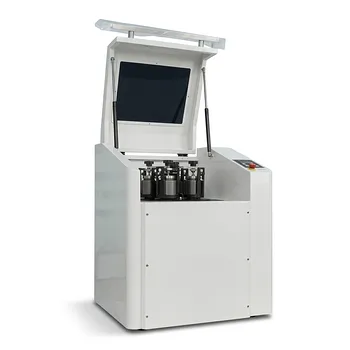
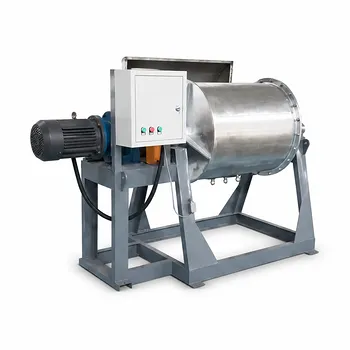
A planetary ball mill functions as a high-energy mechanical alloying device regarding the preparation of carrier powders like iron and yttrium oxide.
Instead of simple stirring, the equipment utilizes high-speed rotation to generate intense impact and shear forces. This process physically forces nano-scale yttrium oxide particles to bond with and embed themselves into larger iron carrier particles, creating a composite powder rather than a loose mixture.
Core Takeaway The planetary ball mill does not merely mix materials; it uses mechanical force to overcome the electrostatic agglomeration of nanopowders. By physically embedding ceramic reinforcements into metal carriers, it creates a uniform, flowable composite powder essential for high-performance sintering or additive manufacturing.
The Mechanics of the Process
Generating Impact and Shear
The planetary ball mill rotates grinding jars around a central axis while the jars spin in the opposite direction on their own axes.
This complex motion generates high centrifugal forces. The grinding media (balls) inside the jars collide with the powder at high speeds, subjecting the iron and yttrium oxide to severe impact and shear forces.
Breaking Down Agglomerations
Nano-sized powders, such as yttrium oxide, naturally tend to clump together due to electrostatic attraction and high surface energy.
The high-energy collisions in the ball mill effectively shatter these agglomerates. This ensures that the reinforcement phase is dispersed as individual particles rather than clusters, which is critical for material homogeneity.
Mechanical Bonding and Embedding
The primary goal is not just dispersion, but physical bonding.
The kinetic energy of the milling media plastically deforms the softer iron particles. Simultaneously, the harder yttrium oxide nanoparticles are pressed into the surface or interior of the iron matrix. This creates a mechanically alloyed composite particle where the reinforcement is locked in place.
Functional Benefits for Material Properties
Increasing Reactivity
The milling process does more than change the shape of the powder; it alters its internal structure.
The impact induces lattice distortion and structural deformation within the powder particles. This "mechanical activation" increases the specific surface area and internal energy of the material, providing the necessary kinetic foundation for phase transformations during subsequent heating.
Enabling Advanced Processing
Preparing powders in this manner solves critical downstream processing issues.
For example, loose nanopowders often fail to enter the liquid phase during melting or clog feeding systems in additive manufacturing. By anchoring the nanoparticles onto the micron-sized iron carrier, the powder creates a flowable feedstock that can be easily processed in standard equipment.
Understanding the Trade-offs
Risk of Contamination
Because the process relies on high-energy collisions between balls and jar walls, there is an inherent risk of wear debris entering the powder mixture.
If the grinding media (e.g., steel, zirconia, or tungsten carbide) degrades, it introduces impurities that can compromise the final alloy's chemistry.
Managing Thermal Buildup
The kinetic energy transfers significant heat to the powder.
Without proper control or pauses in the milling cycle, this heat can induce premature chemical reactions or oxidation before the powder is ready for the sintering phase.
Morphology Control
Prolonged milling can excessively flatten or fracture the metal particles.
Operators must balance the milling time to ensure sufficient embedding of the oxide without degrading the morphology of the iron carrier to a point where it is no longer suitable for packing or flowing.
Making the Right Choice for Your Goal
When utilizing a planetary ball mill for iron and yttrium oxide mixtures, align your parameters with your specific end-use application:
- If your primary focus is Additive Manufacturing: Prioritize parameters that embed the oxide deeply to prevent segregation while maintaining a spherical or flowable particle shape for consistent feeding.
- If your primary focus is Oxide Dispersion Strengthened (ODS) Alloys: Focus on high-energy intensity to achieve atomic-level mixing and maximum lattice distortion to ensure superior high-temperature strength.
- If your primary focus is Sintering Densification: Ensure the process sufficiently increases the specific surface area (mechanical activation) to lower the activation energy required for full density.
The planetary ball mill is the bridge between raw chemical potential and a structurally viable engineering material.
Summary Table:
| Feature | Mechanical Alloying Benefit |
|---|---|
| Mechanism | High-energy impact and shear forces |
| Powder Integration | Embeds nano-oxide into metal carriers |
| Agglomeration | Shatters electrostatic clumps for dispersion |
| Key Outcome | Enhanced reactivity & flowable composite powder |
| Applications | ODS alloys, Sintering, Additive Manufacturing |
Elevate Your Material Research with KINTEK
Unlock superior powder performance and material homogeneity with KINTEK’s high-precision crushing and milling systems. Whether you are developing Oxide Dispersion Strengthened (ODS) alloys or advanced feedstocks for additive manufacturing, our planetary ball mills deliver the high-energy mechanical activation your project demands.
Why choose KINTEK?
- Comprehensive Laboratory Range: From high-temperature furnaces and vacuum systems to advanced planetary mills and hydraulic presses.
- Industry-Leading Expertise: Specializing in equipment for battery research, high-pressure reactors, and precision consumables like ceramics and crucibles.
- Tailored Solutions: We help you balance morphology control and contamination risks to ensure your research yields the highest quality composite powders.
Contact KINTEK Today to Optimize Your Lab Workflow
References
- Alexandr Panichkin, Alexandr Arbuz. RESEARCH OF INJECTION METHODS FOR Y2O3 NANOPARTICLES INTO NICKEL- FREE STAINLESS STEEL DURING INDUCTION VACUUM REMELTING. DOI: 10.59957/jctm.v59.i1.2024.20
This article is also based on technical information from Kintek Solution Knowledge Base .
Related Products
- High Energy Planetary Ball Mill for Laboratory Horizontal Tank Type Milling Machine
- High-Energy Omnidirectional Planetary Ball Mill Milling Machine for Laboratory
- Laboratory Planetary Ball Mill Rotating Ball Milling Machine
- High Energy Planetary Ball Mill Milling Machine for Laboratory
- High Energy Planetary Ball Mill Machine for Laboratory Horizontal Tank Type
People Also Ask
- What is the role of a planetary ball mill in sulfide-based solid-state batteries? Engineer High-Performance Cathodes
- What are the parameters of a planetary ball mill? Master Speed, Time, and Media for Perfect Grinding
- What is the function of a planetary ball mill for nanostructured eutectic steel? Essential Prep for High-Strength Alloys
- What role does a planetary ball mill play in the preparation of NASICON-type solid electrolytes like LATP and LAGP?
- What is the function of a planetary ball mill in solid-state electrolyte prep? Milling vs. SDS Methods Explained