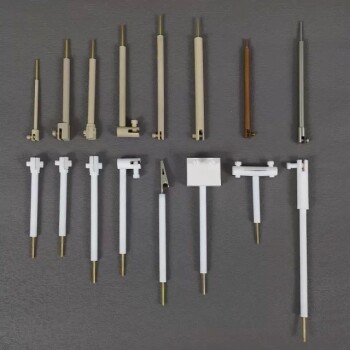
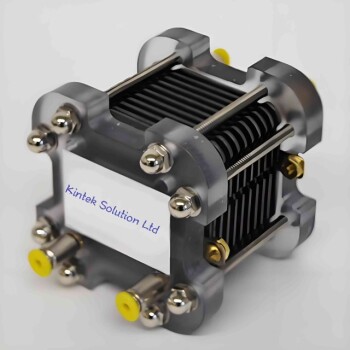
To configure a three-electrode electrochemical cell for testing alloys like 13Cr and P110, you must arrange three distinct components connected to an industrial-grade electrochemical workstation. This setup utilizes the test alloy as the working electrode, a stable metal (typically platinum) as the counter electrode, and a standard reference electrode (such as a saturated calomel electrode) to create a precise measurement environment.
Core Takeaway The three-electrode configuration is the industry standard for corrosion testing because it effectively decouples the current-carrying circuit from the potential-measuring circuit. This setup eliminates potential drop errors caused by solution resistance, ensuring that polarization curves and open circuit potentials reflect the true behavior of the alloy rather than artifacts of the electrolyte.
The Anatomy of the Configuration
The Working Electrode (WE)
This is the primary focus of your experiment. In your specific case, the working electrode is the sample of the alloy you are testing (e.g., 13Cr or P110).
The measured signals originate solely from the interface between this alloy and the electrolyte.
The Counter Electrode (CE)
Also known as the auxiliary electrode, this component completes the electrical circuit. It is typically made of an inert material, most commonly a platinum electrode or a platinum-titanium mesh.
The counter electrode facilitates current flow within the cell without participating in the corrosion reaction itself.
The Reference Electrode (RE)
This electrode provides a stable potential baseline against which the working electrode is measured. A common choice is the saturated calomel electrode (SCE).
Alternative configurations may use a silver/silver chloride (Ag/AgCl) electrode, depending on the specific testing environment.
The Operational Mechanism
Closing the Circuit
The system creates a closed-loop circuit where current flows between the working electrode and the counter electrode. The electrochemical workstation drives this current to induce polarization or measure corrosion rates.
Measuring the Potential
While current flows through the counter electrode, the reference electrode monitors the potential of the working electrode.
Crucially, the reference electrode does not carry significant current. This isolation prevents polarization interference on the reference side, maintaining a stable voltage baseline.
Eliminating Solution Resistance Errors
In highly conductive media, such as formate-based fluids, solution resistance can introduce voltage drops (IR drops) that skew results.
By using a three-electrode setup, the workstation effectively compensates for these potential drops. This allows for the precise measurement of polarization curves and open circuit potentials (OCP).
Understanding the Trade-offs
Complexity of Setup
Compared to a two-electrode system, this configuration requires more cabling and precise physical positioning. If the reference electrode is placed too far from the working electrode, some uncompensated resistance may still persist.
Maintenance of Reference Electrodes
The accuracy of the entire system relies on the stability of the reference electrode. Saturated calomel and Ag/AgCl electrodes require proper storage and filling solutions to prevent potential drift, which would invalidate the test data.
Making the Right Choice for Your Goal
To ensure valid corrosion data for alloys like 13Cr and P110, consider the following:
- If your primary focus is high-precision polarization data: Ensure your reference electrode is a Saturated Calomel Electrode (SCE) to minimize potential drift during the potential sweep.
- If your primary focus is uniform current distribution: Use a platinum-titanium mesh for the counter electrode rather than a simple wire to ensure the current acts evenly across the alloy surface.
Ultimately, the three-electrode system is the only reliable method for isolating the true electrochemical behavior of an alloy from the electrical resistance of the test fluid.
Summary Table:
| Component | Role in Corrosion Testing | Recommended Material |
|---|---|---|
| Working Electrode (WE) | The subject of analysis; source of measurement signal | Alloy sample (e.g., 13Cr, P110) |
| Counter Electrode (CE) | Completes the circuit; facilitates current flow | Platinum wire or Pt-Ti mesh |
| Reference Electrode (RE) | Provides stable potential baseline for WE measurement | Saturated Calomel (SCE) or Ag/AgCl |
| Electrolyte | Conductive medium for the corrosion reaction | Test fluid (e.g., Formate-based) |
Elevate Your Corrosion Analysis with KINTEK Precision
Ensure the integrity of your alloy research with KINTEK’s premium electrochemical solutions. From high-performance electrolytic cells and electrodes to specialized high-temperature high-pressure reactors, we provide the precision tools required for rigorous 13Cr and P110 testing. Our expert team is ready to help you configure the perfect setup for your laboratory.
Maximize your testing accuracy today — Contact our experts now!
References
- Chuanzhen Zang, Zhanghua Lian. Study on the Galvanic Corrosion between 13Cr Alloy Tubing and Downhole Tools of 9Cr and P110: Experimental Investigation and Numerical Simulation. DOI: 10.3390/coatings13050861
This article is also based on technical information from Kintek Solution Knowledge Base .
Related Products
- H Type Electrolytic Cell Triple Electrochemical Cell
- PTFE Electrolytic Cell Electrochemical Cell Corrosion-Resistant Sealed and Non-Sealed
- Electrolytic Electrochemical Cell Gas Diffusion Liquid Flow Reaction Cell
- Electrolytic Electrochemical Cell with Five-Port
- Electrolytic Electrochemical Cell for Coating Evaluation
People Also Ask
- What is a H type cell? A Guide to Divided Electrochemical Cells for Accurate Experiments
- How should the electrolyte be prepared and added to the H-type electrolytic cell? Best Practices for Purity and Safety
- What is the technical necessity of using an H-type electrolytic cell for NO3RR tests? Protect Your Ammonia Yields
- How does the design of an H-type electrolytic cell benefit the neutral water electrolysis process for metal recovery?
- What is the primary function of an H-type electrolytic cell in NitRR? Ensure Accurate Product Yields