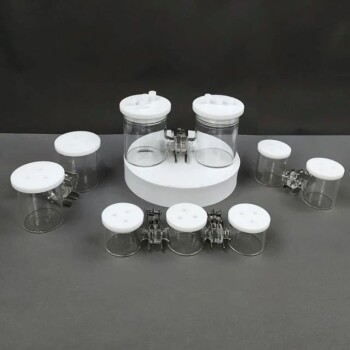
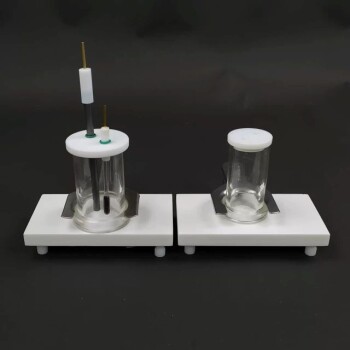
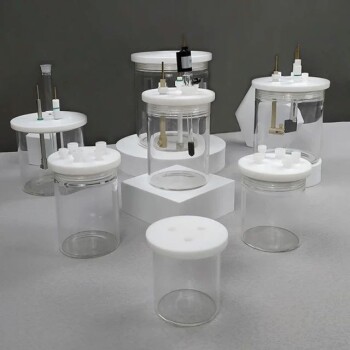
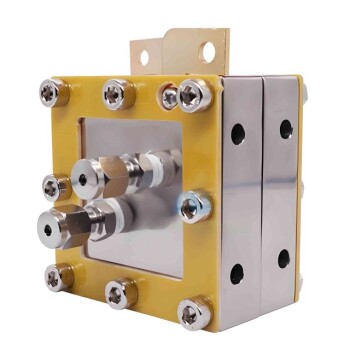
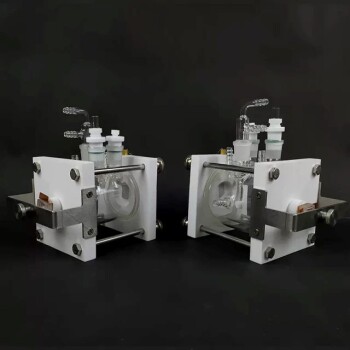
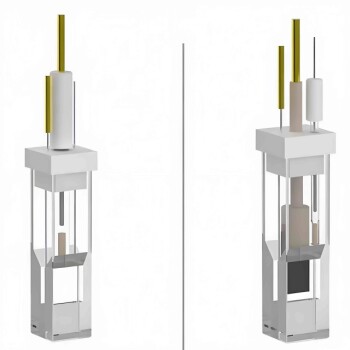
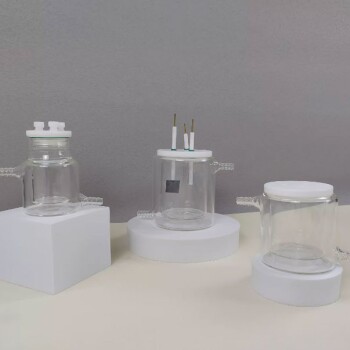
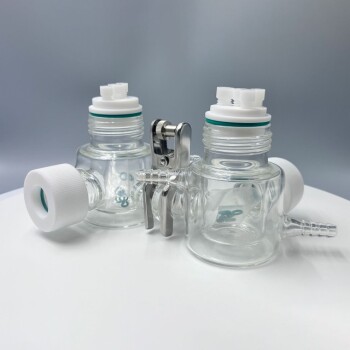
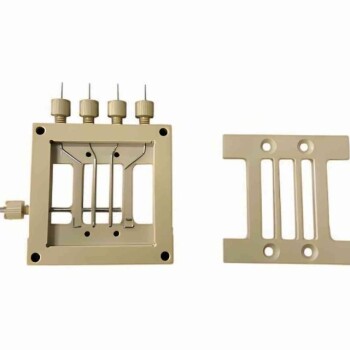
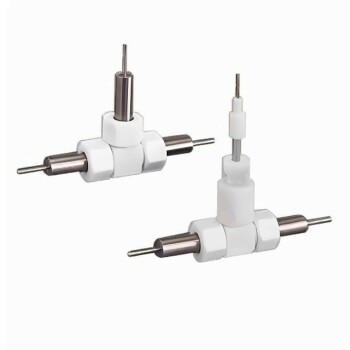
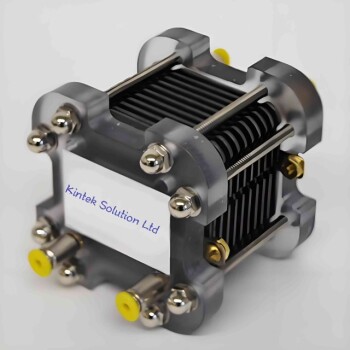
Specialized electrolytic cells achieve concentration by utilizing the varying separation coefficients of isotopes during the breakdown of water molecules. Through the application of a constant current, the cell decomposes water into hydrogen and oxygen gases; however, lighter hydrogen isotopes are released as gas more readily than heavier tritium isotopes. This selective retention confines the tritium within the residual liquid, significantly increasing its specific activity while reducing the total sample volume.
Core Takeaway By exploiting the electrochemical differences between isotopes, electrolytic cells reduce water sample volumes by a factor of 10 to 15 while retaining the target tritium. This pre-treatment is essential for lowering detection limits, enabling Liquid Scintillation Counting (LSC) to accurately measure extremely low levels of environmental radiation.
The Mechanics of Electrolytic Enrichment
The Principle of Isotope Separation
The fundamental mechanism relies on the separation coefficients associated with the electrolysis process. When an electric current is applied to water, chemical bonds break to form gases.
Crucially, the reaction kinetics differ between isotopes. The lighter "protium" (standard hydrogen) atoms dissociate and form gas bubbles much faster than the heavier tritium atoms.
Retention in Residual Liquid
As the electrolysis proceeds, the bulk of the water volume is converted into gas and vented away. Because the heavier isotopes react more slowly, they remain behind in the solution.
Consequently, the tritium is effectively trapped and concentrated within the remaining water, known as the residual liquid.
Volume Reduction Factors
To achieve significant concentration, the process reduces the physical volume of the water sample dramatically.
Primary data indicates a volume reduction by a factor of 10 to 15. This transforms a large, dilute sample into a small, highly potent aliquot ready for analysis.
The Role in Detection Sensitivity
Overcoming Environmental Baselines
Environmental water samples often contain tritium levels that are too low for direct measurement. Standard detection equipment often struggles to distinguish these faint signals from background noise.
Concentration acts as a signal amplifier. By packing the tritium from a large volume into a small space, the specific activity of the sample rises above the detection threshold.
Enhancing Liquid Scintillation Counting
The ultimate goal of this pre-treatment is to prepare the sample for Liquid Scintillation Counting (LSC).
LSC relies on detecting flashes of light caused by radioactive decay. By feeding the instrument a concentrated sample, you significantly improve the statistical accuracy and sensitivity of the final reading.
Understanding the Trade-offs
Process Time vs. Sensitivity
While electrolytic enrichment is powerful, it introduces a significant pre-treatment step. Reducing a sample volume by 15x via electrolysis is a time-consuming process compared to direct measurement.
It requires a controlled application of constant current over an extended period, which impacts the overall throughput of a laboratory.
Sample Volume Requirements
This method is subtractive by nature. To end up with enough "residual liquid" for a valid analysis, you must begin with a sufficiently large initial sample volume.
If the starting sample is too small, the final concentrated volume may be insufficient for accurate processing in the scintillation counter.
Making the Right Choice for Your Goal
To determine if electrolytic concentration is required for your specific application, consider the following:
- If your primary focus is Environmental Monitoring: Use this method to lower detection limits, as it is critical for identifying extremely low-level background radiation that standard scans miss.
- If your primary focus is Process Efficiency: Evaluate if the potential 10-15x gain in sensitivity justifies the additional time and complexity of the electrolysis pre-treatment step.
Success in low-level tritium analysis depends on balancing the need for high sensitivity with the realities of sample volume and processing time.
Summary Table:
| Feature | Description |
|---|---|
| Mechanism | Electrochemical Isotope Separation (Kinetics-based) |
| Operation | Constant current electrolysis of water samples |
| Volume Reduction | 10 to 15 times original volume |
| Target Isotope | Tritium (remains in residual liquid) |
| Primary Goal | Increasing specific activity for LSC detection |
| Key Outcome | Lowered detection limits for environmental monitoring |
Maximize Your Analytical Precision with KINTEK
Elevate your environmental monitoring and laboratory research with KINTEK’s advanced solutions. We specialize in high-performance electrolytic cells and electrodes specifically designed for isotope enrichment and water sample pretreatment.
Whether you require high-temperature furnaces, precision crushing systems, or specialized high-pressure reactors and autoclaves, KINTEK provides the reliability and efficiency your research demands. Our comprehensive portfolio ensures that every step—from sample preparation with our hydraulic presses and milling systems to final analysis—is optimized for the highest sensitivity.
Ready to lower your detection limits? Contact our laboratory specialists today to discover how KINTEK's premium equipment and consumables can transform your workflow.
References
- Karolina Kowalska, Wojciech A. Pisarsk. Thulium-doped barium gallo-germanate glasses modified by titanium dioxide: optical investigations for near infrared applications. DOI: 10.21175/rad.abstr.book.2023.19.3
This article is also based on technical information from Kintek Solution Knowledge Base .
Related Products
- H Type Electrolytic Cell Triple Electrochemical Cell
- PTFE Electrolytic Cell Electrochemical Cell Corrosion-Resistant Sealed and Non-Sealed
- Electrolytic Electrochemical Cell for Coating Evaluation
- Quartz Electrolytic Electrochemical Cell for Electrochemical Experiments
- Electrolytic Electrochemical Cell with Five-Port
People Also Ask
- What is a H type cell? A Guide to Divided Electrochemical Cells for Accurate Experiments
- How should the electrolyte be prepared and added to the H-type electrolytic cell? Best Practices for Purity and Safety
- What is the technical necessity of using an H-type electrolytic cell for NO3RR tests? Protect Your Ammonia Yields
- How does the design of an H-type electrolytic cell benefit the neutral water electrolysis process for metal recovery?
- What is the primary function of an H-type electrolytic cell in NitRR? Ensure Accurate Product Yields