Knowledge muffle furnace What is the dry ashing method? A Simple and Cost-Effective Analytical Technique
Author avatar

Tech Team · Kintek Solution

Updated 2 months ago

What is the dry ashing method? A Simple and Cost-Effective Analytical Technique


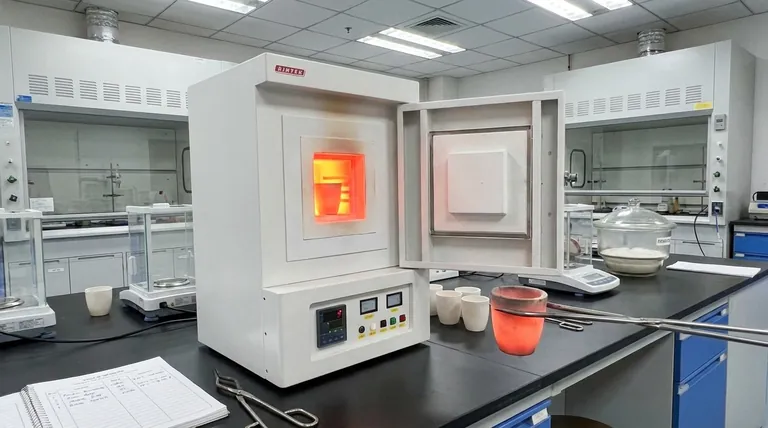
The dry ashing method is a widely used analytical technique for determining the composition of a sample in its dry state. It involves heating the sample in a muffle furnace at high temperatures (typically 500-600°C) to oxidize and remove organic material, leaving behind inorganic residues such as oxides, sulfates, phosphates, and silicates. This method is advantageous due to its simplicity, cost-effectiveness, and ability to handle large sample volumes. However, it may be less accurate for samples containing volatile materials. The ash content is calculated based on the weight difference before and after ashing, providing valuable insights into the mineral composition of the sample.
What is the dry ashing method? A Simple and Cost-Effective Analytical Technique

Key Points Explained:

  1. Simplicity and Ease of Use:

    • Dry ashing is a straightforward process that requires minimal sample preparation. The sample is simply placed in a muffle furnace and heated to high temperatures. This simplicity makes it accessible for routine analysis in laboratories.
    • The method does not require complex reagents or equipment, reducing the likelihood of errors associated with handling hazardous chemicals.
  2. Cost-Effectiveness:

    • Dry ashing is relatively inexpensive compared to other analytical techniques. The primary equipment required is a muffle furnace, which is a one-time investment.
    • There are no ongoing costs for expensive chemicals or reagents, making it a cost-effective option for laboratories with budget constraints.
  3. Handling Large Sample Volumes:

    • Dry ashing is well-suited for analyzing large sample volumes. The muffle furnace can accommodate multiple samples simultaneously, increasing throughput and efficiency.
    • This makes it particularly useful in industries such as food, agriculture, and environmental science, where large-scale analysis is often required.
  4. Mineral Composition Analysis:

    • The method effectively converts minerals in the sample into stable inorganic compounds such as oxides, sulfates, phosphates, and silicates. These compounds can then be analyzed to determine the mineral content of the sample.
    • This is particularly useful in industries like food science, where the mineral content of food products is a critical quality parameter.
  5. Removal of Organic Material:

    • Dry ashing completely oxidizes and removes organic material from the sample, leaving behind only inorganic residues. This is beneficial for analyzing the inorganic composition of samples without interference from organic matter.
    • The process is particularly useful in environmental analysis, where the focus is often on the mineral content of soil, sediment, or ash samples.
  6. Calculation of Ash Content:

    • The ash content is calculated using the formula: [ \text{Ash content} = \frac{M(\text{ash})}{M(\text{dry})} \times 100% ] where (M(\text{ash})) is the weight after ashing and (M(\text{dry})) is the weight before ashing. This provides a quantitative measure of the inorganic content in the sample.
    • This calculation is straightforward and provides a reliable measure of the sample's mineral content.
  7. Limitations and Considerations:

    • While dry ashing has many advantages, it is less accurate for samples containing volatile materials, as these may be lost during the heating process. This can lead to underestimation of the ash content.
    • The method is also not suitable for samples that may form volatile compounds at high temperatures, as this can lead to incomplete ashing and inaccurate results.
  8. Applications in Various Industries:

    • Food Industry: Used to determine the mineral content of food products, which is important for nutritional labeling and quality control.
    • Agriculture: Used to analyze soil and plant samples to assess nutrient content and soil health.
    • Environmental Science: Used to analyze ash and sediment samples to determine pollution levels and environmental impact.

In conclusion, the dry ashing method offers several advantages, including simplicity, cost-effectiveness, and the ability to handle large sample volumes. It is particularly useful for analyzing the mineral composition of samples and removing organic material. However, it is important to consider its limitations, especially when dealing with volatile materials. Overall, dry ashing is a valuable tool in various industries for determining the inorganic content of samples.

Summary Table:

Key Aspect Details
Simplicity Minimal sample preparation, no complex reagents or equipment required.
Cost-Effectiveness One-time investment in a muffle furnace; no recurring chemical costs.
Large Sample Handling Accommodates multiple samples, ideal for industries like food and agriculture.
Mineral Composition Converts minerals into oxides, sulfates, phosphates, and silicates for analysis.
Organic Material Removal Oxidizes organic matter, leaving inorganic residues for accurate analysis.
Ash Content Calculation Formula: [\text{Ash content} = \frac{M(\text{ash})}{M(\text{dry})} \times 100%]
Limitations Less accurate for volatile materials; may underestimate ash content.
Applications Food industry, agriculture, environmental science.

Discover how the dry ashing method can streamline your lab processes—contact us today for expert guidance!

Visual Guide

What is the dry ashing method? A Simple and Cost-Effective Analytical Technique Visual Guide

Related Products

People Also Ask

Related Products

High Temperature Muffle Oven Furnace for Laboratory Debinding and Pre Sintering

High Temperature Muffle Oven Furnace for Laboratory Debinding and Pre Sintering

KT-MD High temperature debinding and pre-sintering furnace for ceramic materials with various molding processes. Ideal for electronic components such as MLCC and NFC.

Vacuum Dental Porcelain Sintering Furnace

Vacuum Dental Porcelain Sintering Furnace

Get precise and reliable results with KinTek's Vacuum Porcelain Furnace. Suitable for all porcelain powders, it features hyperbolic ceramic furnace function, voice prompt, and automatic temperature calibration.

Laboratory Scientific Electric Heating Blast Drying Oven

Laboratory Scientific Electric Heating Blast Drying Oven

The desktop fast autoclave sterilizer is a compact and reliable device used for rapid sterilization of medical, pharmaceutical, and research items.

Laboratory Muffle Oven Furnace Bottom Lifting Muffle Furnace

Laboratory Muffle Oven Furnace Bottom Lifting Muffle Furnace

Efficiently produce batches with excellent temperature uniformity using our Bottom Lifting Furnace. Features two electric lifting stages and advanced temperature control up to 1600℃.

Vacuum Arc Induction Melting Furnace

Vacuum Arc Induction Melting Furnace

Discover the power of Vacuum Arc Furnace for melting active & refractory metals. High-speed, remarkable degassing effect, and free of contamination. Learn more now!

Graphite Vacuum Furnace High Thermal Conductivity Film Graphitization Furnace

Graphite Vacuum Furnace High Thermal Conductivity Film Graphitization Furnace

The high thermal conductivity film graphitization furnace has uniform temperature, low energy consumption and can operate continuously.

Non Consumable Vacuum Arc Induction Melting Furnace

Non Consumable Vacuum Arc Induction Melting Furnace

Explore the benefits of Non-Consumable Vacuum Arc Furnace with high melting point electrodes. Small, easy to operate & eco-friendly. Ideal for laboratory research on refractory metals & carbides.

Spark Plasma Sintering Furnace SPS Furnace

Spark Plasma Sintering Furnace SPS Furnace

Discover the benefits of Spark Plasma Sintering Furnaces for rapid, low-temperature material preparation. Uniform heating, low cost & eco-friendly.

Mesh belt controlled atmosphere furnace

Mesh belt controlled atmosphere furnace

Discover our KT-MB mesh belt sintering furnace - perfect for high-temperature sintering of electronic components & glass insulators. Available for open air or controlled atmosphere environments.

Ultra-High Temperature Graphite Vacuum Graphitization Furnace

Ultra-High Temperature Graphite Vacuum Graphitization Furnace

The ultra-high temperature graphitization furnace utilizes medium frequency induction heating in a vacuum or inert gas environment. The induction coil generates an alternating magnetic field, inducing eddy currents in the graphite crucible, which heats up and radiates heat to the workpiece, bringing it to the desired temperature. This furnace is primarily used for graphitization and sintering of carbon materials, carbon fiber materials, and other composite materials.

Small Vacuum Heat Treat and Tungsten Wire Sintering Furnace

Small Vacuum Heat Treat and Tungsten Wire Sintering Furnace

The small vacuum tungsten wire sintering furnace is a compact experimental vacuum furnace specially designed for universities and scientific research institutes. The furnace features a CNC welded shell and vacuum piping to ensure leak-free operation. Quick-connect electrical connections facilitate relocation and debugging, and the standard electrical control cabinet is safe and convenient to operate.

Dental Porcelain Zirconia Sintering Ceramic Furnace Chairside with Transformer

Dental Porcelain Zirconia Sintering Ceramic Furnace Chairside with Transformer

Experience top-notch sintering with Chairside Sintering Furnace with Transformer. Easy to operate, noise-free pallet, and automatic temperature calibration. Order now!

Controlled Nitrogen Inert Hydrogen Atmosphere Furnace

Controlled Nitrogen Inert Hydrogen Atmosphere Furnace

KT-AH Hydrogen atmosphere furnace - induction gas furnace for sintering/annealing with built-in safety features, dual housing design, and energy-saving efficiency. Ideal for lab and industrial use.

Vertical High Temperature Graphite Vacuum Graphitization Furnace

Vertical High Temperature Graphite Vacuum Graphitization Furnace

Vertical high temperature graphitization furnace for carbonization and graphitization of carbon materials up to 3100℃.Suitable for shaped graphitization of carbon fiber filaments and other materials sintered in a carbon environment.Applications in metallurgy, electronics, and aerospace for producing high-quality graphite products like electrodes and crucibles.

Vacuum Heat Treat and Pressure Sintering Furnace for High Temperature Applications

Vacuum Heat Treat and Pressure Sintering Furnace for High Temperature Applications

Vacuum pressure sintering furnaces are designed for high temperature hot pressing applications in metal and ceramic sintering. Its advanced features ensure precise temperature control, reliable pressure maintenance, and a robust design for seamless operation.

Vacuum Heat Treat Furnace with Ceramic Fiber Liner

Vacuum Heat Treat Furnace with Ceramic Fiber Liner

Vacuum furnace with polycrystalline ceramic fiber insulation liner for excellent heat insulation and uniform temperature field. Choose from 1200℃ or 1700℃ max. working temperature with high vacuum performance and precise temperature control.

Dental Porcelain Zirconia Sintering Ceramic Vacuum Press Furnace

Dental Porcelain Zirconia Sintering Ceramic Vacuum Press Furnace

Get precise dental results with Dental Vacuum Press Furnace. Automatic temperature calibration, low noise tray, and touch screen operation. Order now!

Graphite Vacuum Furnace Bottom Discharge Graphitization Furnace for Carbon Materials

Graphite Vacuum Furnace Bottom Discharge Graphitization Furnace for Carbon Materials

Bottom-out graphitization furnace for carbon materials, ultra-high temperature furnace up to 3100°C, suitable for graphitization and sintering of carbon rods and carbon blocks. Vertical design, bottom discharging, convenient feeding and discharging, high temperature uniformity, low energy consumption, good stability, hydraulic lifting system, convenient loading and unloading.

Large Vertical Graphite Vacuum Graphitization Furnace

Large Vertical Graphite Vacuum Graphitization Furnace

A large vertical high-temperature graphitization furnace is a type of industrial furnace used for the graphitization of carbon materials, such as carbon fiber and carbon black. It is a high-temperature furnace that can reach temperatures of up to 3100°C.

Graphite Vacuum Continuous Graphitization Furnace

Graphite Vacuum Continuous Graphitization Furnace

High-temperature graphitization furnace is a professional equipment for graphitization treatment of carbon materials. It is a key equipment for the production of high-quality graphite products. It has high temperature, high efficiency and uniform heating. It is suitable for various high-temperature treatments and graphitization treatments. It is widely used in metallurgy, electronics, aerospace, etc. industry.


Leave Your Message