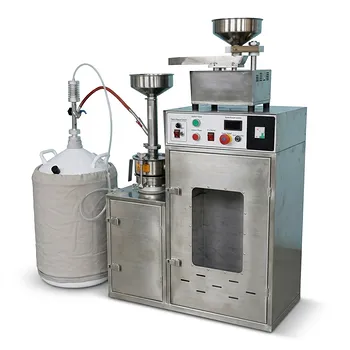
The primary advantage of using a cutting mill for fibrous biomass like pine sawdust and peat is its ability to utilize high-shear forces to achieve rapid refinement while preserving the material’s chemical integrity. This method is significantly more effective than traditional impact grinding because it cleanly severs tough plant fibers without generating the excessive heat that typically degrades volatile organic components.
Cutting mills optimize biomass preparation by combining superior thermal management with a significant increase in specific surface area, ensuring that additive materials remain chemically potent and physically optimized for downstream extraction.
The Mechanics of Shear Force vs. Impact
Overcoming Tough Plant Fibers
Cutting mills employ high-speed rotating blades designed specifically to slice through the resilient structures of wood and peat. Unlike impact grinders that rely on blunt force, these blades exert strong shear forces that effectively handle the toughness of cellulose and lignin.
Superior Thermal Management
Traditional grinding methods often generate significant friction-based heat, which can cause the loss of sensitive chemical compounds. The cutting process achieves rapid refinement without generating excessive heat, allowing for the maximum retention of volatile content within the biomass.
Enhancing Downstream Chemical Processes
Maximizing Specific Surface Area
A primary goal of biomass preparation is to increase the specific surface area of the raw material. By finely grinding materials like pine sawdust to a precise size—such as 35 mesh—cutting mills create a larger interface for chemical reactions.
Optimized Extraction Conditions
An increased surface area provides optimized physical contact for subsequent processes like solvent extraction. This ensures that chemical components, such as lignin, are extracted both sufficiently and uniformly across the entire batch of material.
Understanding the Trade-offs
Maintenance and Blade Sharpness
The efficiency of a cutting mill is directly tied to the sharpness of its rotating blades. Over time, processing abrasive fibrous materials can lead to blade wear, which may reduce the precision of the shear force and increase processing time.
Material Moisture Constraints
Cutting mills perform most consistently when the biomass has a controlled moisture content. Materials that are too wet, such as raw peat, can lead to clumping or "smearing" across the blades rather than clean shearing, potentially hindering the refinement process.
How to Apply This to Your Project
Making the Right Choice for Your Goal
To get the most out of your biomass preparation, tailor your cutting mill parameters to your specific technical requirements:
- If your primary focus is volatile retention: Prioritize the use of a cutting mill over a hammer mill to keep processing temperatures low and preserve the chemical profile of the sawdust or peat.
- If your primary focus is efficient lignin separation: Utilize the mill to reach a fine, consistent mesh size (e.g., 35 mesh) to ensure your solvent has maximum access to the internal structures of the fiber.
- If your primary focus is process consistency: Establish a routine schedule for blade inspection and sharpening to prevent mechanical friction from replacing clean shear forces as the blades dull.
By prioritizing precision shearing over blunt impact, cutting mills provide the physical and chemical consistency necessary for high-performance biomass applications.
Summary Table:
| Key Feature | Advantage for Biomass | Impact on Research/Production |
|---|---|---|
| High-Shear Force | Cleanly severs tough plant fibers (cellulose/lignin) | Superior material refinement without fiber damage |
| Thermal Management | Low heat generation during grinding | Maximum retention of sensitive volatile organic compounds |
| Surface Area Control | Achieve precise mesh sizes (e.g., 35 mesh) | Optimized physical contact for downstream extraction |
| Process Precision | Uniform particle distribution | Consistent and repeatable chemical reaction results |
Elevate Your Biomass Processing with KINTEK Precision
Maximize the potential of your fibrous materials with KINTEK’s advanced laboratory solutions. Whether you are refining pine sawdust for biofuel research or processing peat for chemical extraction, our high-performance crushing and milling systems are engineered to deliver superior shear force while protecting your sample's chemical integrity.
Beyond milling, KINTEK offers a comprehensive suite of tools for your laboratory, including:
- High-Temperature Furnaces: Muffle, tube, and vacuum furnaces for precise heat treatment.
- Sample Preparation: Hydraulic pellet presses, sieving equipment, and durable crucibles.
- Advanced Reactors: High-temperature high-pressure reactors and autoclaves for complex synthesis.
- Specialized Lab Ware: PTFE products, ceramics, and high-performance cooling solutions like ULT freezers.
Ready to optimize your extraction yields and ensure process consistency? Contact our technical experts today to find the perfect equipment tailored to your specific biomass application.
References
- K. V. Slyusarsky, Kirill B. Larionov. Ignition and Emission Characteristics of Waste Tires Pyrolysis Char Co-Combustion with Peat and Sawdust. DOI: 10.3390/en16104038
This article is also based on technical information from Kintek Solution Knowledge Base .
Related Products
- High Precision Diamond Wire Cutting Machine Laboratory Saw Precision Wire EDM Cutting Machine
- 12 Inch 24 Inch High Precision Automatic Diamond Wire Cutting Machine Laboratory Saw Precision Wire EDM Cutting Machine
- Professional Cutting Tools for Carbon Paper Cloth Diaphragm Copper Aluminum Foil and More
- Precision Wire Saw Laboratory Cutting Machine with 800mm x 800mm Workbench for Diamond Single Wire Circular Small Cutting
- Vibrating Disc Mill Small Laboratory Grinding Machine
People Also Ask
- Are diamonds used in machines? Unlock Superior Performance with Diamond Tools
- What machines make lab diamonds? Discover the HPHT and CVD Technologies Behind Lab-Grown Gems
- What machine is used for cutting diamond? Discover the Laser Technology That Shapes Gems
- Can you chemically make diamonds? Yes, CVD & HPHT Create Real Diamonds
- Can I buy lab diamonds? Your Guide to Modern, Ethical, and Affordable Diamonds