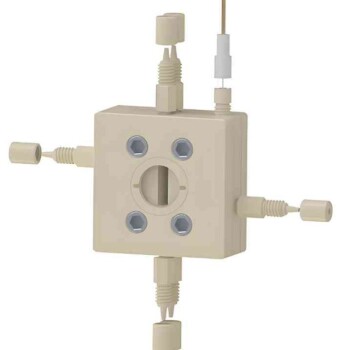
The primary design advantage of a three-chamber flow cell is the complete physical isolation of the catholyte and anolyte environments. This architecture prevents reaction products generated at one electrode from crossing over and interfering with the opposing electrode, ensuring reaction stability and purity. By decoupling these environments, the system can maintain high concentrations of electrolyte at the cathode catalyst layer, which is critical for driving complex electrochemical reactions.
Core Takeaway By physically separating the anodic and cathodic compartments, a three-chamber design eliminates product cross-interference and optimizes the local environment for the catalyst. This configuration significantly reduces mass transfer limitations, enabling the efficient and selective production of multi-carbon compounds like ethylene.
Optimizing Reaction Environments
Achieving Physical Isolation
The defining feature of this design is the physical separation between the anolyte (anode liquid) and catholyte (cathode liquid). In simpler systems, products generated at the cathode can migrate to the anode, where they may be re-oxidized or contaminate the opposing reaction.
The three-chamber structure acts as a barrier to this cross-interference. This ensures that the chemical species meant to remain at the cathode are not consumed or altered by the anode, preserving the integrity of the reduction process.
Enhancing Catalyst Performance
For a catalyst to function efficiently, it requires an optimal chemical environment. The three-chamber design ensures that the cathode catalyst layer maintains direct contact with a high-concentration electrolyte.
This constant contact ensures that ions required for the reaction are readily available at the catalyst surface. It prevents the local depletion of reactants, which is a common bottleneck in high-rate electrolysis.
Overcoming Mass Transfer Limitations
The Role of Gas Diffusion
High-performance carbon dioxide reduction requires bringing gas ($CO_2$), liquid (electrolyte), and solid (catalyst) together simultaneously. This design is often combined with gas diffusion mechanisms to solve this logistics problem.
By integrating gas diffusion, the system effectively manages the flow of $CO_2$ to the catalyst interface. This minimizes the distance gas molecules must travel through liquid, drastically reducing mass transfer limitations.
Unlocking Multi-Carbon Selectivity
The ultimate goal of reducing mass transfer resistance and ensuring electrolyte availability is to influence product selectivity. When $CO_2$ and ions are abundant at the catalyst surface, the system can drive more complex reactions.
This environment specifically favors the formation of multi-carbon products. The primary reference highlights that this configuration is particularly effective for enhancing the selectivity of valuable chemicals like ethylene, which requires the coupling of multiple carbon atoms.
Understanding the Trade-offs
Complexity vs. Necessity
While the three-chamber design offers superior performance for complex products, it introduces distinct operational requirements. The system relies heavily on the precise balance of pressures and flow rates across the chambers.
Unlike simpler single-chamber designs, this configuration requires careful management of the gas diffusion interface. If the gas pressure is too low, the electrolyte may flood the gas chamber; if too high, gas may bubble into the liquid, disrupting the contact between the catalyst and the high-concentration electrolyte.
Making the Right Choice for Your Goal
To determine if a three-chamber flow cell is the correct architecture for your electrochemical system, consider your target products and efficiency requirements.
- If your primary focus is synthesizing multi-carbon fuels: Choose this design to maximize the selectivity for C2+ products like ethylene by overcoming mass transfer limits.
- If your primary focus is preventing product re-oxidation: Use this setup to ensure strict physical isolation between the anolyte and catholyte, eliminating cross-interference.
This architecture is the definitive choice when the purity of the reaction environment and the suppression of mass transfer limits are critical to your success.
Summary Table:
| Feature | Advantage in Three-Chamber Design | Impact on CO2 Reduction |
|---|---|---|
| Physical Isolation | Complete separation of anolyte and catholyte | Prevents product re-oxidation and cross-interference |
| Electrolyte Management | High-concentration contact at the cathode | Maintains optimal chemical environment for catalysts |
| Mass Transfer | Integration with gas diffusion mechanisms | Reduces reactant depletion and enables high-rate electrolysis |
| Product Selectivity | Improved C-C coupling conditions | Favors the production of multi-carbon species like Ethylene |
Elevate Your Electrochemical Research with KINTEK
Precision in CO2 reduction requires high-performance equipment. KINTEK specializes in advanced laboratory solutions, including high-precision electrolytic cells and electrodes designed to solve mass transfer challenges and optimize your reaction environments.
Whether you are scaling up battery research or synthesizing multi-carbon fuels, our comprehensive range of high-temperature furnaces, hydraulic presses, and specialized consumables ensures your lab has the durability and accuracy it needs.
Ready to optimize your carbon reduction system? Contact us today to discover how KINTEK’s expert-engineered tools can drive your next breakthrough.
References
- Hugo‐Pieter Iglesias van Montfort, Thomas Burdyny. Non-invasive current collectors for improved current-density distribution during CO2 electrolysis on super-hydrophobic electrodes. DOI: 10.1038/s41467-023-42348-6
This article is also based on technical information from Kintek Solution Knowledge Base .
Related Products
- Customizable CO2 Reduction Flow Cell for NRR ORR and CO2RR Research
- Electrolytic Electrochemical Cell Gas Diffusion Liquid Flow Reaction Cell
- Electrolytic Electrochemical Cell with Five-Port
- H Type Electrolytic Cell Triple Electrochemical Cell
- Double-Layer Water Bath Electrolytic Electrochemical Cell
People Also Ask
- Why is a customized electrochemical flow cell used for eCO2RR? Achieve Industrial-Grade Performance and Current Density
- What is the purpose of an anion exchange membrane (AEM) or PEM? Enhance Electrochemical Efficiency
- How do the electrochemical cell and three-electrode testing system collaborate? Optimize Zinc Anode Deposition Control
- What is the difference between a voltaic cell and an electrochemical cell? Understand the Two Types of Energy Conversion
- Why must the electrochemical cell be continuously purged with nitrogen? Ensure Precision in Ni-Cr Corrosion Tests