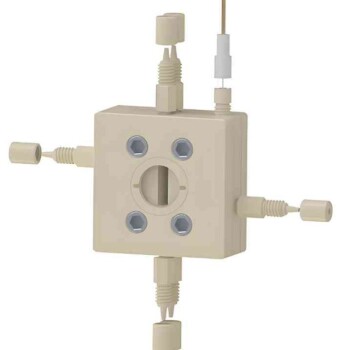
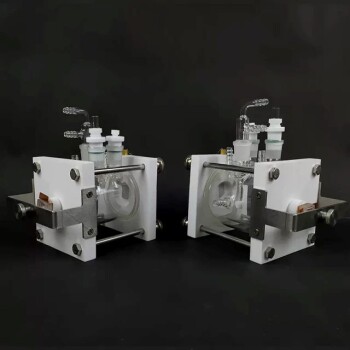
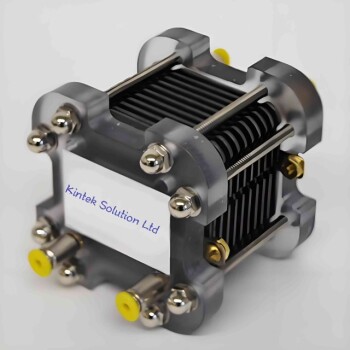
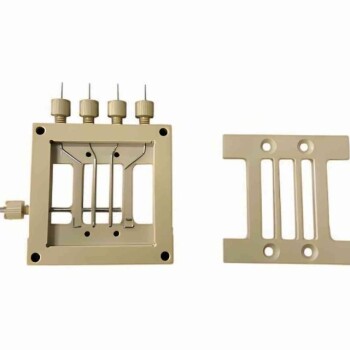
Flow electrolytic cells significantly outperform traditional H-type cells by actively circulating electrolytes and utilizing a compact, thin-film architecture to minimize resistance. These engineering improvements solve critical mass transfer limitations and reduce Ohmic losses, enabling the system to operate stably at the high current densities required for industrial Carbon Dioxide (CO2) reduction.
The Core Advantage Traditional static cells struggle with resistance and efficiency at scale. Flow electrolytic cells solve this by physically narrowing the gap between electrodes and keeping the electrolyte in motion, ensuring the high-speed, stable reactions necessary for commercial applications.
Overcoming Mass Transfer Limitations
The Problem with Stagnation
In static electrolysis, the depletion of reactants near the electrode surface leads to a phenomenon known as concentration polarization. This stifles the reaction rate and limits efficiency.
Active Electrolyte Circulation
Flow cells introduce a dynamic environment by continuously circulating the electrolyte solution. This constant movement refreshes the reactants at the electrode surface.
Enhanced Mass Transfer
By preventing stagnation, flow cells significantly enhance mass transfer. This ensures that CO2 is consistently available for reduction, preventing the performance drops common in static systems.
improving Electrical Efficiency
Compact Reactor Design
Unlike bulky H-type cells, flow cells utilize a highly compact reactor design. This geometry is intentional, specifically engineered to optimize the physical relationship between internal components.
Thin-Film Electrodes
These systems typically employ thin-film electrodes. The use of these specialized electrodes allows for a much tighter configuration within the cell.
Reducing Electrode Spacing
The combination of compact design and thin-film electrodes significantly shortens the distance between electrodes. Reducing this gap is the single most effective way to lower the electrical resistance of the solution.
Minimizing Ohmic Losses
By shortening the current's path through the electrolyte, flow cells minimize Ohmic losses (energy lost as heat due to solution resistance). This allows more energy to drive the chemical reaction rather than being wasted.
Enabling Industrial Scalability
High Current Densities
Because of the improved mass transfer and reduced resistance, flow cells can handle higher current densities. This is a prerequisite for industrial operations where output speed is critical.
Operational Stability
The architecture allows the Carbon Dioxide reduction reaction to operate stably even under these intense electrical loads. Stability is essential for continuous manufacturing processes that cannot afford frequent fluctuations or downtime.
Understanding the Operational Shift
The Move from Static to Dynamic
Transitioning to flow cells implies a move away from simple, static setups. You are introducing active circulation systems to manage the electrolyte, rather than relying on passive diffusion.
Precision Requirements
The benefits of flow cells rely heavily on the compactness and thin-film nature of the components. Achieving the noted reduction in Ohmic losses requires precise engineering to maintain the shortened distance between electrodes without causing shorts.
Making the Right Choice for Your Goal
- If your primary focus is Industrial Application: You must adopt flow cells to achieve the high current densities and stability required for viable production rates.
- If your primary focus is Energy Efficiency: Flow cells are the superior choice because they minimize Ohmic losses by drastically reducing the distance between electrodes.
Flow cells transform CO2 electrolysis from a theoretical possibility into a scalable, high-performance reality.
Summary Table:
| Feature | Traditional H-Type Cell | Flow Electrolytic Cell |
|---|---|---|
| Electrolyte State | Static / Passive Diffusion | Active Continuous Circulation |
| Mass Transfer | Limited by Concentration Polarization | Enhanced via Constant Refreshment |
| Electrode Spacing | Wide Gap (High Resistance) | Compact Thin-Film (Short Distance) |
| Electrical Efficiency | High Ohmic Losses | Minimized Ohmic Losses |
| Current Density | Low (Laboratory Scale) | High (Industrial Scale) |
| Operational Stability | Fluctuating at High Loads | Stable for Continuous Production |
Revolutionize Your CO2 Reduction Research with KINTEK
Transitioning from lab-scale experiments to industrial-grade performance requires precision-engineered hardware. KINTEK specializes in advanced electrolytic cells and electrodes designed to maximize mass transfer and minimize electrical resistance. Whether you are optimizing Carbon Dioxide (CO2) electrolysis or developing next-generation battery technologies, our portfolio—including high-performance flow cells, high-temperature high-pressure reactors, and precision crushing and milling systems—provides the reliability your research demands.
Ready to scale your production and achieve superior energy efficiency? Contact our laboratory equipment experts today to find the perfect solution for your specific application.
References
- Clara Casado‐Coterillo, Ángel Irabien. An Analysis of Research on Membrane-Coated Electrodes in the 2001–2019 Period: Potential Application to CO2 Capture and Utilization. DOI: 10.3390/catal10111226
This article is also based on technical information from Kintek Solution Knowledge Base .
Related Products
- Electrolytic Electrochemical Cell Gas Diffusion Liquid Flow Reaction Cell
- Customizable CO2 Reduction Flow Cell for NRR ORR and CO2RR Research
- Double-Layer Water Bath Electrolytic Electrochemical Cell
- Double Layer Five-Port Water Bath Electrolytic Electrochemical Cell
- Optical Water Bath Electrolytic Electrochemical Cell
People Also Ask
- How does the design of an electrochemical electrolytic cell influence the coating uniformity? Optimize Your Catalysts
- What is the correct shutdown and disassembly procedure after an experiment? Ensure Safety and Protect Your Equipment
- Why are electrolytic cells essential in titanium production? Powering Circular Efficiency and Cost Savings
- What is galvanic cell or electrolytic cell? Unlock the Secrets of Electrochemical Power
- What are the three essential components that comprise an electrolytic cell? Key Elements of Chemical Synthesis