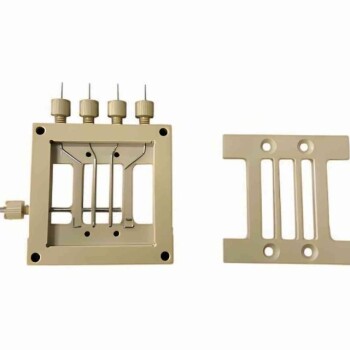
A customized visualization test cell is defined by its integration of transparent optical windows, typically crafted from quartz or sapphire, which permit light to penetrate the device structure. To simulate realistic operating conditions, these cells incorporate a specialized pressure-applying mechanism that maintains component contact without obstructing the view. This specific configuration directs light to the interface between the current collector and the electrolyte, enabling real-time observation of internal electrochemical reactions.
The core value of this design lies in its ability to simultaneously maintain electrochemical bias and optical transparency. It transforms the battery from a "black box" into an observable system, allowing researchers to correlate specific visual phenomena—like dendrite formation—directly with performance data.
The Optical Architecture
Material Selection for Clarity
The primary feature of these test cells is the use of high-quality transparent optical windows.
Designers typically utilize materials such as quartz or sapphire. These are chosen not just for transparency, but for their ability to withstand the chemical and mechanical environment of the cell.
Targeting the Critical Interface
The geometry of the cell is engineered to ensure light reaches a specific target: the interface between the current collector and the electrolyte.
This is the region where the most critical failure modes occur. The design ensures that the optical path is unobstructed, allowing microscopes to focus precisely on this boundary layer.
Mechanical Integration
The Pressure-Applying Mechanism
Solid-state batteries require significant stack pressure to function, which poses a challenge for optical cells.
A customized visualization cell solves this by integrating a pressure-applying mechanism. This component applies the necessary force to maintain ionic conductivity while accommodating the fragile optical windows.
Enabling Real-Time Conditions
The design is robust enough to operate while the battery is under electrochemical bias.
This means the cell is not merely a static viewing chamber; it is a functioning reactor. It allows for operando analysis, capturing dynamic changes as current flows through the system.
Capabilities Enabled by Design
Observing Lithium Nucleation
Because of the optical clarity provided by the quartz or sapphire windows, researchers can directly observe lithium metal nucleation.
This allows for the early detection of where lithium deposits begin to form before they become problematic.
Tracking Dendrite Growth
The design provides a continuous view of dendrite growth trajectories.
By visualizing how these metallic filaments propagate through the electrolyte, researchers can better understand the mechanics of short circuits.
Monitoring SEI Evolution
The high-resolution access allows for the study of the Solid Electrolyte Interphase (SEI).
Users can track the morphological evolution of this layer in real-time, observing how it degrades or stabilizes over repeated cycles.
Understanding the Trade-offs
Balancing Pressure and Visibility
A common challenge in these designs is the conflict between mechanical pressure and the optical aperture.
High pressure is needed for solid-state performance, but the mechanism must not crack the quartz or sapphire window or block the field of view.
Material Limitations
While quartz and sapphire are excellent for optics, they are brittle and expensive.
Designing a cell with these materials requires careful handling protocols to prevent fracture during the assembly or pressurization phases.
Making the Right Choice for Your Research
To maximize the utility of a customized visualization test cell, you must align the design features with your specific research objectives.
- If your primary focus is observing early-stage failure: Prioritize high-quality quartz or sapphire windows to ensure maximum optical resolution for detecting microscopic nucleation events.
- If your primary focus is realistic performance simulation: Ensure the pressure-applying mechanism is robust enough to mimic commercial stack pressures while maintaining the optical path.
By selecting the right configuration, you bridge the gap between theoretical models and observable reality.
Summary Table:
| Feature | Description | Key Research Benefit |
|---|---|---|
| Optical Windows | Quartz or sapphire materials | High-resolution real-time imaging of nucleation |
| Pressure Mechanism | Specialized force-application system | Maintains ionic conductivity under stack pressure |
| Interface Targeting | Optimized geometry for critical layers | Direct observation of dendrite growth and SEI |
| Electrochemical Bias | Functional reactor design | Correlates visual phenomena with electrical data |
| Material Resilience | Chemical & mechanical durability | Withstands harsh operando battery environments |
Elevate Your Battery Research with KINTEK
Ready to transform your solid-state battery analysis from a 'black box' to a clear, observable system? KINTEK specializes in precision laboratory equipment, providing high-performance electrolytic cells, electrodes, and battery research tools designed to meet the rigorous demands of operando microscopy.
Whether you need robust pressure-applying mechanisms or high-purity ceramics and crucibles for material synthesis, our comprehensive portfolio—including high-temperature furnaces and vacuum systems—is engineered for excellence.
Empower your lab with the tools for discovery. Contact us today to find the perfect visualization solution for your research!
Related Products
- Customizable Swagelok Type Test Cells for Advanced Battery Research Electrochemical Analysis
- Custom Ion Conductivity Test Fixtures for Fuel Cell Research
- Cylindrical Battery Steel Case for Battery Lab
- Electrolytic Electrochemical Cell for Coating Evaluation
- Battery Lab Equipment 304 Stainless Steel Strip Foil 20um Thick for Battery Test
People Also Ask
- How does a standardized electrochemical test cell assist in MOx/CNTf electrode screening? Optimize Material Ratios
- Why is a dedicated electrochemical test cell necessary for carbon steel? Ensure Precise Geothermal Corrosion Data
- What is the difference between a voltaic cell and an electrochemical cell? Understand the Two Types of Energy Conversion
- How do the electrochemical cell and three-electrode testing system collaborate? Optimize Zinc Anode Deposition Control
- Why must the electrochemical cell be continuously purged with nitrogen? Ensure Precision in Ni-Cr Corrosion Tests