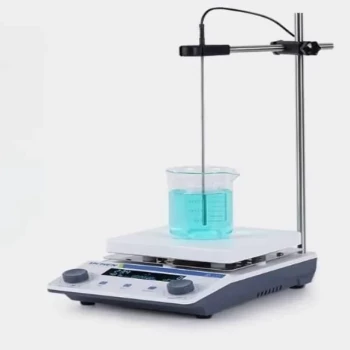
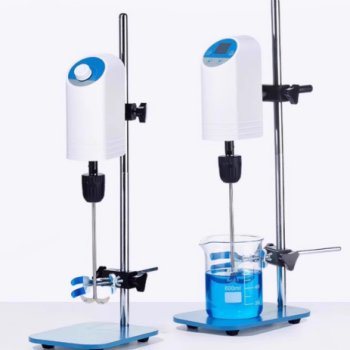
The specific configuration of a laboratory reaction vessel equipped with a precision heating mantle and mechanical stirrer serves to strictly control the thermodynamic and kinetic environment during silver nanowire synthesis. The heating mantle maintains the exact temperature required to regulate the reduction rate of silver ions, while the mechanical stirrer ensures the homogeneity necessary for uniform crystal growth within the solvent.
Success in silver nanowire synthesis relies on stabilizing the reaction environment against fluctuations. The heating mantle governs the speed of chemical reduction, while the mechanical stirrer ensures physical uniformity, directly dictating the final dimensions and consistency of the nanowires.
The Role of Thermal Precision
Controlling Reduction Kinetics
The primary function of the precision heating mantle is to maintain the reaction liquid at a strictly controlled set point, such as 170 °C, throughout the entire synthesis cycle.
This thermal stability is not merely about reaching a boiling point; it is critical for controlling the reduction kinetics of silver ions.
By locking in the temperature, you ensure that the rate at which silver ions reduce to metallic silver remains constant, preventing erratic nucleation rates.
The Role of Mechanical Agitation
Facilitating Mass Transfer
The mechanical stirrer operates within the ethylene glycol solvent to generally facilitate uniform mixing.
This physical agitation ensures efficient mass transfer of reactants throughout the vessel.
Without this consistent movement, concentration gradients could form, leading to localized areas where the reaction proceeds faster or slower than intended.
Guiding Crystal Growth
Beyond simple mixing, the mechanical stirrer promotes the growth of nanowires along specific crystal planes.
This controlled growth mechanism is the defining factor in determining the geometry of the final product.
By maintaining a uniform suspension, the stirrer ensures the resulting nanowires possess a uniform length and diameter, avoiding a batch of mixed shapes and sizes.
Critical Process Variables and Risks
The Impact of Thermal Drift
If the heating mantle lacks precision, temperature fluctuations will occur.
Even minor deviations from the target temperature (e.g., 170 °C) alter the reaction kinetics, potentially causing the silver to form into nanoparticles rather than wires.
Consequences of Poor Mixing
If the mechanical stirring is inadequate or inconsistent, the mass transfer of reactants becomes uneven.
This lack of homogeneity disrupts the growth along specific crystal planes.
The result is often a product with significant variations in wire diameter and length, rendering the batch less useful for precision applications.
Optimizing the Synthesis Environment
To achieve high-quality silver nanowires, you must view the heating and stirring systems as interconnected variables rather than separate tools.
- If your primary focus is Reaction Purity: Prioritize the calibration of the precision heating mantle to ensure the reduction kinetics of silver ions never deviate.
- If your primary focus is Geometric Uniformity: Ensure the mechanical stirrer is set to a speed that maximizes mass transfer in ethylene glycol without disrupting the growth along specific crystal planes.
By rigorously controlling both temperature stability and fluid dynamics, you ensure the reproducible synthesis of uniform silver nanowires.
Summary Table:
| Component | Key Function | Impact on Synthesis |
|---|---|---|
| Precision Heating Mantle | Controls reduction kinetics | Prevents erratic nucleation; ensures stable silver ion reduction. |
| Mechanical Stirrer | Facilitates mass transfer | Eliminates concentration gradients; ensures chemical homogeneity. |
| Ethylene Glycol Solvent | Provides reaction medium | Supports high-temperature stability and uniform mixing. |
| Crystal Growth Guidance | Directs growth planes | Determines final nanowire geometry, uniform length, and diameter. |
Elevate Your Material Synthesis with KINTEK Precision Solutions
Achieving the perfect silver nanowire geometry requires more than just a reaction; it requires absolute environmental stability. KINTEK specializes in high-performance laboratory equipment designed for the most demanding research applications. From high-temperature reaction vessels and autoclaves to precision heating mantles and advanced mechanical stirrers, we provide the tools necessary to lock in your reaction kinetics.
Whether you are focusing on battery research, conductive materials, or high-pressure synthesis, our portfolio of crushing systems, hydraulic presses, and specialized consumables (PTFE/Ceramics) ensures your lab operates with unmatched accuracy.
Ready to optimize your synthesis workflow? Contact KINTEK today to discover how our high-precision systems can deliver the uniform results your research demands.
References
- Alicja Nejman, Małgorzata Cieślak. Silver Nanowires and Silanes in Hybrid Functionalization of Aramid Fabrics. DOI: 10.3390/molecules27061952
This article is also based on technical information from Kintek Solution Knowledge Base .
Related Products
- Laboratory Small Constant Temperature Heated Magnetic Stirrer Heater and Stirrer
- Stainless High Pressure Autoclave Reactor Laboratory Pressure Reactor
- Customizable High Pressure Reactors for Advanced Scientific and Industrial Applications
- High Performance Laboratory Stirrers for Diverse Applications
- High Temperature Constant Temperature Heating Circulator Water Bath Chiller Circulator for Reaction Bath
People Also Ask
- What role does a magnetic stirrer with heating play in ZnO nanoparticle synthesis? Precision Control for Quality Results
- What role does a constant temperature heating magnetic stirrer play in MFC-HAp synthesis? Achieve Material Homogeneity
- What is the function of a laboratory magnetic stirrer in Ni–Cr–P electrodeposition? Optimize Ion Transport & Coating
- Why is a laboratory magnetic stirrer required for benzoic acid esters? Boost Reaction Speed & Yield with High RPM
- What role does a laboratory magnetic stirrer play in TiO2 and TiO2-Ag sol preparation? Master Chemical Kinetics