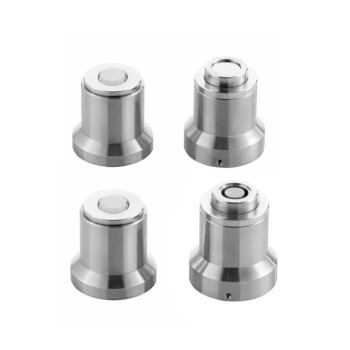
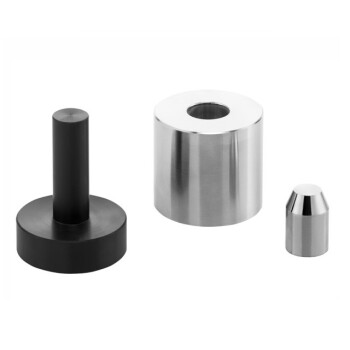
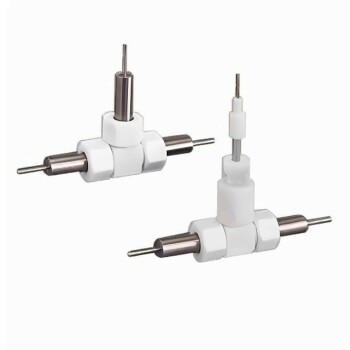
PEEK molds and titanium rods function as the structural and electrical backbone for assembling and testing all-solid-state lithium batteries. PEEK serves as the electrically insulating and chemically inert housing body, while titanium rods act as dual-purpose plungers that compress the active materials and conduct the electrical current.
Core Takeaway The assembly of solid-state batteries presents a conflict: materials must be compressed under immense pressure to conduct ions, yet they are often chemically aggressive and prone to shorting. The PEEK-Titanium combination solves this by using PEEK to isolate and shield the reaction, allowing titanium rods to safely apply the necessary physical force and extract electricity.
The Role of PEEK Molds (The Housing)
Chemical Inertness Against Aggressive Electrolytes
The primary function of the PEEK mold is to serve as a chemically stable container. Solid-state electrolytes, particularly sulfides, are highly reactive and can corrode standard container materials.
PEEK (polyetheretherketone) is chemically inert in this environment. It prevents undesirable side reactions between the mold walls and the active battery sample, ensuring that test results reflect the battery's performance, not environmental contamination.
Electrical Insulation
PEEK acts as a critical insulator between the positive and negative ends of the cell. In a solid-state setup, the entire assembly is under high pressure.
Without a robust insulating sleeve, the conductive plungers (titanium rods) could touch or arc, causing an internal short circuit. PEEK ensures the electrical current travels strictly through the battery stack, not around it.
Structural Integrity Under Load
These molds function as a die for powder compression. To form a solid-state battery, powders must be pressed at values ranging from 200 to 450 MPa.
PEEK possesses high mechanical strength, allowing it to withstand these forming pressures without fracturing or significantly deforming. This maintains the precise geometric shape of the battery pellet during assembly.
The Role of Titanium Rods (The Interface)
Acting as Mechanical Plungers
Titanium rods function as pistons that transmit external pressure to the internal battery layers. Solid-state batteries rely on tight physical contact between solid particles to transport ions.
By transmitting axial force, the rods ensure high-density contact at the electrode-electrolyte interface. This physical compression is vital to lower interfacial impedance and prevent the solid layers from delaminating.
Functioning as Current Collectors
Beyond mechanics, the titanium rods serve as the electrical terminals of the battery. They are in direct contact with the electrode materials.
Because titanium is conductive, it allows for the measurement of the cell’s performance (such as during Electrochemical Impedance Spectroscopy). It bridges the gap between the sealed internal chemistry and the external testing equipment.
Understanding the Trade-offs
Managing Volume Changes
While PEEK and titanium provide a robust static setup, they do not inherently compensate for dynamic changes. During charging and discharging, lithium metal can expand and contract (deposition and stripping).
If the titanium rods are held at a fixed position, the internal pressure will fluctuate, potentially leading to contact failure. Therefore, these components are often used in conjunction with external spring-loaded clamps or hydraulic presses to maintain constant stack pressure (typically 1.5 MPa to over 10 MPa) throughout the cycle.
Pressure Limitations of Polymers
Although PEEK is strong, it is still a polymer. At the extreme upper limits of pressure required for some densification processes (like Spark Plasma Sintering mentioned in supplementary data), harder materials like high-purity graphite may be required instead of PEEK to handle the combination of extreme heat and pressure.
Making the Right Choice for Your Goal
When designing your assembly fixture, the choice of materials dictates the success of your data collection.
- If your primary focus is testing sulfide-based electrolytes: Rely on PEEK molds specifically for their chemical inertness to prevent corrosion that would ruin the sample.
- If your primary focus is minimizing interfacial resistance: Ensure your titanium rods are coupled with a constant-pressure mechanism to compensate for volume expansion during cycling.
- If your primary focus is high-pressure powder densification: Verify that the wall thickness of your PEEK mold is rated for pressures exceeding 200 MPa to prevent radial deformation.
Success in solid-state battery testing relies not just on the chemistry, but on maintaining unyielding physical contact while strictly isolating electrical pathways.
Summary Table:
| Component | Primary Function | Material Advantage |
|---|---|---|
| PEEK Mold | Chemical/Electrical Housing | Chemically inert to sulfides; prevents internal short circuits. |
| Titanium Rods | Dual-Purpose Plungers | High electrical conductivity; transmits high axial force (200-450 MPa). |
| The Assembly | Sample Containment | Maintains structural integrity and high-density interface contact. |
Precision Battery Assembly Starts with KINTEK
Maximize your research accuracy with KINTEK’s specialized testing tools. Whether you are working with sulfide-based electrolytes or high-pressure powder densification, our battery research tools and consumables—including high-strength PEEK molds and conductive titanium plungers—ensure stable interfaces and reliable data.
From high-temperature furnaces and vacuum systems to specialized hydraulic presses and pellet dies, KINTEK provides the comprehensive laboratory equipment needed to push the boundaries of solid-state technology.
Ready to optimize your battery testing workflow? Contact us today to find the perfect solution for your lab.
Related Products
- Button Battery Disassembly and Sealing Mold for Lab Use
- Assemble Square Lab Press Mold for Laboratory Applications
- Battery Lab Equipment 304 Stainless Steel Strip Foil 20um Thick for Battery Test
- Button Battery Tablet Press Sealing Mold for Lab Use
- Polyethylene Separator for Lithium Battery
People Also Ask
- What role do battery test molds or coin cell cases play? Optimize Your All-Solid-State Battery Assembly Today
- What are the parts of a mold assembly? A Guide to Injection Mold Components
- What is a molding tool used for? A Guide to Mass Production Efficiency
- What is a mold assembly? The Critical Final Step to a Functional Injection Mold
- What advantages do standardized laboratory compression-cell molds provide for c-LLZO? Optimize Battery Data Accuracy