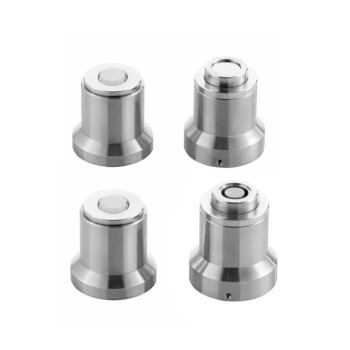
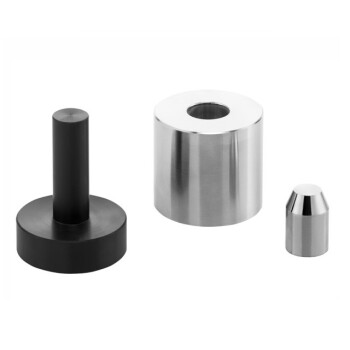
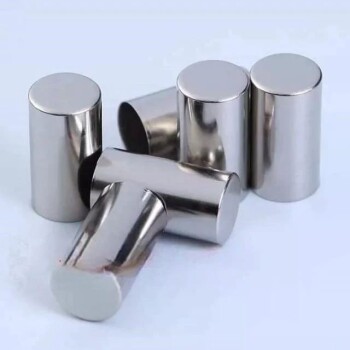
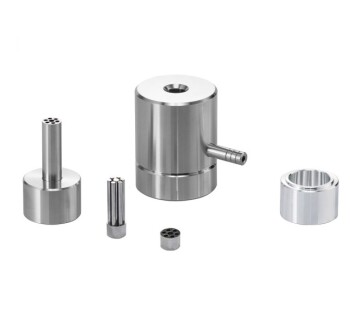
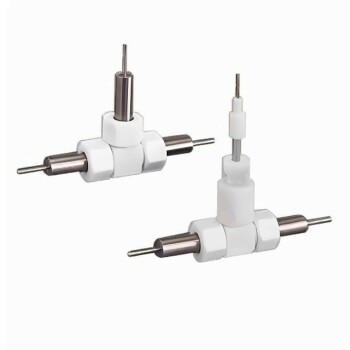
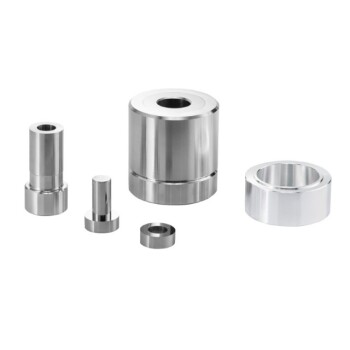
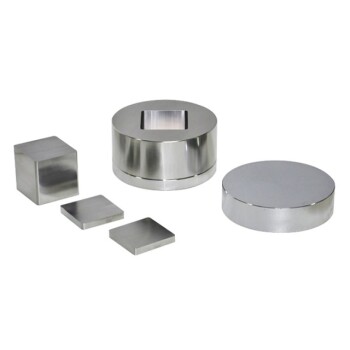
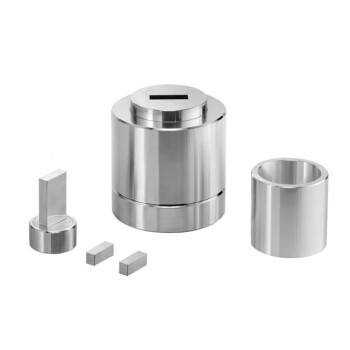
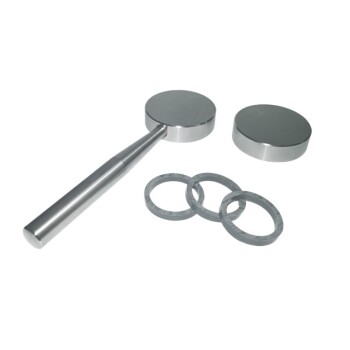
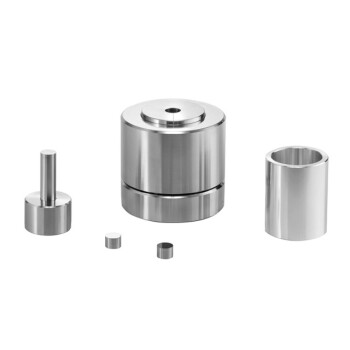
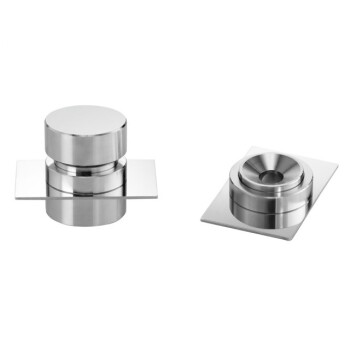
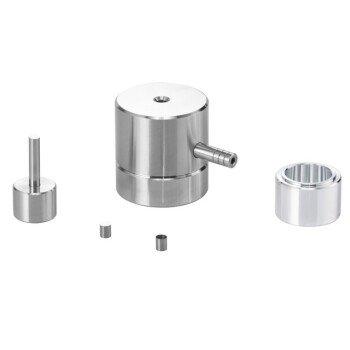
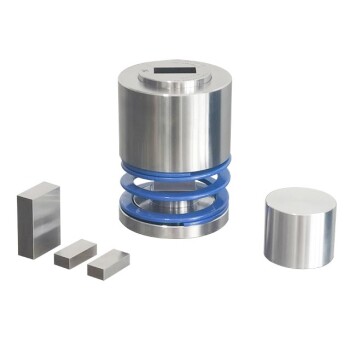
Stainless steel battery test molds serve as dynamic, multifunctional components rather than passive containers.
In the characterization of all-solid-state batteries, these molds primarily act as current collectors and encapsulation shells that isolate sensitive materials from moisture and oxygen. Furthermore, they provide the essential mechanical structure required to maintain constant stack pressure, ensuring that solid components remain in physical contact despite the volume changes that occur during charging and discharging.
Core Insight: The stainless steel mold is an active mechanical constraint system. In solid-state batteries, the mold substitutes for the "wetting" action of liquid electrolytes by applying massive external pressure to force solid particles into contact, making it the defining factor for interfacial stability during testing.
The Critical Role of Mechanical Pressure
Ensuring Interface Connectivity
Unlike liquid electrolytes, solid electrolytes cannot flow to fill gaps. Solid-solid contact is the single most critical factor in performance.
Stainless steel molds are designed to withstand and maintain high external pressures (often exceeding 300 MPa). This pressure forces the electrode and electrolyte layers together, preventing high impedance caused by physical separation.
Counteracting Volume Expansion
Active materials in solid-state batteries, such as silicon or sodium sulfide, undergo significant volume changes during cycling.
Without the rigid constraint of the stainless steel mold, this expansion and contraction would cause the layers to delaminate. The mold acts as a clamp, maintaining stack pressure to prevent electrical contact failure when the battery "breathes."
Densification and Conductivity
The hydraulic pressure applied via these molds eliminates microscopic pores between electrolyte particles.
This densification reduces grain boundary resistance. By minimizing these voids, the mold directly improves the ionic conductivity of the cell, allowing for accurate measurement of the material's true potential.
Electrical and Environmental Functions
Acting as Current Collectors
The stainless steel components (often cylinders or plungers) within the mold serve as the primary electrical pathway.
They transfer electricity directly to and from the active materials. Because stainless steel is conductive, it eliminates the need for additional wiring inside the pressurized area, simplifying the test setup.
Environmental Isolation
Solid-state electrolytes, particularly sulfides, are highly sensitive to air and moisture.
The stainless steel shell provides a robust hermetic seal. This encapsulation protects the battery chemistry from degradation caused by oxygen or humidity, ensuring that test results reflect the battery's chemistry rather than environmental contamination.
Understanding the Trade-offs
The "Ideal Scenario" Bias
Stainless steel molds often apply pressures (e.g., 360–400 MPa) that are difficult to replicate in commercial battery packs.
While this maximizes performance in a lab setting, it can create a gap between research results and real-world application. Data derived from these molds represents the "best case" scenario under rigid confinement.
Material Compatibility Risks
While stainless steel is generally stable, it is not perfectly inert.
In certain voltage ranges or with specific chemistries, there is a risk of side reactions between the steel and the active materials. This is why some setups utilize composite designs with inert materials like PEEK to insulate the steel from specific reaction zones.
Making the Right Choice for Your Goal
The use of stainless steel molds dictates how you interpret your data.
- If your primary focus is Fundamental Material Science: Rely on the high-pressure capabilities of the mold to maximize ionic conductivity and eliminate contact resistance, isolating the intrinsic properties of your material.
- If your primary focus is Commercial Viability: Recognize that the rigid constraint and high pressure of the mold may mask mechanical failures that would occur in flexible pouch cells or lower-pressure commercial packs.
Ultimately, the stainless steel mold is a tool for enforcing the physical conditions necessary for solid-state ion transport, acting as the mechanical backbone of your electrochemical test.
Summary Table:
| Key Role | Primary Function | Impact on Performance |
|---|---|---|
| Mechanical Constraint | Applies constant stack pressure (up to 400 MPa) | Ensures solid-solid contact and reduces interface impedance. |
| Current Collection | Functions as an electrical pathway | Simplifies test setup by eliminating internal wiring. |
| Densification | Eliminates microscopic pores and voids | Maximizes ionic conductivity by reducing grain boundary resistance. |
| Environmental Seal | Isolates materials from moisture/oxygen | Prevents chemical degradation of sensitive solid electrolytes. |
| Structural Support | Counteracts volume expansion/contraction | Prevents delamination during charging and discharging cycles. |
Elevate Your Solid-State Research with KINTEK Precision
Precise mechanical control is the difference between a failed test and a breakthrough. KINTEK specializes in high-performance laboratory equipment, providing the robust battery research tools, stainless steel test molds, and hydraulic presses (pellet, hot, and isostatic) required to achieve the extreme pressures necessary for all-solid-state battery characterization.
From high-temperature furnaces for material synthesis to specialized PTFE products and ceramics for chemical stability, our comprehensive portfolio supports the entire lifecycle of battery development.
Ready to optimize your interfacial stability and ionic conductivity?
Contact KINTEK Experts Today — Let us provide the mechanical backbone for your next electrochemical innovation.
Related Products
- Battery Lab Equipment 304 Stainless Steel Strip Foil 20um Thick for Battery Test
- Button Battery Disassembly and Sealing Mold for Lab Use
- Button Battery Tablet Press Sealing Mold for Lab Use
- Cylindrical Battery Steel Case for Battery Lab
- Special Shape Press Mold for Lab
People Also Ask
- How is a galvanostat used to evaluate F-rGO layers? Quantifying Protective Performance in Lithium Metal Batteries
- What is the sputtering cathode method? A Guide to Thin Film Deposition Technology
- What is sputtering target material? The Blueprint for High-Quality Thin Film Coatings
- What is organic thin film? A Guide to Engineered Molecular Layers for Advanced Tech
- What are the target materials for sputtering? From Metals to Ceramics for Precise Thin Films