The primary advantage of a standard three-electrode system is its ability to rigorously isolate the kinetic behavior of the working electrode from the rest of the cell's variables. By decoupling the current-carrying circuit from the potential-measuring circuit, this configuration ensures that your data reflects only the electrocatalytic properties of your material, free from distortions caused by cell resistance or polarization.
By employing independent working, reference, and auxiliary electrodes, this system eliminates interference from voltage drops and external polarization. It guarantees that the measured current-voltage curves provide a true and accurate baseline for analyzing ethanol oxidation kinetics.
The Architecture of Accuracy
To understand why this system is superior for kinetic studies, you must look at how it assigns specific roles to three independent components.
The Role of the Reference Electrode
In a two-electrode system, the counter electrode must act as both a current carrier and a potential reference, which leads to instability.
In a three-electrode setup, the reference electrode is isolated from significant current flow. Its sole purpose is to provide a stable baseline potential. This ensures that the potential you apply to the working electrode is measured against a constant, unchanging standard.
The Role of the Auxiliary (Counter) Electrode
The auxiliary electrode handles the heavy lifting of current conduction. It completes the circuit with the working electrode, allowing the necessary electrochemical reactions to occur.
Because the auxiliary electrode handles the current, the reference electrode remains unpolarized. This separation is critical for maintaining the integrity of the potential measurement during high-current experiments like ethanol oxidation.
Eliminating Measurement Interference
The deeper need in kinetic studies is eliminating variables that skew data. The three-electrode system addresses the physical limitations of the electrolytic cell itself.
Decoupling the Circuits
This system effectively creates two distinct circuits: one for measuring potential and one for carrying current.
This separation prevents the polarization phenomena occurring at the counter electrode from influencing the voltage reading at the working electrode.
Mitigating Voltage Drop (iR Drop)
One of the most significant sources of error in electrochemical measurements is the voltage drop caused by the resistance of the electrolyte, known as the iR drop.
By separating the circuits, the three-electrode system eliminates the interference caused by this resistance. This ensures the measured activity is derived solely from the catalyst (e.g., tantalum-based nanomaterials) and not the conductivity of the solution.
Common Pitfalls to Avoid
While the three-electrode system offers superior accuracy, it introduces specific requirements for material selection to maintain that precision.
Contamination from the Counter Electrode
If the auxiliary electrode degrades, it can introduce metal impurities into the electrolyte. These impurities may deposit onto the working electrode, altering its catalytic activity and invalidating your kinetic data.
To prevent this, it is standard practice to use a high-purity graphite rod as the auxiliary electrode. Graphite provides a stable current circuit and remains inert in strong acid or alkaline environments, ensuring the observed kinetics belong exclusively to your composite coating.
Making the Right Choice for Your Goal
When designing your experiment, consider how the configuration impacts your specific data requirements.
- If your primary focus is accurate potential mapping: Rely on the three-electrode system to provide a stable baseline that is unaffected by the current magnitude.
- If your primary focus is material purity: Ensure you select an inert auxiliary electrode (like graphite) to prevent cross-contamination that could mimic or mask catalytic activity.
The three-electrode system is not just a setup choice; it is a fundamental requirement for isolating true electrocatalytic performance from experimental noise.
Summary Table:
| Feature | Advantage in Kinetic Studies |
|---|---|
| Reference Electrode | Provides a stable, unpolarized potential baseline |
| Auxiliary Electrode | Handles current load to prevent reference electrode drift |
| Dual-Circuit Design | Decouples potential measurement from current conduction |
| iR Drop Mitigation | Minimizes errors caused by electrolyte resistance |
| Material Integrity | Prevents counter-electrode contamination when using inert materials |
Precision Tools for Accurate Electrochemistry
Unlock the full potential of your kinetic studies with KINTEK. As specialists in advanced laboratory equipment, we provide the high-performance electrolytic cells and electrodes necessary for rigorous ethanol oxidation research. Our precision-engineered solutions ensure that your data reflects true catalytic activity by eliminating experimental interference.
From high-purity graphite auxiliary electrodes to a comprehensive range of crushing, milling, and high-temperature furnace systems, KINTEK supports every stage of your material research. Whether you are developing tantalum-based catalysts or complex composite coatings, we deliver the reliability your lab demands.
Ready to elevate your research accuracy? Contact KINTEK today to find the perfect electrochemical setup for your application.
References
- В. Е. Проскурина, M Ved' B. Electrocatalytic oxidation of ethanol in an alkaline medium on composite coatings based on cobalt alloys. DOI: 10.32434/0321-4095-2020-131-4-106-114
This article is also based on technical information from Kintek Solution Knowledge Base .
Related Products
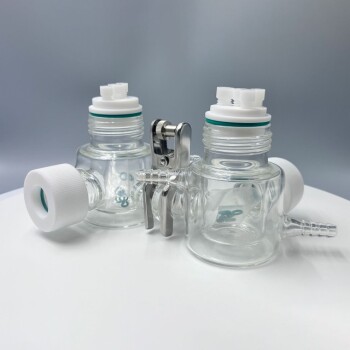
- H Type Electrolytic Cell Triple Electrochemical Cell
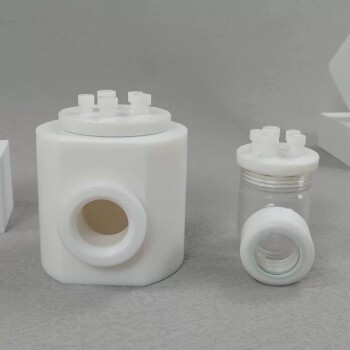
- PTFE Electrolytic Cell Electrochemical Cell Corrosion-Resistant Sealed and Non-Sealed
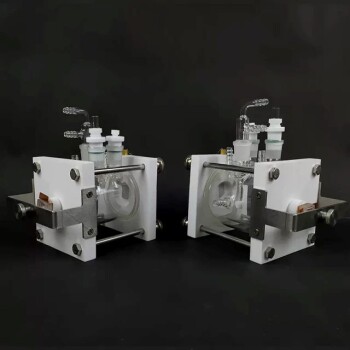
- Electrolytic Electrochemical Cell Gas Diffusion Liquid Flow Reaction Cell
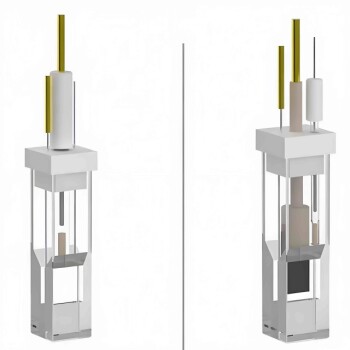
- Electrolytic Electrochemical Cell with Five-Port
- Customizable PEM Electrolysis Cells for Diverse Research Applications
People Also Ask
- What is a H type cell? A Guide to Divided Electrochemical Cells for Accurate Experiments
- How should the electrolyte be prepared and added to the H-type electrolytic cell? Best Practices for Purity and Safety
- What is the technical necessity of using an H-type electrolytic cell for NO3RR tests? Protect Your Ammonia Yields
- How does the design of an H-type electrolytic cell benefit the neutral water electrolysis process for metal recovery?
- What is the primary function of an H-type electrolytic cell in NitRR? Ensure Accurate Product Yields