Autoclave molding is the gold standard for manufacturing continuous fiber-reinforced composites when material performance cannot be compromised. The primary advantage of this process lies in its ability to provide a uniform high-temperature and high-pressure environment, which forces thermosetting matrices—such as high-performance epoxy resins—to fully impregnate the fiber reinforcement.
By precisely controlling pressure and temperature profiles, the autoclave process eliminates microscopic defects and maximizes fiber density. This results in composite materials with superior structural integrity, specifically engineered to meet the rigorous demands of extreme applications like aerospace.
Achieving Structural Integrity Through Environmental Control
Uniform High-Pressure Environment
The core mechanism of an autoclave is the application of consistent, high pressure. This pressure is essential for driving the resin matrix deep into the continuous fiber bundles.
It ensures that the thermosetting matrix fully impregnates the fibers. Without this high-pressure environment, the resin may not saturate the reinforcement completely, leading to dry spots and structural weaknesses.
Precision Thermal Management
Autoclaves allow for the precise control of temperature profiles during the cure cycle. This control is vital for the proper chemical cross-linking of high-performance epoxy resins.
Uniform heating ensures the material cures evenly throughout its thickness. This prevents internal stresses that could warp the part or degrade its mechanical properties.
Optimizing Material Composition
Elimination of Voids
One of the most critical advantages of autoclave molding is the effective removal of air bubbles. The combination of vacuum and external pressure squeezes trapped air out of the laminate before the resin solidifies.
Eliminating these voids is non-negotiable for high-performance parts. Even microscopic air pockets can act as stress concentrators, leading to premature failure under load.
High Fiber Volume Fractions
The process is capable of achieving high fiber volume fractions, typically exceeding 50 vol %. This metric represents the ratio of fiber to resin in the final part.
A higher fiber volume fraction is directly correlated with better performance. By minimizing excess resin and maximizing fiber content, the autoclave produces a lighter, stronger component.
Enhancing Mechanical Performance
Superior Stiffness and Strength
The consolidation achieved in an autoclave significantly enhances the Young’s modulus (stiffness) and overall strength of the composite.
These improvements allow the material to resist deformation under heavy loads. This makes the process ideal for structural components that define the safety and performance of a vehicle or aircraft.
Improved Wear Resistance
The resulting composites exhibit enhanced wear resistance. This is a direct result of the dense, well-consolidated microstructure achieved during molding.
Parts produced this way are better equipped to withstand abrasive environments and long-term operational stress.
Critical Considerations and Trade-offs
The Requirement for Precision
While the results are superior, they rely heavily on the ability to precisely control pressure and temperature profiles.
This is not a "set it and forget it" method. Achieving the cited benefits—such as >50% fiber volume and zero voids—requires rigorous process monitoring and specialized equipment, which distinguishes it from lower-cost, ambient pressure alternatives.
Making the Right Choice for Your Goal
To determine if autoclave molding is required for your specific project, evaluate your performance thresholds:
- If your primary focus is structural stiffness: The ability to achieve fiber volume fractions exceeding 50 vol % will provide the maximum possible Young's modulus.
- If your primary focus is reliability and safety: The effective elimination of air bubbles ensures the consistent structural integrity required for aerospace and similar extreme applications.
- If your primary focus is durability: The full impregnation of fibers ensures high wear resistance and long-term material stability.
For applications where structural failure is not an option, the controlled environment of an autoclave remains the only way to guarantee peak material performance.
Summary Table:
| Feature | Autoclave Molding Benefit | Impact on Material |
|---|---|---|
| Pressure Control | Uniform high-pressure application | Ensures full fiber impregnation and resin saturation |
| Void Content | Effective removal of air bubbles | Prevents stress concentration and premature failure |
| Fiber Density | High fiber volume fractions (>50%) | Maximizes Young's modulus, stiffness, and strength |
| Thermal Profile | Precision temperature management | Uniform curing and elimination of internal stresses |
| Durability | Dense, consolidated microstructure | Enhanced wear resistance and long-term stability |
Elevate your material science with KINTEK’s precision engineering. As specialists in high-performance laboratory equipment, we provide the high-temperature high-pressure reactors and autoclaves essential for achieving the gold standard in composite molding. Whether you are aiming for aerospace-grade structural integrity or maximizing fiber volume fractions, our expert solutions ensure zero-defect results. Contact KINTEK today to discover how our autoclaves and specialized lab tools can optimize your production and drive innovation in your research.
References
- Abdulaziz Kurdi, Li Chang. Recent Advances in High Performance Polymers—Tribological Aspects. DOI: 10.3390/lubricants7010002
This article is also based on technical information from Kintek Solution Knowledge Base .
Related Products
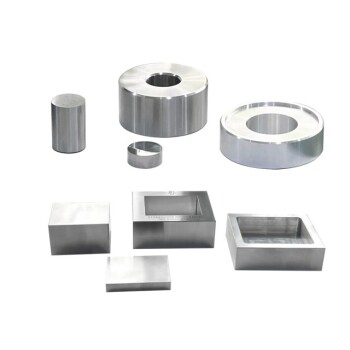
- Anti-Cracking Press Mold for Lab Use
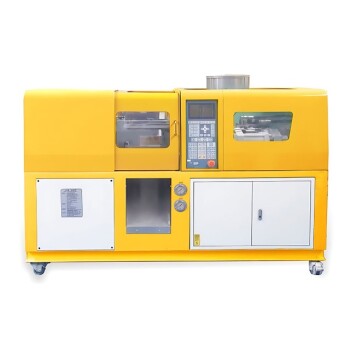
- Small Injection Molding Machine for Lab Use
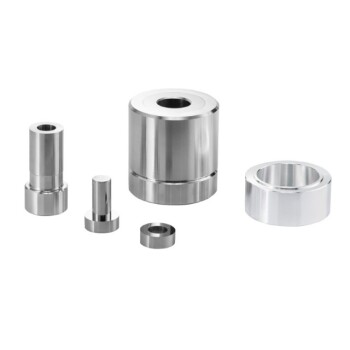
- Cylindrical Press Mold with Scale for Lab
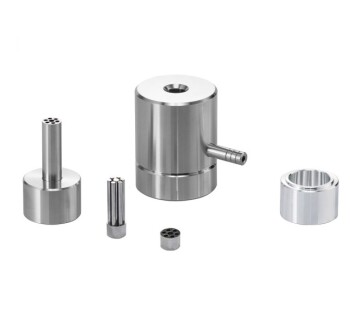
- Round Bidirectional Press Mold for Lab
- Special Heat Press Mold for Lab Use
People Also Ask
- What is the press mould method? A Guide to Consistent, Detailed Ceramic Forms
- How to use a press mold? Master the Art of Creating Consistent Ceramic Forms
- What is the function of press molds during the preparation of SiCf/Ti-43Al-9V composites? Achieve Structural Precision
- What is a press mold used for? Achieve Repeatable Precision and Efficiency
- What is the purpose of specialized pressure devices in sulfide solid-state batteries? Ensure Chemo-Mechanical Stability