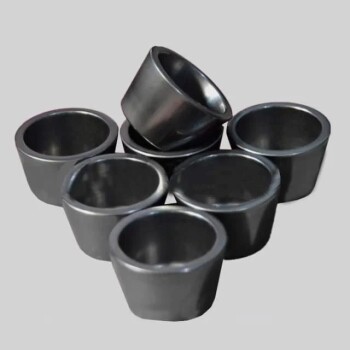
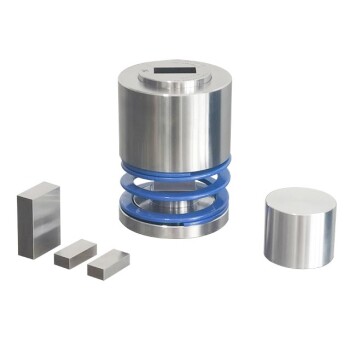
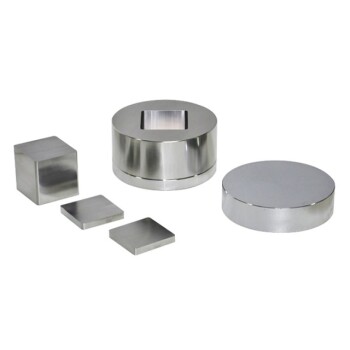
High-purity graphite molds function as both the precise containment vessel and the primary mechanical interface during the vacuum hot-pressing of Molybdenum-Sodium (Mo-Na) alloy targets. They are engineered to define the target's physical geometry while simultaneously transferring immense hydraulic force to the powder mixture under extreme thermal environments.
The critical value of these molds lies in their ability to maintain structural rigidity at 1600°C while exerting 45 MPa of pressure, enabling the loose powder mixture to achieve high-density plastic flow without mold deformation.
The Mechanics of Densification
Geometric Definition
The most immediate function of the graphite mold is to act as a precision container.
It confines the loose Molybdenum-Sodium powder mixture to a specific volume. This confinement defines the final diameter and shape of the alloy target, ensuring near-net-shape forming during the consolidation process.
Mechanical Pressure Transmission
Beyond simple containment, the mold serves as an active transmission medium for the furnace's hydraulic system.
It transfers external mechanical pressure effectively to the internal powder. In the specific context of Mo-Na alloys, the mold facilitates the densification process by delivering necessary force to induce particle rearrangement and diffusion.
Withstanding Extreme Process Conditions
High-Temperature Stability
The vacuum hot-pressing of Mo-Na alloys occurs at intense temperatures, specifically 1600°C.
The high-purity graphite mold must possess exceptional thermal stability. It retains its shape and material properties at these temperatures, preventing the container from softening or chemically reacting aggressively with the alloy.
Structural Strength Under Load
Simultaneous to high heat, the process involves high-pressure application.
The mold is subjected to pressures of 45 MPa. It is designed to withstand this significant stress without cracking or deforming, ensuring the pressure is applied uniaxially to the powder rather than dissipating through mold failure.
Thermal Management Roles
Homogenizing the Thermal Field
While the primary reference focuses on mechanics, high-purity graphite is also utilized for its thermal conductivity.
Drawing from general hot-pressing principles, the mold helps distribute heat evenly across the Mo-Na powder. This thermal field homogenization is critical for preventing uneven thermal stresses that could lead to cracking or inconsistent density within the target.
Critical Considerations and Trade-offs
Purity vs. Contamination
The "high-purity" designation of the graphite is not merely a label; it is a functional requirement.
Low-quality graphite can release impurities or outgas under vacuum, potentially contaminating the Mo-Na alloy. The mold must be pure enough to prevent carbon contamination or the introduction of foreign particles into the target matrix.
Mechanical Limitations
Despite their strength, graphite molds are brittle compared to metals.
While they handle compressive loads (like the 45 MPa required here) exceptionally well, they are susceptible to failure if subjected to shear stress or impact. Misalignment in the hydraulic press can lead to catastrophic mold fracture.
Ensuring Target Quality
To optimize the production of Mo-Na alloy targets, consider the following regarding mold selection and usage:
- If your primary focus is Geometric Precision: Ensure the mold design accounts for slight thermal expansion at 1600°C to maintain strict diameter tolerances.
- If your primary focus is Material Density: Verify that the mold wall thickness is sufficient to withstand the full 45 MPa load without lateral deformation.
- If your primary focus is Alloy Purity: Utilize only certified high-purity graphite grades to minimize the risk of carbon diffusion into the Molybdenum matrix.
The graphite mold is not just a passive container; it is the structural backbone that makes the high-temperature, high-pressure synthesis of Mo-Na targets physically possible.
Summary Table:
| Function | Description | Key Metric |
|---|---|---|
| Geometric Definition | Confines powder to specific volume for near-net-shape forming | Precise Shape/Diameter |
| Pressure Transmission | Transfers hydraulic force to induce particle rearrangement | Up to 45 MPa |
| Thermal Stability | Maintains structural rigidity without softening or reacting | Up to 1600°C |
| Purity Control | Prevents carbon contamination and outgassing in vacuum | High-Purity Grade |
| Thermal Homogenization | Distributes heat evenly to prevent internal cracking | Uniform Density |
Maximize Your Material Synthesis with KINTEK
Precision-engineered graphite molds are essential for high-performance Mo-Na targets. At KINTEK, we specialize in providing advanced laboratory equipment and consumables designed for the most demanding thermal processes.
Our extensive portfolio includes:
- High-Temperature Furnaces: Muffle, vacuum, and CVD systems for precise environment control.
- Hydraulic Presses: Pellet, hot, and isostatic presses for superior material densification.
- Advanced Consumables: High-purity ceramics, crucibles, and customized graphite solutions.
Whether you are conducting battery research or manufacturing high-pressure reactors, KINTEK offers the technical expertise and high-quality tools you need to succeed. Contact us today to optimize your lab's efficiency!
Related Products
- High Purity Pure Graphite Crucible for Evaporation
- Ultra-High Temperature Graphite Vacuum Graphitization Furnace
- Vertical High Temperature Graphite Vacuum Graphitization Furnace
- Molybdenum Vacuum Heat Treat Furnace
- Horizontal High Temperature Graphite Vacuum Graphitization Furnace
People Also Ask
- Why are high-purity graphite crucibles preferred for sulfide solid electrolytes? Achieve Superior Material Purity
- Why is a high-purity graphite crucible required for Chromel-TaC composites? Ensure Peak Purity at 1400°C
- What role do high-purity graphite crucibles play in molten salt corrosion research? Ensure Reactor-Grade Precision
- Why are high-purity graphite crucibles used for magnesium distillation? Ensure 3N8 Purity & Thermal Stability
- Why is a high-purity graphite crucible ideal for nitrogen-doped graphene at 1500 °C? Maximize Purity and Stability