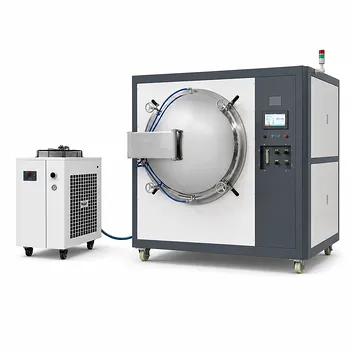
High-purity graphite molds act as the critical interface between the furnace environment and the composite material. In a vacuum hot pressing furnace, these molds serve as high-strength containers that precisely define the final geometry of the diamond composite while withstanding significant mechanical force. Simultaneously, their excellent thermal properties are essential for transferring heat evenly to the powder, ensuring the material achieves a uniform structure during the sintering process.
The effectiveness of the graphite mold lies in its ability to balance structural rigidity with thermal conductivity. It allows the system to apply sufficient pressure for densification without deforming, while simultaneously preventing thermal gradients that would lead to inconsistent material properties.
The Mechanics of Dimensional Precision
Defining Macroscopic Geometry
In the context of preparing diamond composite matrices, the graphite mold functions primarily as a distinct container. It dictates the final shape and dimensions of both the coating and the substrate.
Withstanding Axial Pressure
The process involves substantial mechanical force to achieve densification, often reaching axial pressures around 30 to 50 MPa. The graphite mold is selected for its superior high-temperature strength, allowing it to endure this compression without fracturing or losing its shape.
Compaction at High Temperatures
As the furnace heats the alloy powder, the mold constrains the material. This constraint ensures that when pressure is applied, the powder acts as a cohesive unit, becoming tightly compacted rather than spreading outward.
Thermal Dynamics and Microstructure
Ensuring Uniform Heat Transfer
Graphite possesses excellent thermal conductivity, which is vital in a vacuum environment where convection is absent. The mold acts as a thermal conduit, transferring heat from the furnace elements directly and evenly to the powder sample inside.
Preventing Microstructural Inconsistencies
If heat were applied unevenly, the matrix material would develop a varied microstructure, leading to weak points. The uniform heat distribution provided by the graphite mold ensures the consistency of the matrix material's microstructure throughout the entire volume of the composite.
Facilitating Metallurgical Bonding
The combination of uniform heat and constrained pressure facilitates strong bonding. By maintaining a stable thermal environment, the mold aids in the atomic diffusion and plastic flow required to create a robust metallurgical bond between the alloy powder and the substrate surface.
Understanding the Process Synergy
Interaction with Vacuum Systems
While the vacuum system is responsible for removing adsorbed gases (like water vapor and oxygen) to prevent pore formation, the mold ensures the material remains stable during this off-gassing. The mold allows the material to reach the necessary 850°C sintering temperature efficiently once the low-temperature gas removal phase (<400°C) is complete.
Supporting Densification
The ultimate goal of vacuum hot pressing is near-full densification of the silver matrix or composite. The graphite mold makes this possible by translating the applied axial pressure into effective compaction force, eliminating internal pores that would otherwise weaken the final product.
Optimizing Your Sintering Strategy
Making the Right Choice for Your Goal
- If your primary focus is Geometric Accuracy: Ensure your graphite molds are machined to high tolerances and possess sufficient wall thickness to resist deformation under 50 MPa of pressure.
- If your primary focus is Material Homogeneity: Prioritize high-purity graphite with verified thermal conductivity ratings to eliminate thermal gradients during the heating ramp.
Ultimately, the graphite mold is not just a passive container, but an active thermal and mechanical tool that dictates the structural integrity of your diamond composite.
Summary Table:
| Feature | Role in Vacuum Hot Pressing | Impact on Diamond Composites |
|---|---|---|
| Dimensional Control | Acts as a high-strength container | Ensures precise macroscopic geometry & shape |
| Mechanical Strength | Withstands 30-50 MPa axial pressure | Prevents deformation during high-temp compaction |
| Thermal Conductivity | Facilitates uniform heat transfer | Eliminates thermal gradients & inconsistent microstructures |
| Chemical Stability | Operates efficiently in vacuum/inert gas | Prevents contamination & supports metallurgical bonding |
Elevate Your Advanced Material Synthesis with KINTEK
Precision in sintering requires more than just heat—it demands the right tools. At KINTEK, we specialize in providing high-performance laboratory equipment tailored for the most demanding applications. Whether you are developing diamond composite matrices or advanced ceramics, our vacuum hot pressing systems, high-temperature furnaces, and precision-machined graphite consumables provide the thermal and mechanical stability your research deserves.
Our Expertise Includes:
- High-Temperature Furnaces: Muffle, tube, vacuum, and CVD systems.
- Material Processing: Crushing, milling, and hydraulic presses for pellet preparation.
- Reactor Solutions: High-temperature high-pressure reactors and autoclaves.
- Essential Consumables: High-purity ceramics, crucibles, and specialized PTFE products.
Don't let equipment limitations compromise your material's structural integrity. Contact KINTEK today to discover how our comprehensive range of laboratory solutions can optimize your densification process and ensure near-full densification of your composite materials.
Related Products
- Vacuum Hot Press Furnace Machine for Lamination and Heating
- 600T Vacuum Induction Hot Press Furnace for Heat Treat and Sintering
- Vacuum Hot Press Furnace Machine Heated Vacuum Press
- Vacuum Hot Press Furnace Heated Vacuum Press Machine Tube Furnace
- Vacuum Heat Treat and Pressure Sintering Furnace for High Temperature Applications
People Also Ask
- What advantages does a vacuum hot press furnace provide for LSLBO ceramic electrolytes? Achieve 94% Relative Density
- Why is it necessary to maintain a high-vacuum environment within a vacuum hot press furnace? Optimize Cu-SiC Sintering
- What are the advantages of using a vacuum hot press furnace for sintering CNT/Cu composites? Superior Density & Bonding
- What are the advantages of a vacuum hot press furnace for W-50%Cu? Achieve 99.6% Density at Lower Temperatures
- What role does mechanical pressure play during the vacuum diffusion bonding of tungsten and copper? Keys to Solid Bonding