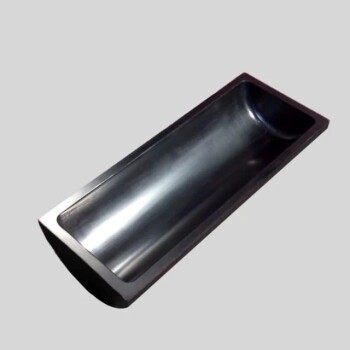
Graphite molds function as the critical structural interface in the powder metallurgy of NiCr-based composites, serving as the primary vessel for both shaping and consolidation. They are responsible for defining the material's geometry during cold pressing and subsequently transmitting high mechanical pressure under extreme heat to ensure a dense, dimensionally accurate final product.
The core value of a graphite mold lies in its ability to maintain structural integrity and chemical inertness at temperatures up to 1200°C. It acts not just as a container, but as an active transmission medium for pressure and heat, directly influencing the density and homogeneity of the composite.
The Dual-Stage Role of Graphite
Graphite molds are not static containers; they are dynamic tools that facilitate two distinct stages of the manufacturing process.
Carrier for Cold Pressing
In the initial stage, the mold functions as a forming vessel. It contains the loose composite powder and withstands the initial "cold pressure" required to create a "green body."
This stage establishes the preliminary shape of the NiCr-based composite. The mold must be rigid enough to define precise geometric dimensions before any heat is applied.
Facilitator of Vacuum Hot Press Sintering
The mold’s most critical function occurs during the sintering phase. It serves as the load-bearing component inside the vacuum furnace.
The mold holds the green body while the environment heats up to extreme temperatures, often reaching 1200°C. It ensures the composite remains contained and supported as the powder particles begin to bond and consolidate.
Critical Performance Mechanisms
To achieve high-quality NiCr-based composites, the mold must perform specific physical functions beyond simple containment.
High-Temperature Pressure Transmission
The mold is the vehicle for mechanical force. It must transmit significant axial pressure (often around 25 MPa) from the press head directly to the composite material.
This transmission forces the powder particles into a tight arrangement, eliminating voids. This process is essential for achieving the high density required for industrial-grade composites.
Thermal and Dimensional Stability
Graphite is chosen because it does not soften or deform easily at 1200°C. It maintains the specific dimensions of the sample even under heavy load.
Furthermore, graphite's high thermal conductivity ensures that heat is distributed uniformly across the composite. This prevents thermal gradients that could lead to uneven sintering or internal stresses within the NiCr matrix.
Understanding the Trade-offs
While graphite is the standard for this application, it is not without limitations that can affect your process.
Chemical Stability Risks
Graphite is generally chemically stable, but it must be high-purity to prevent contamination. If the vacuum environment is compromised, graphite can oxidize rapidly at high temperatures, potentially degrading the mold surface and the composite skin.
Mechanical Wear and Lifespan
Although graphite has excellent high-temperature strength, it is brittle compared to metals. Repeated cycles of high-pressure transmission can eventually lead to micro-cracking or surface wear, which will degrade the dimensional tolerance of future composite batches.
Making the Right Choice for Your Goal
When selecting graphite molds for NiCr-based powder metallurgy, your priorities dictate your material specifications.
- If your primary focus is Maximum Density: Prioritize graphite grades with exceptional compressive strength to ensure efficient pressure transfer without mold deformation at 1200°C.
- If your primary focus is Dimensional Precision: Select high-density, fine-grain graphite to minimize surface roughness and ensure the mold retains its exact geometry under load.
Success in NiCr composite fabrication relies on viewing the graphite mold not as a consumable accessory, but as an active component of the thermal and mechanical processing system.
Summary Table:
| Function | Description | Key Benefit |
|---|---|---|
| Cold Pressing | Acts as a forming vessel for loose powder | Establishes precise preliminary geometry |
| Pressure Transmission | Transfers axial force (up to 25 MPa) to the powder | Eliminates voids for maximum material density |
| Thermal Stability | Maintains structural integrity up to 1200°C | Prevents deformation and internal stresses |
| Heat Distribution | Conducts heat uniformly across the NiCr matrix | Ensures consistent sintering and homogeneity |
Elevate Your Material Research with KINTEK Precision Engineering
At KINTEK, we understand that the quality of your NiCr-based composites depends on the precision of your tools. As specialists in laboratory equipment and consumables, we provide high-purity graphite molds, vacuum hot presses, and high-temperature furnaces designed to withstand the most demanding sintering environments.
Whether you are refining battery research, developing industrial-grade ceramics, or perfecting powder metallurgy, our comprehensive range—from hydraulic pellet presses to isostatic solutions—ensures your lab achieves unmatched density and homogeneity.
Ready to optimize your production process? Contact us today to discover how KINTEK’s expert solutions can enhance your lab's efficiency and output quality.
Related Products
- Round Bidirectional Press Mold for Lab
- XRF & KBR steel ring lab Powder Pellet Pressing Mold for FTIR
- Carbon Graphite Plate Manufactured by Isostatic Pressing Method
- XRF & KBR plastic ring lab Powder Pellet Pressing Mold for FTIR
- High Purity Pure Graphite Crucible for Electron Beam Evaporation
People Also Ask
- How to use a press mold? Master the Art of Creating Consistent Ceramic Forms
- What is the press mould method? A Guide to Consistent, Detailed Ceramic Forms
- What is the function of press molds during the preparation of SiCf/Ti-43Al-9V composites? Achieve Structural Precision
- What is a press mold used for? Achieve Repeatable Precision and Efficiency
- What is the purpose of specialized pressure devices in sulfide solid-state batteries? Ensure Chemo-Mechanical Stability