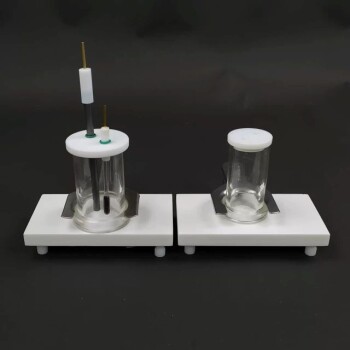
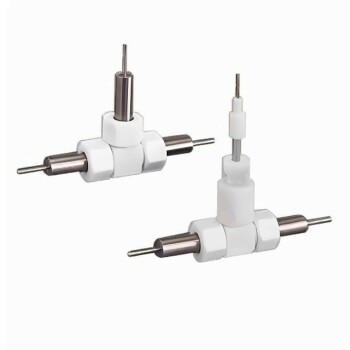
To ensure accurate photoelectrochemical (PEC) performance testing, the electrolytic cell must be equipped with a quartz window rather than standard glass. This specific requirement allows external light sources, such as xenon lamps, to illuminate the working electrode surface with high transmittance across both ultraviolet and visible wavebands. By using quartz, you eliminate the spectral absorption inherent in ordinary glass, ensuring that the light reaching your sample is consistent with the output of your solar simulator.
The inclusion of a quartz window is the defining factor for data integrity in PEC testing; without it, the cell material itself acts as a filter, absorbing high-energy photons and artificially lowering the measured efficiency of the system.
The Critical Role of Optical Transparency
Maximizing Light Transmittance
The primary function of the quartz window is to permit the passage of light without significant loss. In a typical PEC setup, the light source is external to the reactor.
Quartz possesses exceptionally high transmittance properties. It allows the full spectrum of simulated sunlight—specifically high-energy ultraviolet (UV) and visible wavelengths—to pass through the cell wall and reach the photoanode or photocathode unhindered.
Avoiding Spectral Filtering
Ordinary glass is not a neutral medium; it characteristically absorbs specific wavelengths of light, particularly in the UV region.
If a standard glass window is used, it acts as an unintended optical filter. This prevents necessary wavelengths from reaching the electrode, altering the experimental conditions and potentially rendering the data invalid for broad-spectrum solar applications.
Impact on Measurement Accuracy
Reliable Current-Voltage Curves
The accuracy of your current-voltage (I-V) curves relies heavily on the intensity and quality of light hitting the sample.
The primary reference notes that quartz ensures these curves accurately reflect the true photoelectric conversion efficiency of materials like N/TiO2-x. If the window absorbs light, the measured photocurrent will be lower than the material's actual capability, leading to false negative results.
Efficient Electron-Hole Pair Generation
For a reaction to occur, photons must possess enough energy to excite electrons within the semiconductor material.
Quartz ensures that high-energy photons reach the nanostructured surfaces (such as copper oxide or titanium dioxide). This maximizes the separation of photogenerated electron-hole pairs, which is the fundamental driver for photocurrent density and hydrogen evolution efficiency.
Common Pitfalls to Avoid
The "Standard Glass" Error
A frequent source of experimental error is the substitution of quartz with borosilicate or soda-lime glass to reduce costs.
While these materials may appear transparent, they are opaque to ultraviolet light. Using them will significantly reduce system efficiency metrics, not because the catalyst is poor, but because the "fuel" (UV light) is being blocked by the window.
Ignoring Geometry and Positioning
While the material of the window is paramount, the design of the cell also matters.
The setup is typically a three-electrode configuration. The quartz window must be positioned to allow direct, obstruction-free illumination of the working electrode, ensuring the simulated sunlight reaches the electrolyte interface where the reaction occurs.
Optimizing Your Experimental Setup
To obtain valid publication-quality data, you must align your equipment choices with your specific research goals.
- If your primary focus is UV-active catalysts (e.g., TiO2): You must use a quartz window, as standard glass will block the UV radiation required to excite the material.
- If your primary focus is visible-light driven materials: Quartz remains the superior choice to ensure no specific visible wavelengths are absorbed, providing a true "full spectrum" test environment.
- If your primary focus is accurate efficiency benchmarking: A quartz window is required to ensure your photocurrent response and I-V curves are not skewed by optical losses in the reactor wall.
Your choice of window material is the gatekeeper for your experiment's validity; ensure it is quartz to let the full potential of your photocatalyst shine through.
Summary Table:
| Feature | Quartz Window | Standard Glass (Borosilicate) |
|---|---|---|
| UV Transmittance | Exceptionally High (>90%) | Very Low (Opaque to UV) |
| Visible Transmittance | High and Uniform | Variable |
| Impact on PEC Data | Maintains Integrity/Efficiency | Artificially Lowers Photocurrent |
| Spectral Filtering | Minimal/None | Significant UV Filtering |
| Best Use Case | Broad-spectrum Solar Simulation | Basic Visible Light Only |
Elevate Your Photoelectrochemical Research with KINTEK
Don't let inferior materials compromise your data integrity. KINTEK specializes in high-precision laboratory equipment designed for the most demanding research environments. Our specialized electrolytic cells and electrodes are engineered with premium quartz windows to ensure maximum light transmittance and repeatable results for your PEC performance tests.
Whether you are working on hydrogen evolution, CO2 reduction, or advanced battery research, our comprehensive portfolio—including high-temperature furnaces, crushing systems, and cooling solutions—provides the reliability your lab needs.
Ready to optimize your experimental setup? Contact our technical experts today to find the perfect solution for your research goals.
References
- Xiaolan Kang, Zhenquan Tan. <i>In situ</i> formation of defect-engineered N-doped TiO<sub>2</sub> porous mesocrystals for enhanced photo-degradation and PEC performance. DOI: 10.1039/c8na00193f
This article is also based on technical information from Kintek Solution Knowledge Base .
Related Products
- Quartz Electrolytic Electrochemical Cell for Electrochemical Experiments
- Side Window Optical Electrolytic Electrochemical Cell
- Electrolytic Electrochemical Cell with Five-Port
- Optical Water Bath Electrolytic Electrochemical Cell
- H-Type Double-Layer Optical Electrolytic Electrochemical Cell with Water Bath
People Also Ask
- Why is a quartz electrolytic cell used for acrylic acid wastewater? Ensure Chemical Stability & Data Integrity
- How does the design of an electrochemical electrolytic cell influence the coating uniformity? Optimize Your Catalysts
- What are the key features of quartz that make it suitable for electrolytic cells? Discover the 4 Pillars of Superior Performance
- What is the correct shutdown and disassembly procedure after an experiment? Ensure Safety and Protect Your Equipment
- How do the electrochemical cell and three-electrode testing system collaborate? Optimize Zinc Anode Deposition Control