Knowledge What are the signs of the electrolytic cell? Understanding Anode (+) and Cathode (-) Polarity
Author avatar

Tech Team · Kintek Solution

Updated 6 days ago

What are the signs of the electrolytic cell? Understanding Anode (+) and Cathode (-) Polarity


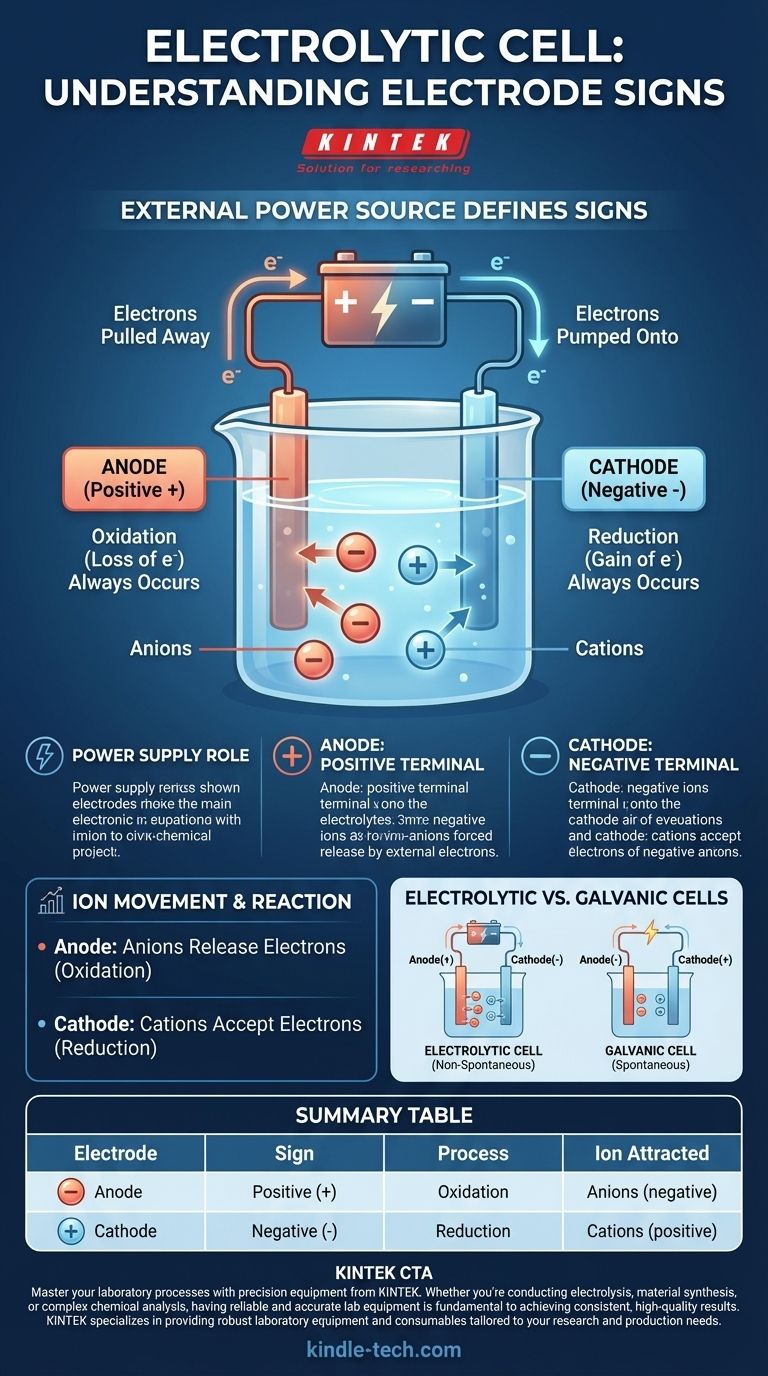
In an electrolytic cell, the sign convention is defined by the external power source. The anode is assigned a positive (+) sign, and the cathode is assigned a negative (-) sign. This is because an external voltage is applied to drive a chemical reaction that would not occur spontaneously.

The key to understanding an electrolytic cell is to recognize that it is not a self-contained system. The signs of its electrodes are dictated entirely by the external power supply to which it is connected, forcing a non-spontaneous chemical change to occur.
What are the signs of the electrolytic cell? Understanding Anode (+) and Cathode (-) Polarity

Why an External Power Source Defines the Signs

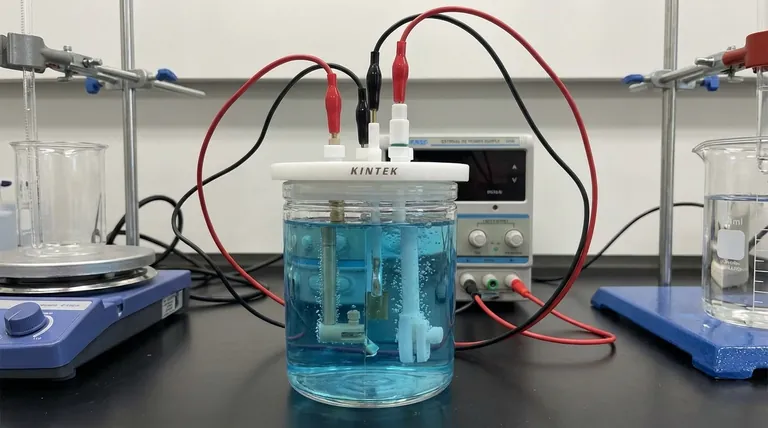
An electrolytic cell uses electrical energy to create chemical energy. This process, known as electrolysis, requires an outside force—a battery or DC power supply—to initiate and sustain the reaction.

The Role of the Power Supply

The power supply acts as an "electron pump." It pulls electrons from one electrode and pushes them to the other, creating a charge imbalance that forces ions in the electrolyte solution to react.

The Anode is Connected to the Positive Terminal

The positive terminal of the external power supply is connected to the anode. This terminal actively pulls electrons away from the anode, leaving it with a net positive charge.

The Cathode is Connected to the Negative Terminal

Conversely, the negative terminal of the power supply is connected to the cathode. This terminal actively pumps electrons onto the cathode, giving it an excess of electrons and a net negative charge.

How Ion Movement Creates the Reaction

The forced charges on the electrodes are what attract the ions dissolved in the electrolyte, compelling them to move and react. The fundamental definitions of oxidation and reduction remain constant.

Anode: The Site of Oxidation (Always)

Regardless of the cell type, oxidation (the loss of electrons) always occurs at the anode. In an electrolytic cell, negatively charged ions (anions) are attracted to the positive anode, where they release their excess electrons and are oxidized.

Cathode: The Site of Reduction (Always)

Similarly, reduction (the gain of electrons) always occurs at the cathode. Positively charged ions (cations) in the solution are attracted to the negative cathode, where they accept the excess electrons and are reduced.

A Critical Distinction: Electrolytic vs. Galvanic Cells

A primary source of confusion arises when comparing electrolytic cells to galvanic (or voltaic) cells, such as a standard battery. Their sign conventions are opposite for a very specific reason.

Spontaneous vs. Non-Spontaneous Reactions

A galvanic cell runs on a spontaneous chemical reaction that produces electrical energy. Here, the anode is the natural source of electrons, making it negative, and the cathode is where they are consumed, making it positive.

An electrolytic cell runs a non-spontaneous reaction that consumes electrical energy. The external power source reverses the natural polarity to force the reaction to proceed.

The Universal Constant

Despite the difference in signs, the core processes are the same in both cell types:

  • Anode is always the site of Oxidation.
  • Cathode is always the site of Reduction.

How to Remember the Signs

Use these principles to keep the conventions clear based on your goal.

  • If your primary focus is identifying the terminals: Remember that in an electrolytic cell, the signs match the external power supply: the Anode is Positive and the Cathode is Negative.
  • If your primary focus is tracking the ions: Follow the simple rule of opposite charges: negative anions move to the positive anode, and positive cations move to the negative cathode.
  • If your primary focus is distinguishing cell types: Associate "electrolytic" with an external power source that forces a positive charge on the anode and a negative charge on the cathode to drive the reaction.

Ultimately, the signs of an electrolytic cell are a direct consequence of an external power source overriding the natural flow of a chemical reaction.

Summary Table:

Electrode Sign Process Ion Attracted
Anode Positive (+) Oxidation Anions (negative)
Cathode Negative (-) Reduction Cations (positive)

Master your laboratory processes with precision equipment from KINTEK.

Whether you're conducting electrolysis, material synthesis, or complex chemical analysis, having reliable and accurate lab equipment is fundamental to achieving consistent, high-quality results. KINTEK specializes in providing robust laboratory equipment and consumables tailored to your research and production needs.

Contact our experts today to discuss how our solutions can power your innovations and enhance the efficiency of your laboratory workflows.

Visual Guide
What are the signs of the electrolytic cell? Understanding Anode (+) and Cathode (-) Polarity Visual Guide

Related Products

People Also Ask

Related Products

Electrolytic Electrochemical Cell with Five-Port

Electrolytic Electrochemical Cell with Five-Port

Streamline your laboratory consumables with Kintek's Electrolytic Cell with five-port design. Choose from sealed and non-sealed options with customizable electrodes. Order now.

Double Layer Five-Port Water Bath Electrolytic Electrochemical Cell

Double Layer Five-Port Water Bath Electrolytic Electrochemical Cell

Experience optimal performance with our Water Bath Electrolytic Cell. Our double-layer, five-port design boasts corrosion resistance and longevity. Customizable to fit your specific needs. View specs now.

Double-Layer Water Bath Electrolytic Electrochemical Cell

Double-Layer Water Bath Electrolytic Electrochemical Cell

Discover the temperature-controllable electrolytic cell with a double-layer water bath, corrosion resistance, and customization options. Complete specifications included.

Quartz Electrolytic Electrochemical Cell for Electrochemical Experiments

Quartz Electrolytic Electrochemical Cell for Electrochemical Experiments

Looking for a reliable quartz electrochemical cell? Our product boasts excellent corrosion resistance and complete specifications. With high-quality materials and good sealing, it's both safe and durable. Customize to meet your needs.

Optical Water Bath Electrolytic Electrochemical Cell

Optical Water Bath Electrolytic Electrochemical Cell

Upgrade your electrolytic experiments with our Optical Water Bath. With controllable temperature and excellent corrosion resistance, it's customizable for your specific needs. Discover our complete specifications today.

Electrolytic Electrochemical Cell Gas Diffusion Liquid Flow Reaction Cell

Electrolytic Electrochemical Cell Gas Diffusion Liquid Flow Reaction Cell

Looking for a high-quality gas diffusion electrolysis cell? Our liquid flow reaction cell boasts exceptional corrosion resistance and complete specifications, with customizable options available to suit your needs. Contact us today!

H-Type Double-Layer Optical Electrolytic Electrochemical Cell with Water Bath

H-Type Double-Layer Optical Electrolytic Electrochemical Cell with Water Bath

Double-layer H-type optical water bath electrolytic cells, with excellent corrosion resistance and a wide range of specifications available. Customization options are also available.

H Type Electrolytic Cell Triple Electrochemical Cell

H Type Electrolytic Cell Triple Electrochemical Cell

Experience versatile electrochemical performance with our H-type Electrolytic Cell. Choose from membrane or non-membrane sealing, 2-3 hybrid configurations. Learn more now.

Electrolytic Electrochemical Cell for Coating Evaluation

Electrolytic Electrochemical Cell for Coating Evaluation

Looking for corrosion-resistant coating evaluation electrolytic cells for electrochemical experiments? Our cells boast complete specifications, good sealing, high-quality materials, safety, and durability. Plus, they're easily customizable to meet your needs.

PTFE Electrolytic Cell Electrochemical Cell Corrosion-Resistant Sealed and Non-Sealed

PTFE Electrolytic Cell Electrochemical Cell Corrosion-Resistant Sealed and Non-Sealed

Choose our PTFE Electrolytic Cell for reliable, corrosion-resistant performance. Customize specifications with optional sealing. Explore now.

Customizable PEM Electrolysis Cells for Diverse Research Applications

Customizable PEM Electrolysis Cells for Diverse Research Applications

Custom PEM test cell for electrochemical research. Durable, versatile, for fuel cells & CO2 reduction. Fully customizable. Get a quote!

Thin-Layer Spectral Electrolysis Electrochemical Cell

Thin-Layer Spectral Electrolysis Electrochemical Cell

Discover the benefits of our thin-layer spectral electrolysis cell. Corrosion-resistant, complete specifications, and customizable for your needs.

Flat Corrosion Electrolytic Electrochemical Cell

Flat Corrosion Electrolytic Electrochemical Cell

Discover our flat corrosion electrolytic cell for electrochemical experiments. With exceptional corrosion resistance and complete specifications, our cell guarantees optimal performance. Our high-quality materials and good sealing ensure a safe and durable product, and customization options are available.

FS Electrochemical Hydrogen Fuel Cells for Diverse Applications

FS Electrochemical Hydrogen Fuel Cells for Diverse Applications

KINTEK's FS Electrochemical Cell: Modular PEM fuel cell stack for R&D and training. Acid-resistant, scalable, and customizable for reliable performance.

Customizable Swagelok Type Test Cells for Advanced Battery Research Electrochemical Analysis

Customizable Swagelok Type Test Cells for Advanced Battery Research Electrochemical Analysis

The KINTEK Swagelok-type test cell is a modular, T-shaped device constructed from high-quality, chemically inert materials.

Customizable CO2 Reduction Flow Cell for NRR ORR and CO2RR Research

Customizable CO2 Reduction Flow Cell for NRR ORR and CO2RR Research

The cell is meticulously crafted from high-quality materials to ensure chemical stability and experimental accuracy.

Customizable High Pressure Reactors for Advanced Scientific and Industrial Applications

Customizable High Pressure Reactors for Advanced Scientific and Industrial Applications

This laboratory-scale high-pressure reactor is a high-performance autoclave engineered for precision and safety in demanding research and development environments.

Mini SS High Pressure Autoclave Reactor for Laboratory Use

Mini SS High Pressure Autoclave Reactor for Laboratory Use

Mini SS High Pressure Reactor - Ideal for medicine, chemical, and scientific research industries. Programmed heating temp and stirring speed, up to 22Mpa pressure.

High Pressure Laboratory Autoclave Reactor for Hydrothermal Synthesis

High Pressure Laboratory Autoclave Reactor for Hydrothermal Synthesis

Discover the applications of Hydrothermal Synthesis Reactor - a small, corrosion-resistant reactor for chemical labs. Achieve rapid digestion of insoluble substances in a safe and reliable way. Learn more now.

Stainless High Pressure Autoclave Reactor Laboratory Pressure Reactor

Stainless High Pressure Autoclave Reactor Laboratory Pressure Reactor

Discover the versatility of Stainless High Pressure Reactor - a safe and reliable solution for direct and indirect heating. Built with stainless steel, it can withstand high temperatures and pressures. Learn more now.


Leave Your Message