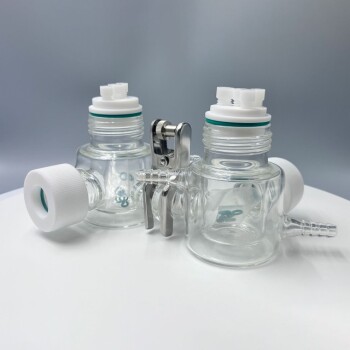
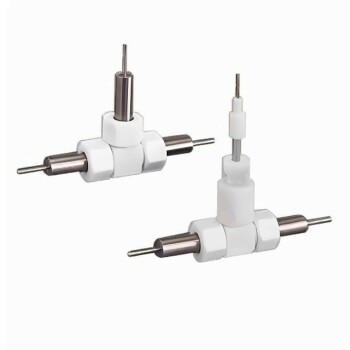
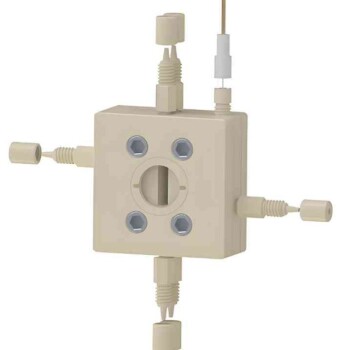
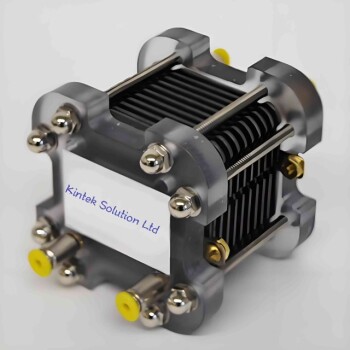
Specialized electrochemical cells for in-situ ATR-SEIRAS are engineered to bridge the gap between optical spectroscopy and electrochemical application. By integrating a silicon prism coated with a thin gold film, these cells direct infrared light to the catalyst surface while simultaneously maintaining an electrical potential. This unique configuration allows for the real-time capture of vibrational signals from short-lived adsorbed intermediates.
The primary value of this specialized hardware is its ability to reveal the invisible steps of a chemical reaction. By synchronizing infrared detection with electrochemical stimuli, these cells identify how surface modifications alter reaction pathways and lower energy barriers during critical processes like the Oxygen Evolution Reaction (OER).
The Structural Mechanics of the Cell
The Optical Interface
The core component of these specialized cells is a silicon prism tailored for internal reflection.
This prism serves as the conduit for infrared light. It guides the beam directly to the active surface where the reaction occurs.
The Conductive Substrate
Coating the prism is a thin gold film. This film performs a dual function in the apparatus.
First, it acts as the conductive electrode surface where the catalyst is deposited. Second, it enhances the surface sensitivity of the infrared absorption, which is essential for detecting minute quantities of molecules.
Analytical Functions and Capabilities
Real-Time Intermediate Detection
The most critical function of these cells is the capture of vibrational signals from adsorbed intermediates.
Because the detection happens in-situ (while the reaction is running), researchers can observe species that exist only momentarily. The reference specifically notes the ability to detect OOH radicals at the exact moment an electrochemical potential is applied.
Deciphering Reaction Pathways
These cells allow scientists to observe how surface modifications physically change the course of a chemical reaction.
By monitoring the specific vibrational signatures of intermediates, researchers can map out the step-by-step pathway the reaction follows. This confirms whether a modification has successfully shifted the reaction to a more efficient route.
Quantifying Energy Barriers
Beyond just identifying species, the cell aids in understanding thermodynamic efficiency.
In the context of the Oxygen Evolution Reaction (OER), the data gathered helps determine how specific catalyst structures reduce energy barriers. This provides the mechanistic evidence needed to explain why a catalyst performs better.
Understanding the Trade-offs
Material Specificity
The reliance on a silicon prism and gold film architecture is a defining constraint of this setup.
While this combination provides excellent optical throughput and conductivity, it limits the types of chemistries and electrolytes compatible with the cell. The materials used must not react adversely with the silicon or gold components during the experiment.
Complexity of Operation
The requirement to align infrared optics with electrochemical control introduces significant complexity.
Successful data acquisition requires precise synchronization. If the potential application and spectral capture are not perfectly timed, the transient intermediates (like OOH radicals) may be missed entirely, rendering the data incomplete.
Leveraging This Technology for Your Research
## Making the Right Choice for Your Goal
Depending on what you are trying to prove about your catalyst, focus your analysis on the specific data these cells provide:
- If your primary focus is Mechanism Validation: Concentrate on identifying the vibrational fingerprints of specific intermediates (like OOH) to prove the existence of a theoretical pathway.
- If your primary focus is Catalyst Optimization: Use the cell to measure how surface modifications correlate with a reduction in energy barriers compared to a baseline material.
These specialized cells transform the theoretical understanding of catalysis into observable, empirical fact.
Summary Table:
| Feature | Function in ATR-SEIRAS | Research Value |
|---|---|---|
| Silicon Prism | Internal reflection conduit for IR light | High optical throughput for signal clarity |
| Thin Gold Film | Conductive substrate & signal enhancer | Enables electrode potential & surface sensitivity |
| In-situ Monitoring | Real-time vibrational signal capture | Detects short-lived intermediates (e.g., OOH radicals) |
| Kinetic Analysis | Quantifying energy barriers | Maps reaction pathways for OER optimization |
Elevate Your Spectroelectrochemical Research with KINTEK
Precision in in-situ ATR-SEIRAS requires high-performance hardware that bridges the gap between electrochemistry and spectroscopy. At KINTEK, we specialize in providing researchers with the advanced tools needed to reveal invisible reaction steps.
Our extensive portfolio supports your entire lab workflow, featuring:
- Specialized Electrolytic Cells & Electrodes optimized for precise signal detection.
- High-performance high-temperature reactors and autoclaves for demanding synthesis.
- Comprehensive battery research tools, PTFE products, and ceramics for diverse chemical compatibility.
Whether you are validating reaction mechanisms or optimizing catalyst efficiency, KINTEK’s laboratory equipment ensures accuracy and durability. Contact our technical experts today to find the perfect solution for your specialized electrochemical applications!
References
- Yanrong Xue, Lu Xu. Stabilizing ruthenium dioxide with cation-anchored sulfate for durable oxygen evolution in proton-exchange membrane water electrolyzers. DOI: 10.1038/s41467-023-43977-7
This article is also based on technical information from Kintek Solution Knowledge Base .
Related Products
- Thin-Layer Spectral Electrolysis Electrochemical Cell
- Electrolytic Electrochemical Cell for Coating Evaluation
- Side Window Optical Electrolytic Electrochemical Cell
- Electrolytic Electrochemical Cell with Five-Port
- Multifunctional Electrolytic Electrochemical Cell Water Bath Single Layer Double Layer
People Also Ask
- What are the recommended post-experiment procedures for cleaning and storing the thin-layer spectroelectrochemical cell?
- What preparation steps are required before initiating an experiment with the thin-layer spectroelectrochemical cell?
- What operational environments and sealing options are available for the thin-layer spectroelectrochemical cell?
- For what types of systems, temperature ranges, and sealing configurations is the thin-layer spectroelectrochemical cell designed? Ideal for Aqueous and Non-Aqueous Analysis
- What are the necessary preparation steps before using a thin-layer spectroelectrochemical cell? A Guide to Reliable Results