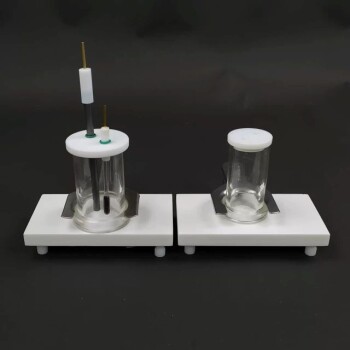
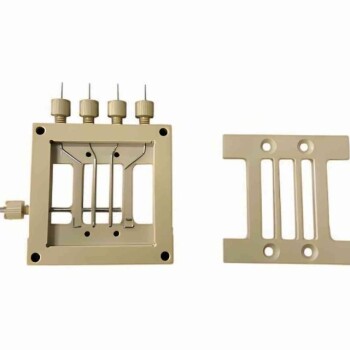
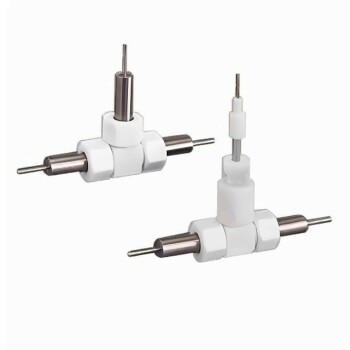
The standard in-situ Raman electrolytic cell is engineered with a specific port configuration designed to support a three-electrode system and fluid management. The cell typically features three openings with a diameter of Φ6.2mm for electrode insertion and four openings with a diameter of Φ3.2mm for gas and liquid inlets or outlets.
The standard configuration prioritizes compatibility with common electrode shaft sizes and standard tubing, but the number and size of these apertures can be customized to meet specific experimental constraints.
Detailed Aperture Specifications
Electrode Ports
The cell includes three Φ6.2mm openings.
These are specifically sized to accommodate the shafts of the working electrode, counter electrode, and reference electrode.
This diameter allows for a secure fit for standard electrochemical probes while ensuring the electrodes can be submerged correctly into the electrolyte.
Gas and Liquid Management
There are four Φ3.2mm openings dedicated to fluid dynamics.
These ports allow for the introduction of electrolytes or the purging of gases (aeration/deaeration) during the experiment.
The smaller diameter is optimized for standard tubing connections, ensuring a tight seal to maintain the integrity of the reaction environment.
Port Distribution
While the total count is standard, the arrangement often splits these ports across the cell body to facilitate organized cable management.
A common configuration places two 6.2mm and two 3.2mm ports on one side, with the remaining one 6.2mm and two 3.2mm ports on the opposite side.
This separation prevents overcrowding of wires and tubing around the optical window.
Design Context and Materiality
Optical Access
The cell body typically features a quartz window on top.
This component is critical for in-situ Raman spectroscopy, as it provides optical transparency for the laser to focus on the working electrode surface below.
Material Compatibility
The cell body and lid are generally constructed from PEEK (Polyether ether ketone).
This material is chosen for its high chemical resistance and mechanical strength, ensuring the cell does not react with the electrolyte or degrade during long-term polarization.
Understanding Configuration Variability
Sealed vs. Non-Sealed Requirements
It is critical to distinguish between sealed and non-sealed experiment requirements.
A non-sealed cell may only utilize the three Φ6.2mm electrode holes, omitting the smaller gas ports if atmospheric isolation is not required.
However, for sealed cells involving gas evolution or strict atmosphere control, the full configuration of three Φ6.2mm and two to four Φ3.2mm ports becomes essential.
Customization Limitations
While the Φ6.2mm and Φ3.2mm sizes are standard, they are not universal.
If your experiment utilizes non-standard electrodes (e.g., larger shaft diameters) or specialized gas lines, the standard "off-the-shelf" openings will be insufficient.
Manufacturers allow for customization, so verification of your probe dimensions against these aperture standards is required before acquisition.
Making the Right Choice for Your Goal
- If your primary focus is standard three-electrode voltammetry: Ensure your electrode shafts fit the Φ6.2mm tolerance to ensure a proper seal without damaging the PEEK lid.
- If your primary focus is gas evolution or sensitive catalysis: Verify that the Φ3.2mm ports are positioned to allow efficient gas purging without blocking the optical path of the Raman laser.
Select the configuration that balances the physical size of your probes with the necessity of a sealed reaction environment.
Summary Table:
| Opening Type | Quantity | Diameter | Primary Function |
|---|---|---|---|
| Electrode Ports | 3 | Φ6.2mm | Insertion of working, counter, and reference electrodes. |
| Fluid Ports | 4 | Φ3.2mm | Gas purging (aeration/deaeration) and liquid inlet/outlet. |
| Optical Window | 1 | Custom | Quartz window for laser transparency during Raman spectroscopy. |
| Cell Material | N/A | N/A | PEEK for high chemical resistance and mechanical strength. |
Precision Solutions for Your Electrochemical Research
Elevate your spectroscopic analysis with KINTEK’s high-performance in-situ Raman electrolytic cells. Whether you require standard Φ6.2mm electrode ports or a fully customized configuration for specialized research, our PEEK-constructed cells ensure maximum chemical resistance and optical clarity.
Beyond electrolytic cells and electrodes, KINTEK offers a comprehensive range of laboratory equipment including:
- Advanced Furnaces: Muffle, vacuum, CVD, and induction melting systems.
- Sample Preparation: Crushing, milling, sieving, and hydraulic presses.
- Fluid & Thermal Control: ULT freezers, freeze dryers, and high-pressure autoclaves.
- Specialized Consumables: High-quality PTFE, ceramics, and crucibles.
Ready to optimize your experimental setup? Contact KINTEK today to discuss your specific aperture requirements and discover how our laboratory solutions can drive your next breakthrough.
Related Products
- Thin-Layer Spectral Electrolysis Electrochemical Cell
- Electrolytic Electrochemical Cell for Coating Evaluation
- Electrolytic Electrochemical Cell with Five-Port
- Electrolytic Electrochemical Cell Gas Diffusion Liquid Flow Reaction Cell
- Flat Corrosion Electrolytic Electrochemical Cell
People Also Ask
- What are the recommended post-experiment procedures for cleaning and storing the thin-layer spectroelectrochemical cell?
- What preparation steps are required before initiating an experiment with the thin-layer spectroelectrochemical cell?
- What operational environments and sealing options are available for the thin-layer spectroelectrochemical cell?
- For what types of systems, temperature ranges, and sealing configurations is the thin-layer spectroelectrochemical cell designed? Ideal for Aqueous and Non-Aqueous Analysis
- What are the necessary preparation steps before using a thin-layer spectroelectrochemical cell? A Guide to Reliable Results