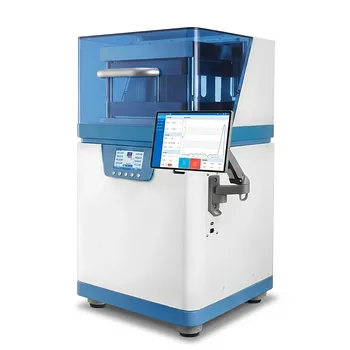
High-pressure reactors enable the synthesis of iron nanoparticles with superior crystallinity, precise morphology, and narrow size distributions by operating in a subcritical environment. In this state, water’s dielectric constant and reaction activity change significantly, allowing for chemical transformations that are physically impossible at ambient temperatures and pressures.
High-pressure hydrothermal synthesis transcends the limitations of ambient methods by utilizing autogenous pressure to manipulate the thermodynamic path of crystal growth. This results in high-purity, structurally stable iron nanoparticles with optimized electrochemical properties.
Enhanced Chemical Activity and Kinetics
Manipulation of Solvent Properties
High-pressure reactors create a closed environment where water can be heated far beyond its atmospheric boiling point. In this subcritical state, the dielectric constant of water decreases, and its reaction activity increases, allowing it to act as both a solvent and a potent catalyst.
Accelerated Reaction Rates
Increased pressure directly boosts reaction rates by reducing reactant volume and increasing collision frequency. This environment enhances the solubility of precursor components, facilitating faster hydrolysis and oxidation reactions compared to ambient processes.
Optimized Thermodynamic Equilibrium
The high-pressure environment can shift chemical equilibrium toward the product side, particularly in reactions involving gas-phase precursors or intermediates. This shift can significantly increase the reaction yield and ensure the complete conversion of iron sources into the desired nanostructures.
Precision in Particle Engineering
Superior Crystallinity and Phase Purity
The hydrothermal method promotes efficient phase transformation and crystal growth at relatively lower temperatures than traditional solid-state methods. This controlled environment ensures the formation of pure phases and high-quality crystals, which are critical for magnetic and electrochemical applications.
Morphology and Size Control
High-pressure reactors allow for the oriented growth of reaction precursors, leading to specific structures like layered plates or uniform nanospheres. The stable thermodynamic conditions within the autoclave result in a narrow particle size distribution, preventing the irregular growth often seen in ambient-pressure synthesis.
Prevention of Volatilization Loss
The sealed nature of the reactor maintains autogenous pressure, which prevents the loss of volatile components or ions. For iron-based materials involving secondary elements like lithium, this prevents the formation of ion-deficient compounds and maintains the intended stoichiometry.
Structural Integration and Stability
Formation of Strong Chemical Bonds
High-pressure conditions facilitate the formation of tight physical contact or strong chemical bonds between iron nanoparticles and supports like reduced graphene oxide (rGO). This creates rapid electron transport channels and prevents the volume expansion or detachment of particles during use.
Uniform Loading on Substrates
The hydrothermal environment ensures that iron particles or co-catalysts are uniformly loaded onto the surface of other nanostructures, such as nanowires. This uniformity is essential for maintaining stable peroxidase and oxidase activities in sensing and catalytic applications.
Understanding the Trade-offs
System Complexity and Safety
Operating at high pressures and temperatures requires specialized autoclave equipment and rigorous safety protocols to manage the risk of vessel failure. Unlike ambient methods, these systems are "black boxes" during the reaction, making real-time monitoring of crystal growth more technically challenging.
Cost and Scalability
The initial capital investment for high-pressure reactors is significantly higher than for open-beaker ambient setups. While the process yields higher-quality materials, the batch-processing nature of most laboratory autoclaves can limit high-volume throughput compared to continuous ambient-flow processes.
Making the Right Choice for Your Goal
Hydrothermal synthesis in high-pressure reactors is the gold standard when material performance depends on crystal integrity and structural stability.
- If your primary focus is phase purity and crystallinity: Use high-pressure reactors to ensure complete phase transformation and avoid the formation of amorphous impurities.
- If your primary focus is morphology control: Leverage the oriented growth capabilities of the hydrothermal environment to create uniform nanospheres or specific layered structures.
- If your primary focus is hybrid material stability: Utilize high-pressure conditions to forge strong chemical bonds between iron particles and conductive supports like rGO for improved durability.
By mastering the high-pressure environment, you can engineer iron nanoparticles with the precise technical specifications required for advanced electrochemical and sensing technologies.
Summary Table:
| Feature | High-Pressure Hydrothermal | Ambient Temperature Methods |
|---|---|---|
| Crystallinity | Superior phase purity & crystal integrity | Often amorphous or less stable |
| Morphology Control | Precise (nanospheres, plates, etc.) | Irregular & hard to control |
| Particle Distribution | Narrow & uniform size distribution | Broad & inconsistent |
| Chemical Bonding | Strong covalent/physical bonds (e.g., with rGO) | Weak surface attachment |
| Reaction Kinetics | Accelerated by subcritical state | Slower; limited by boiling points |
Elevate Your Nanomaterial Synthesis with KINTEK
Achieving the perfect crystal structure and particle morphology requires more than just chemistry—it requires precision engineering. KINTEK specializes in advanced laboratory equipment designed for high-performance research. Our industry-leading high-temperature high-pressure reactors and autoclaves provide the stable, subcritical environments necessary for superior hydrothermal synthesis.
Whether you are developing iron nanoparticles for sensing or energy storage, we offer a comprehensive range of tools including crushing and milling systems, PTFE-lined vessels, and high-temperature furnaces to support every stage of your workflow.
Ready to optimize your reaction yields and material stability? Contact our technical experts today to find the perfect high-pressure solution for your lab!
References
- Vinay Chandra Jha, Rahul Mishra. Biosynthesis of Iron Nanoparticles from Spinacia Oleracea and its Application in Wastewater Treatment. DOI: 10.59670/ml.v20is13.6263
This article is also based on technical information from Kintek Solution Knowledge Base .
Related Products
- Customizable Laboratory High Temperature High Pressure Reactors for Diverse Scientific Applications
- Customizable High Pressure Reactors for Advanced Scientific and Industrial Applications
- Stainless High Pressure Autoclave Reactor Laboratory Pressure Reactor
- Visual High-Pressure Reactor for In-Situ Observation
- Mini SS High Pressure Autoclave Reactor for Laboratory Use
People Also Ask
- How do high-pressure and high-temperature reactors ensure the effective treatment of lignocellulosic wastewater in WAO?
- What equipment is required for high-pressure high-temperature reactions? Master Extreme Chemistry Safely
- How do you control high pressure in a reactor? A Guide to Safe & Stable Operation
- How does initial oxygen pressure affect the wet oxidation of pharmaceutical sludge? Master Your Oxidation Depth
- Why is argon better than nitrogen for inert atmosphere? Ensure Absolute Reactivity & Stability