While there are three primary types of natural graphite, understanding the landscape requires acknowledging a fourth, man-made category that is critical to modern industry. The three natural types are amorphous graphite, flake graphite, and the much rarer vein graphite. Each is defined by its physical morphology and degree of crystallinity, which are direct results of its unique geological formation.
The classification of graphite is not merely academic; it is a direct indicator of its purity, crystal structure, and performance characteristics. This fundamental difference in formation dictates each type's industrial application and market value, from low-cost lubricants to high-performance battery anodes.
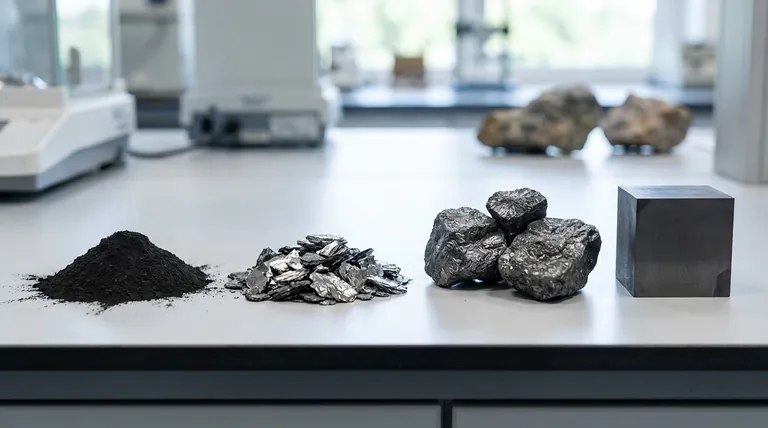
The Three Natural Forms of Graphite
Natural graphite is mined directly from the earth. Its properties are a product of the intense heat and pressure that transformed ancient carbon deposits over millions of years. The specific conditions of this metamorphosis created three distinct forms.
Amorphous Graphite
Amorphous graphite forms from the geological metamorphism of anthracite coal seams. The term "amorphous" is a misnomer, as it is still crystalline, but it has the smallest crystal size of any natural graphite.
It is typically the lowest in purity (70-85% carbon) and the least expensive to produce. Its microcrystalline structure makes it ideal for applications where high conductivity is not the primary requirement.
Common uses include brake linings, refractories (heat-resistant bricks for furnaces), gaskets, and basic lubricants.
Flake Graphite
Flake graphite is found in metamorphic rocks as discrete, flat, plate-like particles. It is less common than amorphous and forms when carbon material is subjected to higher temperatures and pressures.
This type has a much higher degree of crystallinity and carbon content (typically 90-95%) than amorphous graphite. Its layered structure of stacked graphene sheets gives it excellent electrical and thermal conductivity.
It is the cornerstone of the green energy transition, as it can be processed into spherical graphite for use in lithium-ion battery anodes. Other uses include fuel cells, high-strength composites, and thermal management materials.
Vein (or Lump) Graphite
Vein graphite is the rarest and highest-quality form of natural graphite. It is believed to be formed from the hydrothermal deposition of carbon-rich fluids into fractures and fissures within rock, creating crystalline "veins."
It boasts the highest natural purity (often >98% carbon) and the largest crystal structures, leading to superior electrical and thermal conductivity.
Due to its rarity and high cost, it is used in niche, high-performance applications like advanced lubricants, specialized batteries, and carbon brushes for electric motors.
The Industrial Powerhouse: Synthetic Graphite
Synthetic graphite is not mined but is an engineered product created by heating carbonaceous precursor materials (like petroleum coke or coal tar pitch) to extremely high temperatures (2,500-3,000°C) in a process called graphitization.
Defining Characteristics
This process allows for the creation of graphite with near-perfect crystal structure and ultra-high purity (often >99.9%). Its properties can be precisely tailored to meet specific industrial demands, offering a level of consistency that natural graphite cannot match.
However, the graphitization process is extremely energy-intensive, making synthetic graphite significantly more expensive than most natural forms.
Critical Applications
Synthetic graphite dominates applications where performance and purity are non-negotiable. This includes graphite electrodes for electric arc furnaces (EAFs) in steelmaking, moderators in nuclear reactors, and increasingly, high-performance anodes for electric vehicle batteries.
Understanding the Trade-offs: Purity vs. Cost
The choice between graphite types is a classic engineering trade-off between performance requirements and economic constraints.
The Purity and Crystallinity Spectrum
On the natural side, the quality spectrum increases from amorphous to flake to vein graphite. Each step up represents a larger, more perfect crystal structure, resulting in better conductivity and higher carbon content. Synthetic graphite sits at the very top of this spectrum, offering engineered perfection.
The Cost Equation
Cost is inversely related to abundance and directly related to processing effort. Amorphous graphite is the most abundant and cheapest. Flake graphite sits in the middle, with its price increasingly driven by demand from the battery sector. Vein graphite's rarity makes it the most expensive natural form, while synthetic graphite's high energy cost places it at a premium price point.
Making the Right Choice for Your Application
The ideal type of graphite is determined entirely by your technical requirements and budget.
- If your primary focus is large-scale industrial use with cost sensitivity (like refractories or brake linings): Amorphous graphite is the clear choice due to its low cost and sufficient performance.
- If your primary focus is high-performance energy storage (like EV batteries): High-purity spherical graphite, processed from natural flake or created synthetically, is the industry standard.
- If your primary focus is consistent, high-purity performance in manufacturing (like steelmaking electrodes): Synthetic graphite is the only reliable option.
- If your primary focus is ultimate thermal or electrical conductivity for niche applications: Vein graphite or tailored synthetic graphite provides the highest performance, though at a significant cost.
Understanding these fundamental distinctions allows you to select a material perfectly matched to your engineering and economic goals.
Summary Table:
| Type of Graphite | Carbon Purity | Key Characteristics | Common Applications |
|---|---|---|---|
| Amorphous | 70-85% | Lowest cost, microcrystalline structure | Refractories, brake linings, lubricants |
| Flake | 90-95% | High conductivity, plate-like crystals | Li-ion battery anodes, composites |
| Vein (Lump) | >98% | Rarest natural form, superior conductivity | Advanced lubricants, niche batteries |
| Synthetic | >99.9% | Engineered perfection, highest purity, energy-intensive | Graphite electrodes (steelmaking), high-performance battery anodes |
Need High-Performance Graphite for Your Lab or Production?
Choosing the right graphite material is critical for the success of your application, whether it's for battery research, material synthesis, or high-temperature processing. KINTEK specializes in providing high-quality lab equipment and consumables, including graphite products tailored to meet stringent industrial and research requirements.
We help you:
- Select the optimal material based on your specific needs for purity, conductivity, and thermal properties.
- Source reliable graphite components for furnaces, electrodes, and custom applications.
- Enhance your lab's efficiency with consumables that deliver consistent, high-performance results.
Let our experts guide you to the perfect solution. Contact KINTEL today to discuss your graphite needs!
Visual Guide

Related Products
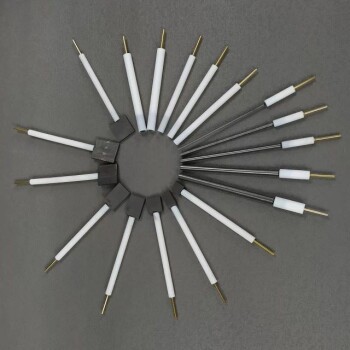
- Graphite Disc Rod and Sheet Electrode Electrochemical Graphite Electrode
- Ultra-High Temperature Graphite Vacuum Graphitization Furnace
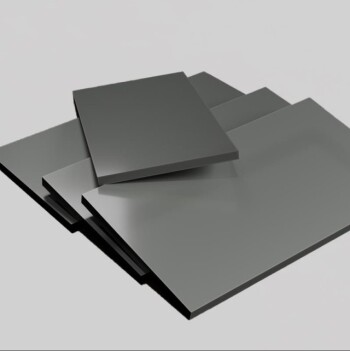
- Carbon Graphite Plate Manufactured by Isostatic Pressing Method
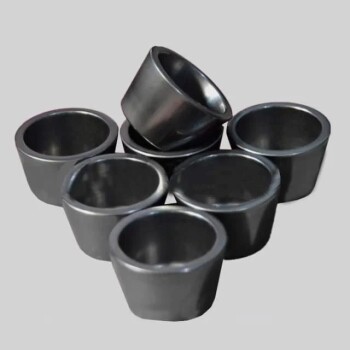
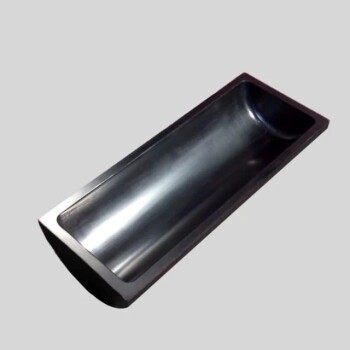
- High Purity Pure Graphite Crucible for Evaporation
- High Purity Pure Graphite Crucible for Electron Beam Evaporation
People Also Ask
- Why are high-purity graphite electrodes and graphite crucibles utilized in thermal plasma reactors? Ultimate Stability
- How should a graphite electrode be pre-treated before use? Ensure Reliable Electrochemical Data
- What reaction pathway and mechanism are associated with the use of graphite electrodes in biomass conversion?
- What are the key precautions for handling graphite electrodes? Ensure Safety & Maximize Performance
- What is the correct procedure for installing and connecting a graphite electrode during an experiment? Ensure Accurate Electrochemical Results