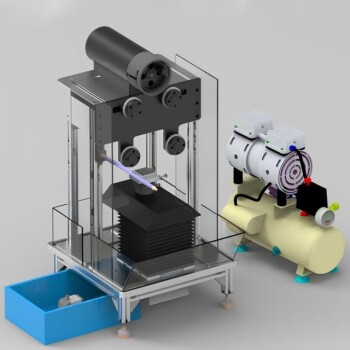
CVD diamonds are defined primarily by specific non-metallic inclusions that act as a fingerprint of their creation. Unlike other synthetic methods, Chemical Vapor Deposition (CVD) produces gems that are free of metal flux, instead containing graphite spots or unique mineral traces resulting from their layer-by-layer crystallization in a gas plasma environment.
Core Takeaway The most definitive characteristic of a CVD diamond is the absence of metal inclusions. While they are chemically identical to natural diamonds, their rapid, layer-by-layer growth process often leaves behind specific "birthmarks" such as black graphite inclusions, silicon traces, and structural graining.
The Signature of Layer-by-Layer Growth
The physical characteristics of a CVD diamond are a direct result of how it is grown. Because the diamond crystallizes from ionized gas rather than molten metal, the internal landscape of the stone differs significantly from High Pressure High Temperature (HPHT) synthetics.
Absence of Metal
The most critical distinction is that CVD diamonds never contain metal inclusions.
In HPHT diamonds, remnants of the molten metal catalyst (flux) are common. Because the CVD process utilizes carbon-rich gases like methane in a vacuum chamber, there is no metal present to become trapped inside the crystal lattice.
Graphite Inclusions
Instead of metal, the most common inclusion in CVD diamonds is graphite.
During the layer-by-layer growth process, carbon atoms sometimes fail to crystallize into the diamond structure and instead form non-diamond carbon spots. These appear as small black graphitic inclusions or rough edges within the stone.
Mineral Inclusions
Beyond graphite, CVD diamonds can feature other mineral inclusions.
These are trapped within the diamond as it grows on the seed crystal. While generally microscopic, these non-carbon minerals help gemologists distinguish CVD stones from natural ones.
Unique Chemical Fingerprints
While standard magnification reveals graphite, advanced analysis often uncovers trace elements that act as a definitive "signature" for CVD origin.
Silicon Traces
A unique characteristic often found in CVD diamonds is the presence of silicon inclusions.
This occurs because the ionized plasma in the growth chamber can etch the silica observation windows. This releases silicon atoms, which then settle into the growing diamond crystal. This defect is extremely rare in natural diamonds and is a strong indicator of CVD origin.
Structural and Visual Characteristics
The environment inside the growth chamber—specifically the plasma energy and rapid crystallization—affects the visual structure of the gem.
Lack of Color Zoning
CVD diamonds are generally produced as colorless gems without color zoning.
This means the color is typically uniform throughout the stone. In contrast, natural and HPHT stones may sometimes exhibit uneven color distribution or zoning patterns.
Internal Graining
Due to the rapid nature of the layer-by-layer growth, CVD diamonds may exhibit internal graining.
This structural irregularity is faint but creates a striated pattern within the diamond. It is a physical record of the diamond being built up aggressively over a short period.
Understanding the Trade-offs
While CVD diamonds possess the exact same durability (Mohs hardness of 10) and brilliance as natural diamonds, the manufacturing process introduces specific imperfections that buyers and analysts must recognize.
The "Brown" Tint Issue
CVD crystals are frequently grown with a brownish hue.
This is a common side effect of the rapid growth rate and vacuum conditions. While the goal is a colorless stone, the "as-grown" crystal is often undesirable in its raw state.
Dependence on Post-Growth Treatment
To correct the brown tint, many CVD diamonds undergo post-growth HPHT annealing.
This treatment subjects the diamond to high pressure and temperature to decolorize it. Consequently, a vast majority of the colorless CVD diamonds on the market today were originally brown. While this improves aesthetics, it means the stone is not "as grown."
Making the Right Choice for Your Goal
When evaluating a diamond, understanding these inclusion patterns allows you to determine its origin and quality.
- If your primary focus is identification: Look for black graphite spots or silicon traces and the total absence of metallic flux to confirm CVD origin.
- If your primary focus is purchase quality: Be aware that "colorless" CVD stones have likely undergone post-growth annealing to remove brown tints caused by rapid manufacturing.
The clarity of a CVD diamond is defined not by what is missing, but by the unique carbon and silicon signatures left behind by its creation.
Summary Table:
| Feature | CVD Diamond Characteristic | Significance for Identification |
|---|---|---|
| Metal Inclusions | Completely Absent | Distinguishes CVD from HPHT (which uses metal flux) |
| Common Inclusions | Black Graphite Spots | Result of non-diamond carbon trapped during growth |
| Chemical Trace | Silicon (Si) | Key indicator; often etched from chamber windows |
| Growth Pattern | Layer-by-layer Graining | A physical record of rapid crystallization in plasma |
| Color Profile | Uniform (often Post-Treated) | Initial brown tints are often removed via HPHT annealing |
| Durability | 10 Mohs Scale | Identical physical properties to natural diamonds |
Elevate Your Diamond Research with Precision Equipment
At KINTEK, we understand the intricate science behind Chemical Vapor Deposition. Whether you are growing high-purity crystals or analyzing the structural graining of lab-grown gems, our advanced laboratory solutions provide the reliability you need.
We specialize in high-performance high-temperature furnaces (CVD, PECVD, MPCVD), precise crushing and milling systems, and high-pressure reactors designed for the most demanding material science applications. From PTFE consumables to specialized cooling solutions, KINTEK supports researchers and manufacturers in achieving superior diamond quality and consistency.
Ready to optimize your lab's performance? Contact our technical experts today to find the perfect equipment for your CVD diamond production and analysis.
Related Products
- CVD Diamond for Thermal Management Applications
- CVD Diamond Optical Windows for Lab Applications
- CVD Diamond Domes for Industrial and Scientific Applications
- CVD Diamond Dressing Tools for Precision Applications
- Custom CVD Diamond Coating for Lab Applications
People Also Ask
- How long does it take to make a CVD diamond? A Detailed Look at the Growth Timeline
- What are the optical properties of CVD diamond? Unlock Unmatched Performance for Demanding Applications
- What is the hardness of CVD diamond? The Ultimate Guide to Engineered Super-Materials
- What is the chemical vapour deposition method for diamonds? Grow a Diamond from a Gas
- How long does it take to grow a CVD diamond? A 2-4 Week Journey to a Flawless Gem