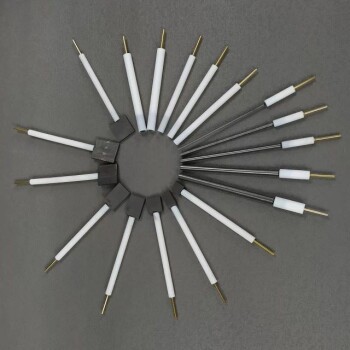
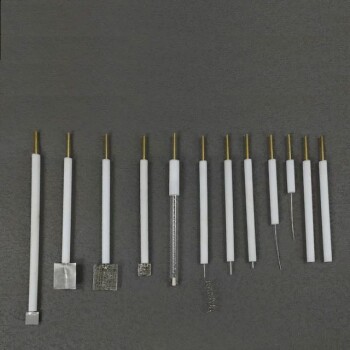
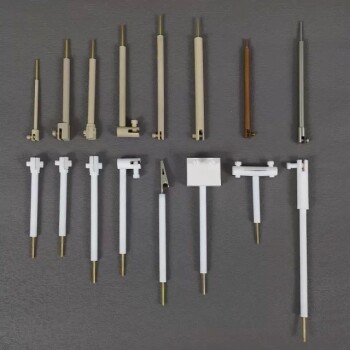
The standard three-electrode configuration for evaluating cobalt phosphide (CoP) electrodes consists of the CoP-based material as the working electrode, a high-purity graphite or platinum counter electrode, and a stable reference electrode such as mercury/mercury oxide (Hg/HgO). This setup allows the electrochemical workstation to isolate the electrical behavior of the catalyst from other circuit variables, ensuring that measured signals accurately reflect the intrinsic hydrogen evolution reaction (HER) activity.
To obtain precise electrocatalytic data, the three-electrode system decouples the potential measurement from the current-carrying circuit. This configuration is essential for eliminating interference from polarization and internal resistance, allowing for the accurate determination of overpotential and reaction kinetics.
Components of the HER Test Configuration
The Working Electrode (WE)
The working electrode is the site where the hydrogen evolution reaction actually occurs. In this specific configuration, the WE consists of the prepared cobalt phosphide (CoP) catalyst, often supported on a conductive substrate like Ti mesh (e.g., CoP/rGO@Ti).
The Counter Electrode (CE)
The counter electrode (or auxiliary electrode) completes the electrical circuit to allow current to flow. For CoP HER evaluation, high-purity graphite paper or a platinum (Pt) plate is typically used to ensure the CE does not limit the reaction rate at the working electrode.
The Reference Electrode (RE)
The reference electrode provides a stable, known potential against which the working electrode's potential is measured. Common choices include the mercury/mercury oxide (Hg/HgO) electrode or silver/silver chloride (Ag/AgCl), depending on the pH of the electrolyte used.
Technical Advantages for HER Evaluation
Elimination of Ohmic Interference
The three-electrode system uses a high-impedance path for the reference electrode, meaning almost no current flows through it. This effectively eliminates the ohmic voltage drop (iR drop) within the circuit, ensuring that the measured potential is the actual potential at the catalyst surface.
Isolation of Reaction Kinetics
By using a separate counter electrode, the workstation prevents counter electrode polarization from affecting the results. This allows researchers to derive critical performance indicators, such as onset potential and Tafel slopes, without noise from the counter-reaction.
High-Sensitivity Signal Collection
The electrochemical workstation accurately clamps the potential and collects current signals with high sensitivity. This precision is vital for capturing the subtle charge transfer resistance (Rct) through Electrochemical Impedance Spectroscopy (EIS).
Understanding the Trade-offs and Pitfalls
Counter Electrode Contamination
While platinum is a standard counter electrode, it can sometimes undergo dissolution and redeposition onto the working electrode during long-term HER testing. This "platinum poisoning" can lead to artificially high performance results, making high-purity graphite a safer choice for long-term stability tests.
Reference Electrode Compatibility
The choice of reference electrode must match the electrolyte pH. Using a reference electrode that is unstable in highly acidic or alkaline environments will cause potential drift, leading to inaccurate overpotential measurements and inconsistent polarization curves.
Working Electrode Film Uniformity
If the CoP catalyst is applied as a thin film, non-uniform loading can lead to inconsistent current distribution. This may result in "hot spots" on the electrode that do not accurately represent the material's intrinsic catalytic properties.
How to Apply This to Your HER Research
When configuring your workstation for cobalt phosphide testing, align your hardware choices with your specific experimental environment:
- If your primary focus is high-precision kinetic studies: Use a three-electrode setup with iR compensation enabled on the workstation to remove the influence of electrolyte resistance.
- If your primary focus is long-term stability testing: Prioritize high-purity graphite counter electrodes to prevent platinum dissolution from skewing your durability data.
- If your primary focus is commercial scalability: Ensure the catalyst loading on the working electrode substrate is uniform and accurately recorded to provide meaningful mass activity calculations.
A correctly configured three-electrode system transforms raw current and potential data into a definitive profile of a catalyst's true electrochemical potential.
Summary Table:
| Component | Typical Material | Primary Function in HER Testing |
|---|---|---|
| Working Electrode (WE) | CoP on Ti mesh / Conductive substrate | The active site for the Hydrogen Evolution Reaction (HER). |
| Counter Electrode (CE) | High-purity Graphite or Platinum (Pt) | Completes the circuit; Graphite prevents Pt poisoning. |
| Reference Electrode (RE) | Hg/HgO or Ag/AgCl | Provides a stable potential to measure catalyst kinetics. |
| Electrolyte | pH-dependent (Acidic/Alkaline) | Facilitates ion transport; determines RE selection. |
Elevate Your Electrocatalysis Research with KINTEK
Achieving precision in Hydrogen Evolution Reaction (HER) testing requires more than just a setup—it requires high-quality, reliable hardware. KINTEK specializes in advanced laboratory equipment designed for the most demanding electrochemical applications.
Whether you are developing Cobalt Phosphide catalysts or next-generation energy materials, we provide the tools you need for success:
- Electrochemical Essentials: High-precision electrolytic cells, premium electrodes, and sensitive workstations.
- Advanced Systems: High-temperature high-pressure reactors, autoclaves, and CVD/PECVD systems for material synthesis.
- Battery & Energy Tools: Battery research consumables, cooling solutions (ULT freezers), and crushing/milling systems.
Ready to optimize your lab's performance? Contact KINTEK today to discuss your specific research needs and discover how our comprehensive portfolio can accelerate your breakthroughs.
References
- Xinwu Xu, Yibo He. Corrosion-resistant cobalt phosphide electrocatalysts for salinity tolerance hydrogen evolution. DOI: 10.1038/s41467-023-43459-w
This article is also based on technical information from Kintek Solution Knowledge Base .
Related Products
- Three-dimensional electromagnetic sieving instrument
- H Type Electrolytic Cell Triple Electrochemical Cell
- Gold Disc Electrode
- Rotating Platinum Disk Electrode for Electrochemical Applications
- Metal Disc Electrode Electrochemical Electrode
People Also Ask
- Why is sieving equipment essential for the classification of processed bio-activated carbon? Optimize Performance
- What are the limitations of sieving? Understanding the Constraints of Particle Size Analysis
- What are advantages and disadvantages of sieving method? A Guide to Reliable & Cost-Effective Particle Sizing
- How is sieving important? The Critical Role of Particle Size Analysis in Quality Control
- What is sieving and how does it work? A Guide to Accurate Particle Size Analysis