Knowledge evaporation boat What does a thermal evaporator do? Achieve High-Purity Thin Film Deposition
Author avatar

Tech Team · Kintek Solution

Updated 2 months ago

What does a thermal evaporator do? Achieve High-Purity Thin Film Deposition


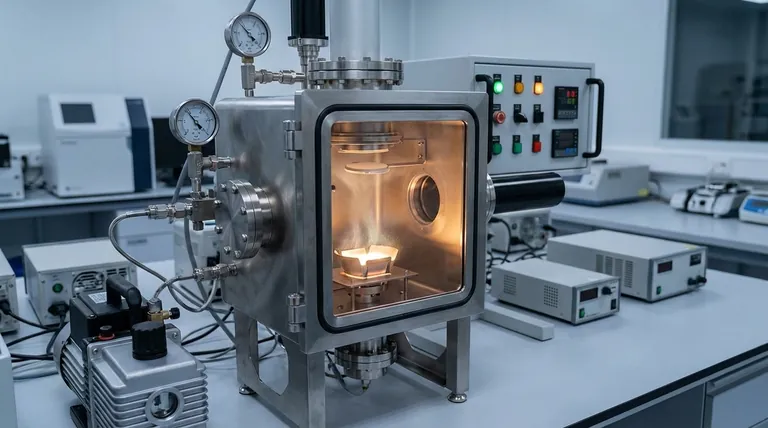
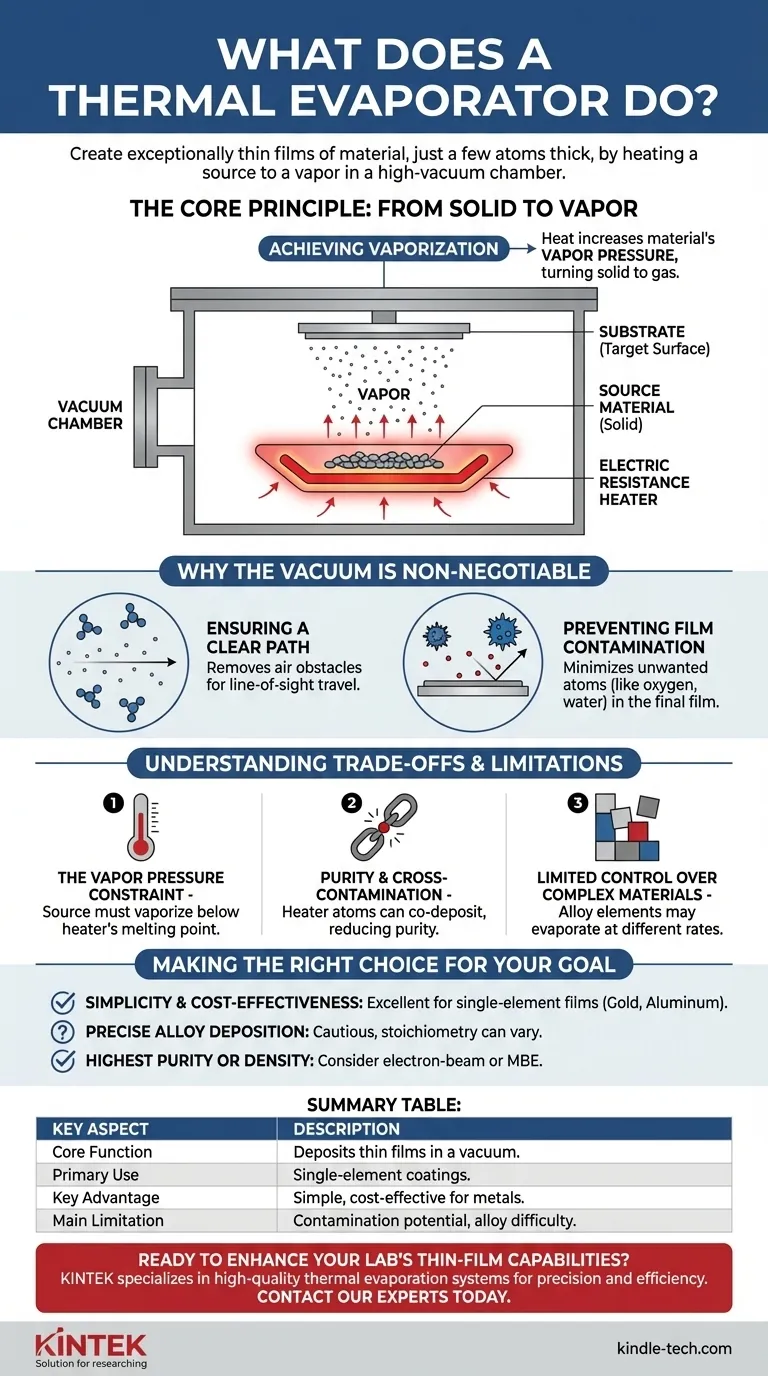
At its core, a thermal evaporator is a system used to create exceptionally thin films of material, often just a few atoms thick. It accomplishes this by heating a source material inside a high-vacuum chamber until it turns into a vapor, which then travels and condenses onto a target surface, known as a substrate.

A thermal evaporator fundamentally controls a material's phase change from solid to vapor. It uses heat to create a cloud of atoms in a vacuum, allowing them to precisely coat a surface without interference from air or impurities.
What does a thermal evaporator do? Achieve High-Purity Thin Film Deposition

The Core Principle: From Solid to Vapor

The entire process hinges on carefully managing heat and pressure to transform a solid source material into a gas that can be precisely directed.

The Role of the Heater

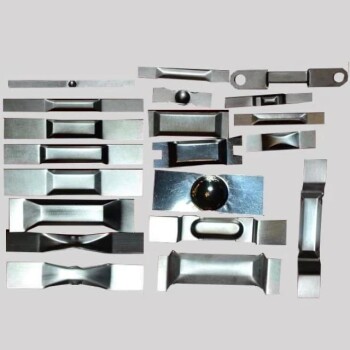
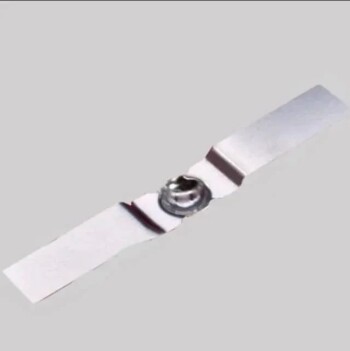
An electric resistance heater, often a small metallic boat or filament, is the engine of the evaporator. An electric current is passed through it, causing it to heat up significantly, much like the filament in an old incandescent lightbulb.

The source material you wish to deposit, typically in the form of pellets, wire, or powder, is placed directly onto or into this heater.

Achieving Vaporization

As the heater's temperature rises, it transfers this energy to the source material, causing it to melt. With continued heating, the material's vapor pressure increases dramatically.

Vapor pressure is the inherent tendency of a material to turn into a gas. By raising the temperature high enough, the material effectively boils and releases a vapor of its own atoms into the chamber.

Why the Vacuum is Non-Negotiable

The process is always performed inside a high-vacuum chamber. This controlled environment is not an optional feature; it is essential for two critical reasons.

Ensuring a Clear Path

At atmospheric pressure, a chamber is filled with trillions of air molecules (nitrogen, oxygen, etc.). If you tried to evaporate a material in these conditions, the vapor atoms would constantly collide with air molecules.

The vacuum removes these obstacles, creating a clear, line-of-sight path. This allows the vaporized atoms to travel unimpeded from the source directly to the substrate, ensuring an efficient and predictable coating process.

Preventing Film Contamination

The second purpose of the vacuum is to maintain purity. Gasses like oxygen and water vapor are highly reactive and can easily incorporate themselves into the growing film.

This incorporation of impurities can drastically alter the desired electrical, optical, or mechanical properties of the final film. A high vacuum minimizes the presence of these unwanted atoms, leading to a much purer deposit.

Understanding the Trade-offs and Limitations

While powerful, thermal evaporation is not a universal solution. Understanding its inherent constraints is key to using it effectively.

The Vapor Pressure Constraint

A fundamental limitation is that the source material must vaporize at a temperature lower than the melting point of the heating element.

If the heater melts or begins to vaporize before the source material does, it will contaminate the film or destroy the setup. This is why specific heater materials (like tungsten or molybdenum) are chosen for their extremely high melting points.

Purity and Cross-Contamination

While the vacuum removes atmospheric gasses, the heating element itself can be a source of contamination if operated at too high a temperature. Atoms from the heater can co-deposit with the source material.

This makes the technique less suitable for applications demanding the absolute highest levels of purity compared to other methods like electron-beam evaporation.

Limited Control Over Complex Materials

When evaporating alloys or compounds, the individual elements may have different vapor pressures. The element with the higher vapor pressure will evaporate faster, meaning the composition of the resulting film may not match the composition of the source material.

Making the Right Choice for Your Goal

Thermal evaporation is a foundational thin-film deposition technique. Here’s how to decide if it aligns with your needs.

  • If your primary focus is simplicity and cost-effectiveness: Thermal evaporation is an excellent and widely used method for depositing single-element films, especially common metals like aluminum, gold, chromium, or silver.
  • If your primary focus is depositing a precise alloy: You must be cautious, as the final film's stoichiometry can differ from the source. Other techniques like sputtering may offer better compositional control.
  • If your primary focus is the absolute highest film purity or density: Consider more advanced methods like electron-beam evaporation or molecular beam epitaxy (MBE), which provide greater control over contamination and film structure.

It is a powerful tool that transforms bulk materials into high-performance, atomically thin surfaces.

Summary Table:

Key Aspect Description
Core Function Deposits thin films of material onto a substrate in a vacuum.
Primary Use Coating with single-element materials like gold, silver, and aluminum.
Key Advantage Simplicity and cost-effectiveness for many metal deposition tasks.
Main Limitation Potential for contamination and difficulty with precise alloy deposition.

Ready to enhance your lab's thin-film capabilities?

KINTEK specializes in providing high-quality lab equipment, including reliable thermal evaporation systems. Whether you are depositing metals for electronics, optics, or research, our solutions are designed for precision and efficiency.

Contact our experts today to discuss your specific application and find the perfect thermal evaporator for your laboratory needs.

Visual Guide
What does a thermal evaporator do? Achieve High-Purity Thin Film Deposition Visual Guide

Related Products

People Also Ask

Related Products

Molybdenum Tungsten Tantalum Evaporation Boat for High Temperature Applications

Molybdenum Tungsten Tantalum Evaporation Boat for High Temperature Applications

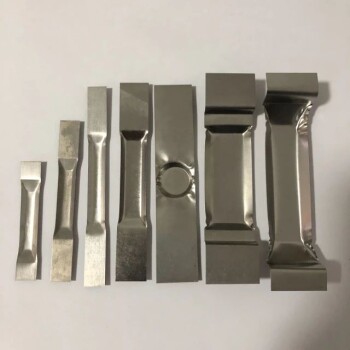
Evaporation boat sources are used in thermal evaporation systems and are suitable for depositing various metals, alloys and materials. Evaporation boat sources are available in different thicknesses of tungsten, tantalum and molybdenum to ensure compatibility with a variety of power sources. As a container, it is used for vacuum evaporation of materials. They can be used for thin film deposition of various materials, or designed to be compatible with techniques such as electron beam fabrication.

Aluminized Ceramic Evaporation Boat for Thin Film Deposition

Aluminized Ceramic Evaporation Boat for Thin Film Deposition

Vessel for depositing thin films; has an aluminum-coated ceramic body for improved thermal efficiency and chemical resistance. making it suitable for various applications.

Evaporation Boat for Organic Matter

Evaporation Boat for Organic Matter

The evaporation boat for organic matter is an important tool for precise and uniform heating during the deposition of organic materials.

5L Heating Chilling Circulator Cooling Water Bath Circulator for High and Low Temperature Constant Temperature Reaction

5L Heating Chilling Circulator Cooling Water Bath Circulator for High and Low Temperature Constant Temperature Reaction

KinTek KCBH 5L Heating Chilling Circulator - Ideal for labs and industrial conditions with multi-functional design and reliable performance.

20L Heating Chilling Circulator Cooling Water Bath Circulator for High and Low Temperature Constant Temperature Reaction

20L Heating Chilling Circulator Cooling Water Bath Circulator for High and Low Temperature Constant Temperature Reaction

Maximize lab productivity with KinTek KCBH 20L Heating Chilling Circulator. Its all-in-one design offers reliable heating, chilling, and circulating functions for industrial and lab use.

50L Heating Chilling Circulator Cooling Water Bath Circulator for High and Low Temperature Constant Temperature Reaction

50L Heating Chilling Circulator Cooling Water Bath Circulator for High and Low Temperature Constant Temperature Reaction

Experience versatile heating, chilling, and circulating capabilities with our KinTek KCBH 50L Heating Chilling Circulator. Ideal for labs and industrial settings, with efficient and reliable performance.

100L Heating Chilling Circulator Cooling Water Bath Circulator for High and Low Temperature Constant Temperature Reaction

100L Heating Chilling Circulator Cooling Water Bath Circulator for High and Low Temperature Constant Temperature Reaction

Get all-in-one heating, chilling, and circulating capabilities with our KinTek KCBH 80L Heating Chilling Circulator. High efficiency, reliable performance for labs and industrial applications.

High Purity Pure Graphite Crucible for Evaporation

High Purity Pure Graphite Crucible for Evaporation

Vessels for high temperature applications, where materials are kept at extremely high temperatures to evaporate, allowing thin films to be deposited on substrates.

30L Heating Chilling Circulator Cooling Water Bath Circulator for High and Low Temperature Constant Temperature Reaction

30L Heating Chilling Circulator Cooling Water Bath Circulator for High and Low Temperature Constant Temperature Reaction

Get versatile lab performance with KinTek KCBH 30L Heating Chilling Circulator. With max. heating temp of 200℃ and max. chilling temp of -80℃, it's perfect for industrial needs.

Molybdenum Tungsten Tantalum Special Shape Evaporation Boat

Molybdenum Tungsten Tantalum Special Shape Evaporation Boat

Tungsten Evaporation Boat is ideal for vacuum coating industry and sintering furnace or vacuum annealing. we offers tungsten evaporation boats that are designed to be durable and robust, with long operating lifetimes and to ensure consistent smooth and even spreading of the molten metals.

Ceramic Evaporation Boat Set Alumina Crucible for Laboratory Use

Ceramic Evaporation Boat Set Alumina Crucible for Laboratory Use

It can be used for vapor deposition of various metals and alloys. Most metals can be evaporated completely without loss. Evaporation baskets are reusable.1

Hemispherical Bottom Tungsten Molybdenum Evaporation Boat

Hemispherical Bottom Tungsten Molybdenum Evaporation Boat

Used for gold plating, silver plating, platinum, palladium, suitable for a small amount of thin film materials. Reduce the waste of film materials and reduce heat dissipation.

Tungsten Evaporation Boat for Thin Film Deposition

Tungsten Evaporation Boat for Thin Film Deposition

Learn about tungsten boats, also known as evaporated or coated tungsten boats. With a high tungsten content of 99.95%, these boats are ideal for high-temperature environments and widely used in various industries. Discover their properties and applications here.

10L Heating Chilling Circulator Cooling Water Bath Circulator for High and Low Temperature Constant Temperature Reaction

10L Heating Chilling Circulator Cooling Water Bath Circulator for High and Low Temperature Constant Temperature Reaction

Experience efficient lab performance with KinTek KCBH 10L Heating Chilling Circulator. Its all-in-one design offers reliable heating, chilling, and circulating functions for industrial and lab use.

High Temperature Constant Temperature Heating Circulator Water Bath Chiller Circulator for Reaction Bath

High Temperature Constant Temperature Heating Circulator Water Bath Chiller Circulator for Reaction Bath

Efficient and reliable, KinTek KHB Heating Circulator is perfect for your lab needs. With a max. heating temperature of up to 300℃, it features accurate temperature control and fast heating.

Electron Beam Evaporation Coating Gold Plating Tungsten Molybdenum Crucible for Evaporation

Electron Beam Evaporation Coating Gold Plating Tungsten Molybdenum Crucible for Evaporation

These crucibles act as containers for the gold material evaporated by the electron evaporation beam while precisely directing the electron beam for precise deposition.

Electron Beam Evaporation Coating Oxygen-Free Copper Crucible and Evaporation Boat

Electron Beam Evaporation Coating Oxygen-Free Copper Crucible and Evaporation Boat

Electron Beam Evaporation Coating Oxygen-Free Copper Crucible enables precise co-deposition of various materials. Its controlled temperature and water-cooled design ensure pure and efficient thin film deposition.

Electron Beam Evaporation Coating Conductive Boron Nitride Crucible BN Crucible

Electron Beam Evaporation Coating Conductive Boron Nitride Crucible BN Crucible

High-purity and smooth conductive boron nitride crucible for electron beam evaporation coating, with high temperature and thermal cycling performance.

Evaporation Crucible for Organic Matter

Evaporation Crucible for Organic Matter

An evaporation crucible for organic matter, referred to as an evaporation crucible, is a container for evaporating organic solvents in a laboratory environment.

E Beam Crucibles Electron Gun Beam Crucible for Evaporation

E Beam Crucibles Electron Gun Beam Crucible for Evaporation

In the context of electron gun beam evaporation, a crucible is a container or source holder used to contain and evaporate the material to be deposited onto a substrate.


Leave Your Message