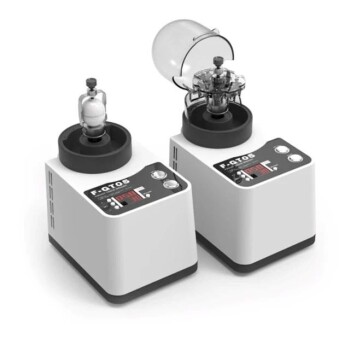
To prevent oxidation during Fe3Al production, the ball mill jar must function as a hermetically sealed environment that completely excludes atmospheric oxygen. Specifically, the jar must be capable of holding a vacuum and being backfilled with a high-purity inert gas, such as 99.99% argon, to neutralize the chemical reactivity of the powders.
High-energy milling drastically increases the reactivity of materials by expanding their surface area and raising temperatures. To produce alloy powders with low oxygen content, you must use a vacuum ball mill jar equipped with a sealing ring to maintain a strictly inert argon atmosphere.
The Drivers of Oxidation Risk
Increased Surface Area
During high-energy ball milling, the precursor powders are relentlessly fractured and deformed.
This process significantly increases the specific surface area of the material.
As fresh, unoxidized surfaces are exposed, the powder becomes highly susceptible to reacting with any oxygen present in the environment.
Elevated Processing Temperatures
The kinetic energy from the milling media converts into heat during the process.
This resulting rise in temperature acts as a catalyst, accelerating chemical reactions.
Without environmental controls, this thermal energy makes the already reactive powders oxidize rapidly.
Essential Jar Specifications
Vacuum Capabilities
The jar must be designed to withstand evacuation.
Before milling begins, the air inside the jar must be removed to eliminate the initial presence of oxygen.
High-Integrity Sealing
A robust sealing ring is a non-negotiable component of the jar assembly.
This seal ensures that once the environment is established, no ambient air can leak in during the long, high-stress milling cycle.
Inert Gas Backfilling
After evacuation, the jar must be backfilled with an inert gas.
The primary reference specifies high-purity argon (99.99%) for this purpose.
This gas acts as a protective blanket, preventing the hot, high-surface-area powders from interacting with oxygen.
Critical Considerations and Trade-offs
Sensitivity to Gas Purity
Using standard industrial argon is often insufficient for sensitive alloys like Fe3Al.
You must adhere strictly to the 99.99% purity standard; anything less introduces trace contaminants that can compromise the final alloy's mechanical properties.
Reliance on Seal Integrity
The entire protection strategy relies on the mechanical integrity of the sealing ring.
If the seal degrades due to wear or improper installation, the vacuum is lost, and the batch will likely suffer from oxidation regardless of the initial gas purity.
Ensuring Process Integrity
To successfully produce Fe3Al powders with low oxygen content, align your equipment choices with your quality goals.
- If your primary focus is chemical purity: Prioritize the supply of 99.99% high-purity argon to effectively blanket the reactive surfaces.
- If your primary focus is equipment reliability: Select a ball mill jar with a proven high-vacuum sealing mechanism to prevent atmospheric leakage during the heating phase.
Strict adherence to these environmental controls is the only way to transform reactive precursors into high-quality alloy powders.
Summary Table:
| Requirement | Specification | Purpose |
|---|---|---|
| Atmosphere Control | 99.99% High-Purity Argon | Neutralizes chemical reactivity of powders |
| Jar Integrity | Hermetically Sealed with O-ring | Prevents ambient oxygen/moisture ingress |
| Pressure Capability | Vacuum-rated with Backfill Port | Eliminates initial oxygen and facilitates gas inerting |
| Surface Management | Constant Inert Blanketing | Protects new surfaces created by high-energy fracturing |
Secure Your Material Purity with KINTEK
Don't let oxidation compromise your alloy research. KINTEK specializes in precision-engineered laboratory solutions, offering robust crushing and milling systems and vacuum-rated ball mill jars designed for the most sensitive reactions. Whether you are producing Fe3Al precursors or advanced battery materials, our high-performance ball mills, hydraulic presses, and high-temperature furnaces ensure repeatable, oxygen-free results every time.
Ready to upgrade your lab's processing capabilities? Contact KINTEK today for expert consultation!
Related Products
- Laboratory Jar Ball Mill with Alumina Zirconia Grinding Jar and Balls
- Laboratory Ball Mill Jar Mill with Metal Alloy Grinding Jar and Balls
- Laboratory Single Horizontal Jar Mill
- Laboratory Four-Body Horizontal Jar Mill
- Laboratory Jar Mill with Agate Grinding Jar and Balls
People Also Ask
- What are the primary functions of using a ball mill for BZCY72 powder? Achieve High Purity and Enhanced Sintering
- In what way does a laboratory ball mill affect material properties when modifying PHBV/pulp fiber composites?
- Why is a laboratory ball mill required for ultra-fine fly ash? Unlock Nano-Scale Adsorption Power
- What is the function of a laboratory ball mill in the preparation of AMMCs? Optimize Dispersion & Grain Refinement
- What is the function of a laboratory ball mill in the pretreatment of waste tire char (WTC)? Optimize Material Reactivity