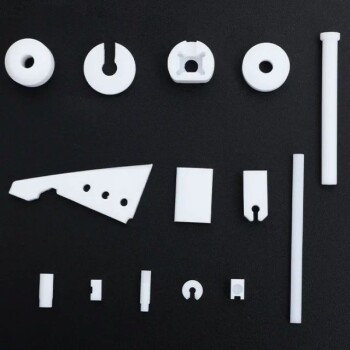
PTFE insulation sleeves serve as the critical interface between the structural integrity and electrical safety of a solid-state battery mold. They function primarily to define the geometric shape of the compressed powder while simultaneously acting as a barrier to electrically isolate the positive and negative current collectors, preventing internal short circuits.
The PTFE sleeve is not merely a passive container; it is an active component that enables high-pressure molding without compromising the electrochemical data. It ensures that the physical compression of the powder does not lead to electrical interference or chemical contamination.
Primary Functions in Battery Assembly
Defining Geometric Geometry
The first role of the PTFE sleeve is powder molding. In the assembly process, loose battery powder must be compressed into a solid, cohesive pellet.
The sleeve provides the radial confinement necessary for this process. It dictates the final shape of the solid electrolyte or electrode material, ensuring precise dimensions for consistent testing.
Preventing Internal Short Circuits
The second, equally vital function is electrical insulation.
Inside the mold, the positive and negative current collectors are placed under significant pressure. Without a physical barrier, these conductive elements could make contact.
The PTFE sleeve physically separates these collectors. This isolation is mandatory to prevent internal short circuits, which would render the battery cell useless and invalidate any test data.
Material Stability and Performance
Ensuring Chemical Inertness
Beyond mechanics and electronics, the chemical properties of the sleeve are essential. Solid-state battery materials can be highly reactive.
PTFE (Teflon) is selected for its chemical inertness. It remains stable even when in direct contact with active battery materials.
This ensures that the sleeve does not degrade or react with the powder, preserving the purity of the sample and the accuracy of the electrochemical results.
Operational Constraints and Criticality
The Consequence of Geometry Failure
The dual nature of the sleeve means that mechanical failure leads to electrical failure.
If the sleeve does not maintain the geometric shape effectively, the current collectors may shift. This misalignment can bypass the insulation barrier, leading directly to the short circuits the sleeve was designed to prevent.
Reliance on Material Integrity
The system relies entirely on the continuous integrity of the PTFE.
Because the sleeve is the only barrier against chemical interaction and electrical shorts, any surface defects or damage to the sleeve directly threatens the validity of the experiment.
Ensuring Assembly Success
For engineers and researchers assembling solid-state battery molds, the PTFE sleeve dictates the reliability of your cell.
- If your primary focus is Geometric Precision: Ensure the PTFE sleeve is sized correctly to confine the powder strictly, defining the pellet's shape under pressure.
- If your primary focus is Electrical Integrity: Verify the sleeve fully isolates the current collectors, as this is the primary safeguard against internal short circuits.
- If your primary focus is Chemical Purity: Rely on the inert nature of PTFE to maintain stability, ensuring no reactions occur between the mold and your active materials.
The PTFE sleeve is the fundamental component that allows high-pressure physical assembly to coexist with sensitive electrochemical testing.
Summary Table:
| Function | Description | Key Benefit |
|---|---|---|
| Powder Molding | Provides radial confinement for loose powder under high pressure. | Ensures precise geometric shape and pellet consistency. |
| Electrical Isolation | Separates positive and negative current collectors physically. | Prevents internal short circuits during testing. |
| Chemical Stability | Utilizes PTFE's inert properties to resist reactivity. | Preserves sample purity and ensures data accuracy. |
| Pressure Endurance | Maintains structural integrity under high-pressure molding. | Facilitates high-density solid-state battery assembly. |
Elevate Your Battery Research with KINTEK Precision
Ensure the integrity of your solid-state experiments with KINTEK’s high-performance laboratory solutions. As specialists in advanced material research, we provide everything from PTFE consumables and ceramic crucibles to specialized hydraulic pellet presses and battery research tools.
Whether you are scaling up with high-temperature vacuum furnaces or perfecting cell assembly with our premium insulation sleeves, KINTEK delivers the reliability your lab demands. Don't let material failure compromise your data—leverage our expertise in high-pressure and high-temperature environments to achieve breakthrough results.
Ready to optimize your assembly process? Contact KINTEK today for expert guidance and tailored equipment solutions!
Related Products
- Custom PTFE Teflon Parts Manufacturer for Non-Standard Insulator Customization
- Polyethylene Separator for Lithium Battery
People Also Ask
- How is PTFE utilized for insulation in Alloy 22 corrosion setups? Ensure Signal Purity & Accuracy
- Is PTFE corrosion resistant? Discover the Ultimate Chemical Resistance for Your Lab
- What are the specific applications of PTFE in micro-batch slug flow systems? Enhance Your Microfluidic Reaction Purity
- What is the primary function of PTFE in Gas Diffusion Electrodes (GDE)? Ensure Peak Electrochemical Performance
- What is the function of PTFE in a gas diffusion electrode? Mastering CO2 Electrolyzer Stability