Knowledge What is the capacity of a laboratory oven? How to Choose the Right Size for Your Lab Needs
Author avatar

Tech Team · Kintek Solution

Updated 6 days ago

What is the capacity of a laboratory oven? How to Choose the Right Size for Your Lab Needs


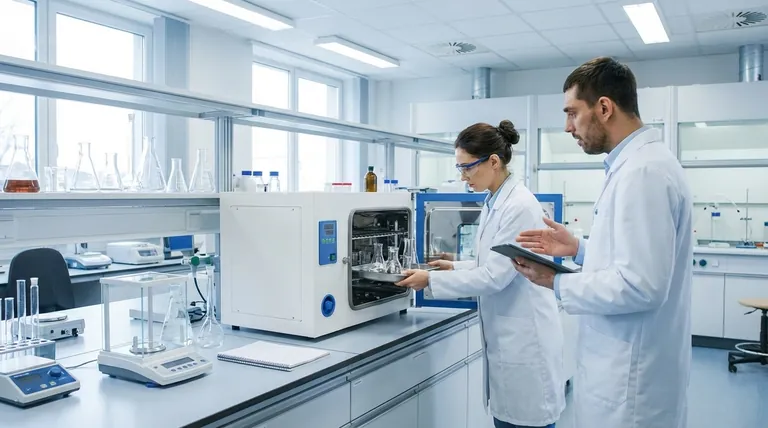
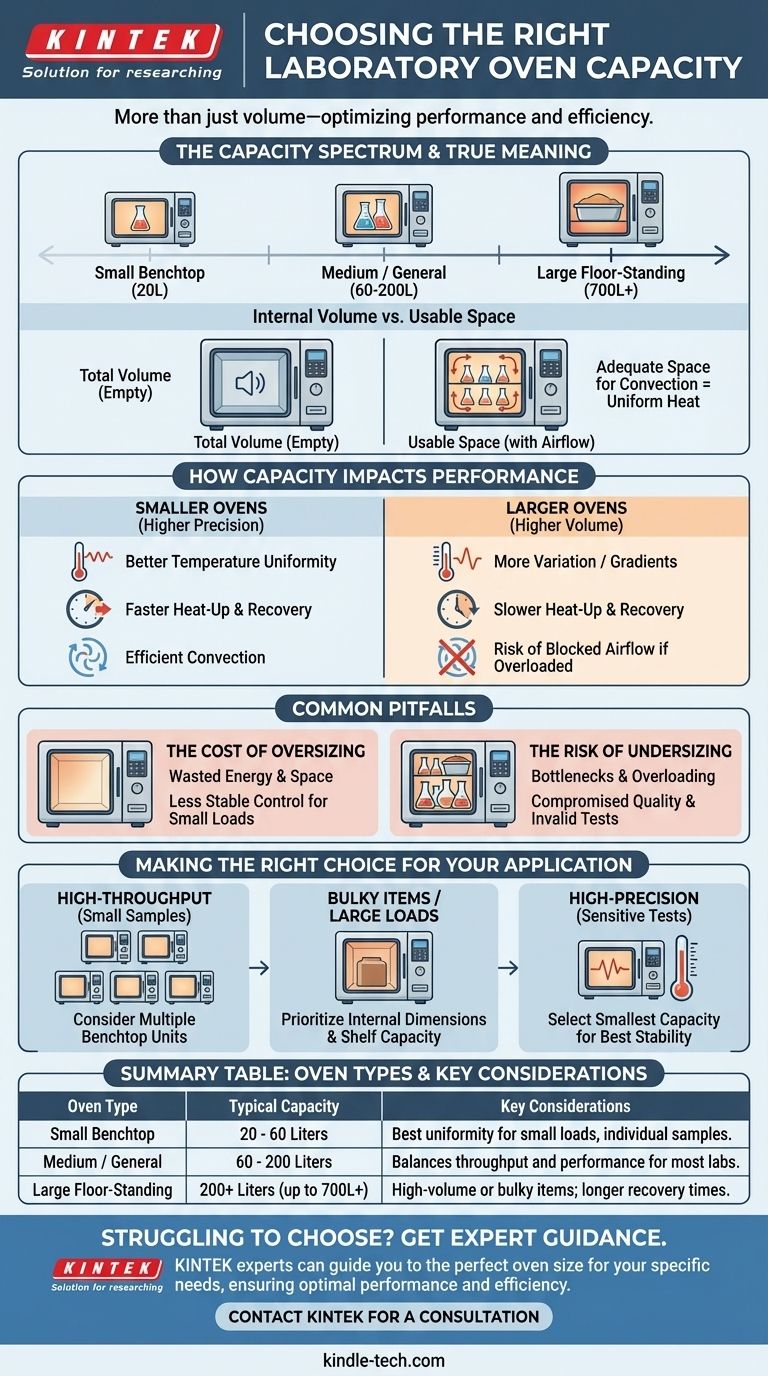
The capacity of a laboratory oven is not a single number, but a range that varies dramatically based on the model and its intended use. Capacities typically start from small benchtop units around 20 Liters (less than 1 cubic foot) and can extend to large, floor-standing models exceeding 700 Liters (over 24 cubic feet).

Choosing the correct oven capacity is not just about fitting your items inside. The critical challenge is selecting a volume that ensures optimal performance—specifically temperature uniformity and recovery—for your specific application without wasting energy or lab space.
What is the capacity of a laboratory oven? How to Choose the Right Size for Your Lab Needs

Understanding What "Capacity" Truly Means

The stated volume is only the beginning of the story. True capacity is a function of usable space and how that space impacts the oven's primary function of delivering stable, uniform heat.

Internal Volume (Liters or Cubic Feet)

This is the most common metric advertised by manufacturers. It refers to the total empty space inside the oven's chamber. This figure helps you categorize ovens into general sizes, such as small benchtop models for individual use or large-capacity units for high-throughput work.

Usable Space vs. Total Volume

Crucially, you cannot use 100% of the internal volume. Laboratory ovens rely on convection heating—the circulation of hot air—to ensure all samples reach the target temperature uniformly. For this to work, you must leave adequate space around your samples for air to flow.

Overloading an oven by packing it too tightly blocks this airflow, creating cold spots and compromising the accuracy of your drying, curing, or sterilization process.

Shelf Capacity and Loading

The practical capacity is also defined by the number of shelves and their individual weight limits. Consider not just the total volume but how your specific glassware, components, or samples will be arranged on the shelves provided.

How Capacity Directly Impacts Oven Performance

A larger chamber is not inherently better. The oven's volume is directly tied to its thermal performance characteristics, which are critical for achieving reliable and repeatable results.

Temperature Uniformity

Maintaining a consistent temperature throughout the entire chamber is one of the most important functions of a lab oven. Larger ovens inherently have a more difficult time achieving tight uniformity, as there is a greater volume of air to heat and circulate. For highly sensitive materials, a smaller, well-designed oven often provides superior stability.

Heat-Up and Recovery Times

A larger volume of air takes more energy and time to heat up initially. More importantly, every time you open the door, cool air enters the chamber. A larger oven will take significantly longer to recover its setpoint temperature, which can slow down your workflow and affect sample consistency.

The Role of Convection and Venting

As noted, convection is key to removing moisture during a drying process. The circulated air picks up humidity, which is then expelled through a vent. If an oven is overloaded, this process becomes inefficient, dramatically increasing drying times and potentially leaving samples improperly treated.

Common Pitfalls to Avoid

Choosing the wrong size has practical consequences that go beyond just fitting your samples. Understanding these trade-offs is key to making a sound investment.

The Cost of Oversizing

Selecting an oven that is too large for your typical workload is inefficient. It consumes more electricity to heat the unused space, has a larger physical footprint in your lab, and may provide less stable temperature control for small sample loads.

The Risk of Undersizing

An undersized oven creates a workflow bottleneck, forcing you to run more cycles than necessary. More critically, it encourages users to overload the chamber to save time, which directly compromises the quality and reliability of the results. This can invalidate tests and ruin sensitive materials.

Making the Right Choice for Your Application

Analyze your primary need to determine the ideal capacity.

  • If your primary focus is high-throughput processing of many small samples: Consider multiple smaller benchtop ovens, which can offer greater flexibility and better temperature recovery than one single large unit.
  • If your primary focus is drying large or bulky items: Prioritize the oven's internal dimensions and shelf weight capacity, ensuring your specific items will fit with adequate clearance for airflow.
  • If your primary focus is high-precision heating for sensitive tests: Select the smallest capacity that will comfortably meet your needs, as this often provides the best temperature uniformity and stability.

Ultimately, selecting the right oven capacity is about matching the physical space to your scientific requirements to ensure repeatable and accurate results.

Summary Table:

Oven Type Typical Capacity Range Key Considerations
Small Benchtop 20 - 60 Liters Ideal for individual samples, offers best temperature uniformity for small loads.
Medium / General Purpose 60 - 200 Liters Balances throughput and performance for most standard lab applications.
Large Floor-Standing 200+ Liters (up to 700L+) Designed for high-volume processing or large/bulky items; longer heat recovery.

Struggling to choose the right lab oven capacity for your specific application?

KINTEK specializes in laboratory equipment and consumables, helping labs like yours achieve precise and reliable results. Our experts can guide you to the perfect oven size—ensuring optimal temperature uniformity, efficient workflow, and energy savings—based on your exact samples and throughput needs.

Don't let the wrong oven size compromise your work. Contact KINTEK today for a personalized consultation!

Visual Guide
What is the capacity of a laboratory oven? How to Choose the Right Size for Your Lab Needs Visual Guide

Related Products

People Also Ask

Related Products

Laboratory Scientific Electric Heating Blast Drying Oven

Laboratory Scientific Electric Heating Blast Drying Oven

The desktop fast autoclave sterilizer is a compact and reliable device used for rapid sterilization of medical, pharmaceutical, and research items.

1200℃ Muffle Furnace Oven for Laboratory

1200℃ Muffle Furnace Oven for Laboratory

Upgrade your lab with our 1200℃ Muffle Furnace. Achieve fast, precise heating with Japan alumina fibers and Molybdenum coils. Features TFT touch screen controller for easy programming and data analysis. Order now!

Graphite Vacuum Furnace Negative Material Graphitization Furnace

Graphite Vacuum Furnace Negative Material Graphitization Furnace

Graphitization furnace for battery production has uniform temperature and low energy consumption. Graphitization furnace for negative electrode materials: an efficient graphitization solution for battery production and advanced functions to enhance battery performance.

Laboratory Vortex Mixer Orbital Shaker Multifunctional Rotation Oscillation Mixer

Laboratory Vortex Mixer Orbital Shaker Multifunctional Rotation Oscillation Mixer

The inching mixer is small in size, mixes quickly and thoroughly, and the liquid is in a vortex shape, which can mix all the test solutions attached to the tube wall.

Custom PTFE Teflon Parts Manufacturer PTFE Beaker and Lids

Custom PTFE Teflon Parts Manufacturer PTFE Beaker and Lids

The PTFE beaker is a laboratory container that is resistant to acid, alkali, high and low temperatures and is suitable for temperatures ranging from -200ºC to +250ºC. This beaker has excellent chemical stability and is widely used for heat treatment samples and volume analysis.

Laboratory Sterilizer Lab Autoclave Pulsating Vacuum Desktop Steam Sterilizer

Laboratory Sterilizer Lab Autoclave Pulsating Vacuum Desktop Steam Sterilizer

The pulsating vacuum desktop steam sterilizer is a compact and reliable device used for rapid sterilization of medical, pharmaceutical, and research items.

Laboratory Vibratory Sieve Shaker Machine Slap Vibrating Sieve

Laboratory Vibratory Sieve Shaker Machine Slap Vibrating Sieve

KT-T200TAP is a slapping and oscillating sieving instrument for laboratory desktop use, with 300 rpm horizontal circular motion and 300 vertical slapping motions to simulate manual sieving to help sample particles pass through better.

Horizontal High Temperature Graphite Vacuum Graphitization Furnace

Horizontal High Temperature Graphite Vacuum Graphitization Furnace

Horizontal Graphitization Furnace: This type of furnace is designed with the heating elements placed horizontally, allowing for uniform heating of the sample. It's well-suited for graphitizing large or bulky samples that require precise temperature control and uniformity.

Lab Internal Rubber Mixer Rubber Kneader Machine for Mixing and Kneading

Lab Internal Rubber Mixer Rubber Kneader Machine for Mixing and Kneading

Lab internal rubber mixer is suitable for mixing, kneading and dispersing various chemical raw materials such as plastics, rubber, synthetic rubber, hot melt adhesive and various low-viscosity materials.

Electric Rotary Kiln Pyrolysis Furnace Plant Machine Calciner Small Rotary Kiln Rotating Furnace

Electric Rotary Kiln Pyrolysis Furnace Plant Machine Calciner Small Rotary Kiln Rotating Furnace

Electric rotary kiln - precisely controlled, it's ideal for calcination and drying of materials like lithium cobalate, rare earths, and non-ferrous metals.

Large Vertical Graphite Vacuum Graphitization Furnace

Large Vertical Graphite Vacuum Graphitization Furnace

A large vertical high-temperature graphitization furnace is a type of industrial furnace used for the graphitization of carbon materials, such as carbon fiber and carbon black. It is a high-temperature furnace that can reach temperatures of up to 3100°C.

Graphite Vacuum Furnace Bottom Discharge Graphitization Furnace for Carbon Materials

Graphite Vacuum Furnace Bottom Discharge Graphitization Furnace for Carbon Materials

Bottom-out graphitization furnace for carbon materials, ultra-high temperature furnace up to 3100°C, suitable for graphitization and sintering of carbon rods and carbon blocks. Vertical design, bottom discharging, convenient feeding and discharging, high temperature uniformity, low energy consumption, good stability, hydraulic lifting system, convenient loading and unloading.

Vacuum Heat Treat and Pressure Sintering Furnace for High Temperature Applications

Vacuum Heat Treat and Pressure Sintering Furnace for High Temperature Applications

Vacuum pressure sintering furnaces are designed for high temperature hot pressing applications in metal and ceramic sintering. Its advanced features ensure precise temperature control, reliable pressure maintenance, and a robust design for seamless operation.

Automatic Laboratory Heat Press Machine

Automatic Laboratory Heat Press Machine

Precision automatic heat press machines for labs—ideal for material testing, composites, and R&D. Customizable, safe, and efficient. Contact KINTEK today!

Multi Heating Zones CVD Tube Furnace Machine Chemical Vapor Deposition Chamber System Equipment

Multi Heating Zones CVD Tube Furnace Machine Chemical Vapor Deposition Chamber System Equipment

KT-CTF14 Multi Heating Zones CVD Furnace - Precise Temperature Control and Gas Flow for Advanced Applications. Max temp up to 1200℃, 4 channels MFC mass flow meter, and 7" TFT touch screen controller.

Vacuum Cold Trap Chiller Indirect Cold Trap Chiller

Vacuum Cold Trap Chiller Indirect Cold Trap Chiller

Boost vacuum system efficiency and prolong pump life with our Indirect Cold Trap. Built-in chilling system with no need for fluid or dry ice. Compact design and easy to use.

Laboratory Oscillating Orbital Shaker

Laboratory Oscillating Orbital Shaker

Mixer-OT orbital shaker uses brushless motor, which can run for a long time. It is suitable for vibration tasks of culture dishes, flasks and beakers.

High-Purity Titanium Foil and Sheet for Industrial Applications

High-Purity Titanium Foil and Sheet for Industrial Applications

Titanium is chemically stable, with a density of 4.51g/cm3, which is higher than aluminum and lower than steel, copper, and nickel, but its specific strength ranks first among metals.

Laboratory Multifunctional Small Speed-Adjustable Horizontal Mechanical Shaker for Lab

Laboratory Multifunctional Small Speed-Adjustable Horizontal Mechanical Shaker for Lab

The laboratory multifunctional speed-regulating oscillator is a constant-speed experimental equipment specially developed for modern bioengineering production units.

Custom PTFE Teflon Parts Manufacturer for Culture Dish and Evaporation Dish

Custom PTFE Teflon Parts Manufacturer for Culture Dish and Evaporation Dish

The PTFE culture dish evaporating dish is a versatile laboratory tool known for its chemical resistance and high-temperature stability. PTFE, a fluoropolymer, offers exceptional non-stick properties and durability, making it ideal for various applications in research and industry, including filtration, pyrolysis, and membrane technology.


Leave Your Message