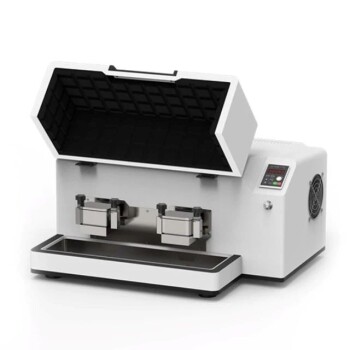
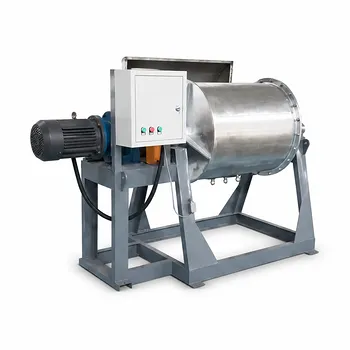
The core function of a high-energy ball mill in the preparation of Al-Cu-ZrC composite powders is to act as a high-intensity kinetic reactor that facilitates mechanical alloying. Through high-frequency impacts of grinding media, the mill physically forces the aluminum and copper matrix to undergo repeated cold welding and fracturing, while simultaneously fragmenting and refining the micron-sized ZrC reinforcement particles.
Core Takeaway High-energy ball milling is not merely a mixing process; it is a mechanical alloying technique that fundamentally alters particle structure. By balancing the fracturing of ceramic reinforcements with the cold welding of metal powders, it creates the uniform dispersion and grain refinement necessary for high-hardness composite materials.
The Mechanical Alloying Mechanism
Refinement of the Reinforcement Phase
The primary challenge in creating Al-Cu-ZrC composites is handling the hard ceramic phase (ZrC). The high-energy ball mill addresses this by delivering high-frequency impacts via the grinding media.
This intense mechanical energy serves to fragment the initial micron-sized ZrC particles. By physically breaking these particles down, the mill reduces their scale, preparing them for better integration into the metal matrix.
Evolution of the Matrix (Al-Cu)
While the ceramic particles are being crushed, the metallic matrix (Aluminum and Copper) undergoes a different transformation. The soft metal powders are subjected to a continuous cycle of cold welding and fracturing.
As the grinding media impacts the metal powders, they flatten and weld together, trapping the refined ZrC particles between layers. Subsequent impacts fracture these welded particles, exposing fresh surfaces for re-welding. This cycle is the definition of mechanical alloying.
Achieving Microstructural Homogeneity
Uniform Dispersion
The ultimate goal of the welding-fracturing cycle is uniform dispersion. Simple mixing often leads to agglomeration (clumping) of the reinforcement phase, which creates weak points in the final material.
The high-energy milling process mechanically forces the ZrC particles into the Al-Cu matrix. This ensures the reinforcement is evenly distributed throughout the composite, which is a critical prerequisite for consistent material performance.
Grain Size Refinement
Beyond mixing, the high-energy input significantly refines the grain size of the composite powder.
The constant introduction of defects and structural deformation during milling prevents grain growth and reduces the average grain size. This establishes the structural foundation required for producing materials with high hardness.
Understanding the Process Dynamics
The Balance of Forces
A critical aspect of this process is the balance between the impact energy and the material behavior.
The process relies on the dual action of fracturing (breaking the brittle ZrC) and welding (binding the ductile Al-Cu). If the energy is insufficient, the ZrC will not fragment, leading to poor dispersion. Conversely, the specific mechanics of the mill must ensure that the matrix does not simply agglomerate without incorporating the reinforcement.
Mechanical Energy Input
The effectiveness of this method is directly tied to the mechanical energy provided by the mill.
Unlike low-energy mixing, high-energy milling utilizes intense friction and shear forces. This energy input is non-negotiable; it is the driving force that overcomes the natural resistance of the materials to mix at the atomic or near-atomic level.
Making the Right Choice for Your Goal
When employing high-energy ball milling for Al-Cu-ZrC composites, your operational parameters should be dictated by your specific material objectives:
- If your primary focus is Hardness: Prioritize the refinement aspect of the milling process to ensure ZrC particles are fragmented to the smallest possible size and grain size is minimized.
- If your primary focus is Microstructural Uniformity: Focus on the duration of the cold welding and fracturing cycle to guarantee that the reinforcement phase is fully and evenly entrapped within the matrix.
Successful preparation of Al-Cu-ZrC composites relies on utilizing the ball mill not just as a mixer, but as a tool to mechanically force the integration of disparate materials through high-energy impact.
Summary Table:
| Mechanism | Function in Al-Cu-ZrC Preparation |
|---|---|
| Mechanical Alloying | Facilitates repeated cold welding and fracturing of Al-Cu matrix. |
| ZrC Fragmentation | Breaks down micron-sized ceramic reinforcements for better integration. |
| Grain Refinement | Introduces structural defects to reduce grain size for higher hardness. |
| Kinetic Dispersion | Forces uniform distribution of ZrC to prevent phase agglomeration. |
| Energy Input | Provides intense shear and impact forces to overcome material resistance. |
Elevate Your Material Synthesis with KINTEK Precision
Achieving perfect microstructural homogeneity in Al-Cu-ZrC composites requires more than just a mixer—it requires a high-performance crushing and milling system designed for intense mechanical alloying. KINTEK specializes in providing researchers and manufacturers with state-of-the-art laboratory equipment, including high-energy ball mills, hydraulic presses (pellet, hot, isostatic), and high-temperature furnaces for post-milling sintering.
Whether you are refining ceramic reinforcements or developing high-hardness alloys, our comprehensive portfolio of crucibles, ceramics, and planetary mills ensures your lab achieves repeatable, industrial-grade results.
Ready to optimize your powder metallurgy process? Contact our technical experts today to find the perfect milling solution for your research goals.
Related Products
- High Energy Planetary Ball Mill Milling Machine for Laboratory
- High Energy Planetary Ball Mill for Laboratory Horizontal Tank Type Milling Machine
- High-Energy Omnidirectional Planetary Ball Mill Milling Machine for Laboratory
- High Energy Planetary Ball Mill Milling Machine for Laboratory
- High Energy Planetary Ball Mill Machine for Laboratory Horizontal Tank Type
People Also Ask
- How does a planetary ball mill provide mechanical activation for scandium recovery? Maximize Your Leaching Efficiency
- What role do planetary ball mills and zirconia media play in LLZT preparation? Optimize Your Solid Electrolyte Research
- What is the function of a planetary ball mill in the preparation of high-entropy rare earth silicate multi-phase ceramics?
- What is the purpose of using a planetary ball mill for cathode material regeneration? Achieve Atomic-Level Mixing
- What is the primary function of a planetary ball mill? Mastering SiC/Al Composite Mixing for Homogeneity