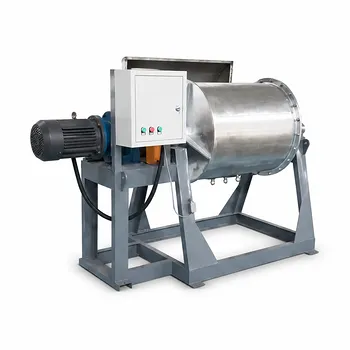
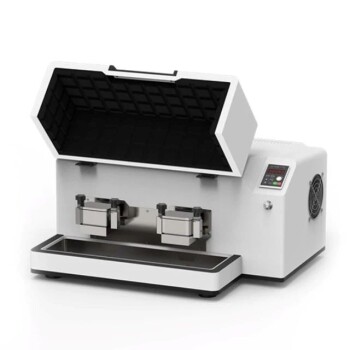
The critical role of the planetary ball mill in pretreating Cr40-Si60 is to mechanically activate the powder. While it ensures a uniform physical mixture of silicon and chromium, its primary technical value lies in inducing severe lattice distortion and high-density defects within the particles to facilitate downstream processing.
Core Takeaway The planetary ball mill does more than blend materials; it acts as a mechanical activator that fundamentally alters the internal energy state of the powder. By introducing crystalline defects, it lowers the energy barrier for atomic diffusion, making the subsequent solid-phase reaction during sintering significantly more efficient.
The Mechanism of Mechanical Activation
The term "mixing" fails to capture the high-energy physics occurring inside the mill. For Cr40-Si60, the process is a deliberate modification of the material's microstructure.
Inducing Lattice Distortion
The high-energy collisions in a planetary ball mill subject the powder particles to intense impact and shear forces.
This physical trauma causes severe lattice distortion within the crystalline structure of the silicon and chromium. The atoms are forced out of their equilibrium positions, creating a strained, high-energy state.
Creating High-Density Defects
Beyond simple distortion, the process generates a high concentration of crystalline defects.
These defects disrupt the perfect order of the crystal lattice. In materials science, these disruptions are not "flaws" but necessary active sites that dramatically increase the internal energy of the material.
Facilitating the Sintering Process
The ultimate goal of this pretreatment is to optimize the material for the sintering stage. The mechanical activation described above is directly linked to reaction kinetics.
Enhancing Atomic Diffusion
Sintering relies on the movement of atoms (diffusion) to bond particles together.
The lattice distortions and defects created by the ball mill act as "highways" for atomic movement. They effectively activate the powder, allowing atoms to diffuse more readily across particle boundaries.
Promoting Solid-Phase Reactions
Because the powder is in a highly activated state, the chemical reactivity is enhanced.
This pre-activation facilitates the solid-phase reactions required to form the final alloy structure. Without this high-energy pretreatment, the sintering process would likely require higher temperatures or longer durations to achieve the same material density and phase homogeneity.
Achieving Compositional Uniformity
While activation is the "deep" benefit, the surface-level requirement of homogeneity remains critical.
Macroscopic Homogenization
Chromium and silicon have different densities and particle characteristics.
The centrifugal forces generated by the planetary ball mill prevent segregation. This ensures a uniform dispersion of the two elements, guaranteeing that the stoichiometry (the ratio of Cr to Si) is consistent throughout the entire bulk of the material.
Breaking Agglomerates
Powders, particularly fine ones, tend to cluster together.
The impact energy of the grinding media breaks down these agglomerates. This exposes fresh surfaces and ensures that the silicon and chromium particles are in intimate contact, which is a prerequisite for a uniform reaction.
Understanding the Trade-offs
High-energy processing is a powerful tool, but it introduces specific variables that must be managed to avoid diminishing returns.
Contamination Risks
The same friction and impact that activate the powder can wear down the grinding media (balls and jars).
If not monitored, this can introduce trace impurities (such as iron or zirconia) into the Cr40-Si60 mixture, potentially altering the alloy's final properties.
Oxidation Sensitivity
Mechanical activation increases the surface energy and surface area of the powder.
While this aids sintering, it also makes the powder highly reactive to oxygen. As seen in similar alloy preparations (like Nb-Cr-Si), maintaining a protective atmosphere (e.g., Argon) is often required to prevent unwanted oxidation of the highly active precursor.
Making the Right Choice for Your Goal
The planetary ball mill is a precision tool. How you utilize it should depend on the specific bottleneck in your manufacturing process.
- If your primary focus is Sintering Density: Prioritize higher energy milling to maximize lattice distortion and defect density, ensuring rapid atomic diffusion.
- If your primary focus is Compositional Purity: Use harder, wear-resistant grinding media and strictly controlled protective atmospheres to prevent contamination of the activated surface.
Summary: The planetary ball mill transforms Cr40-Si60 from a passive mixture into a highly reactive precursor, utilizing mechanical energy to store the thermodynamic potential needed for superior sintering.
Summary Table:
| Process Function | Impact on Cr40-Si60 Powder | Key Benefit for Sintering |
|---|---|---|
| Mechanical Activation | Induces lattice distortion and crystal defects | Lowers the energy barrier for atomic diffusion |
| Homogenization | Uniformly disperses Chromium and Silicon particles | Ensures consistent stoichiometry and phase purity |
| Deagglomeration | Breaks down clusters to increase surface contact | Enhances chemical reactivity and solid-phase reaction |
| Energy Storage | Increases internal energy via impact and shear | Accelerates material densification at lower temperatures |
Elevate Your Material Research with KINTEK Precision
Maximize the potential of your alloy powders with KINTEK’s industry-leading solutions. Whether you are performing high-energy mechanical activation for Cr40-Si60 or preparing advanced materials for battery research, our equipment ensures the purity and precision your lab demands.
Our specialized portfolio includes:
- Crushing & Milling Systems: High-performance planetary ball mills for uniform dispersion and lattice activation.
- High-Temperature Furnaces: Muffle, vacuum, and CVD furnaces for superior sintering and solid-phase reactions.
- Advanced Laboratory Tools: From hydraulic pellet presses and isostatic systems to high-pressure reactors and electrolytic cells.
- Premium Consumables: Durable ceramics, crucibles, and PTFE products to prevent contamination.
Ready to achieve superior material density and phase homogeneity? Contact KINTEK today to consult with our experts and find the perfect equipment for your research goals!
Related Products
- High Energy Planetary Ball Mill for Laboratory Horizontal Tank Type Milling Machine
- Laboratory Planetary Ball Mill Rotating Ball Milling Machine
- High-Energy Omnidirectional Planetary Ball Mill Milling Machine for Laboratory
- High Energy Planetary Ball Mill Milling Machine for Laboratory
- Laboratory Horizontal Planetary Ball Mill Milling Machine
People Also Ask
- What is the role of a planetary ball mill in sulfide-based solid-state batteries? Engineer High-Performance Cathodes
- What are the parameters of a planetary ball mill? Master Speed, Time, and Media for Perfect Grinding
- What is the function of a planetary ball mill for nanostructured eutectic steel? Essential Prep for High-Strength Alloys
- What role does a planetary ball mill play in the preparation of NASICON-type solid electrolytes like LATP and LAGP?
- What is the function of a planetary ball mill in solid-state electrolyte prep? Milling vs. SDS Methods Explained