Knowledge What is the difference between a voltaic cell and an electrochemical cell? Understand the Two Types of Energy Conversion
Author avatar

Tech Team · Kintek Solution

Updated 6 days ago

What is the difference between a voltaic cell and an electrochemical cell? Understand the Two Types of Energy Conversion


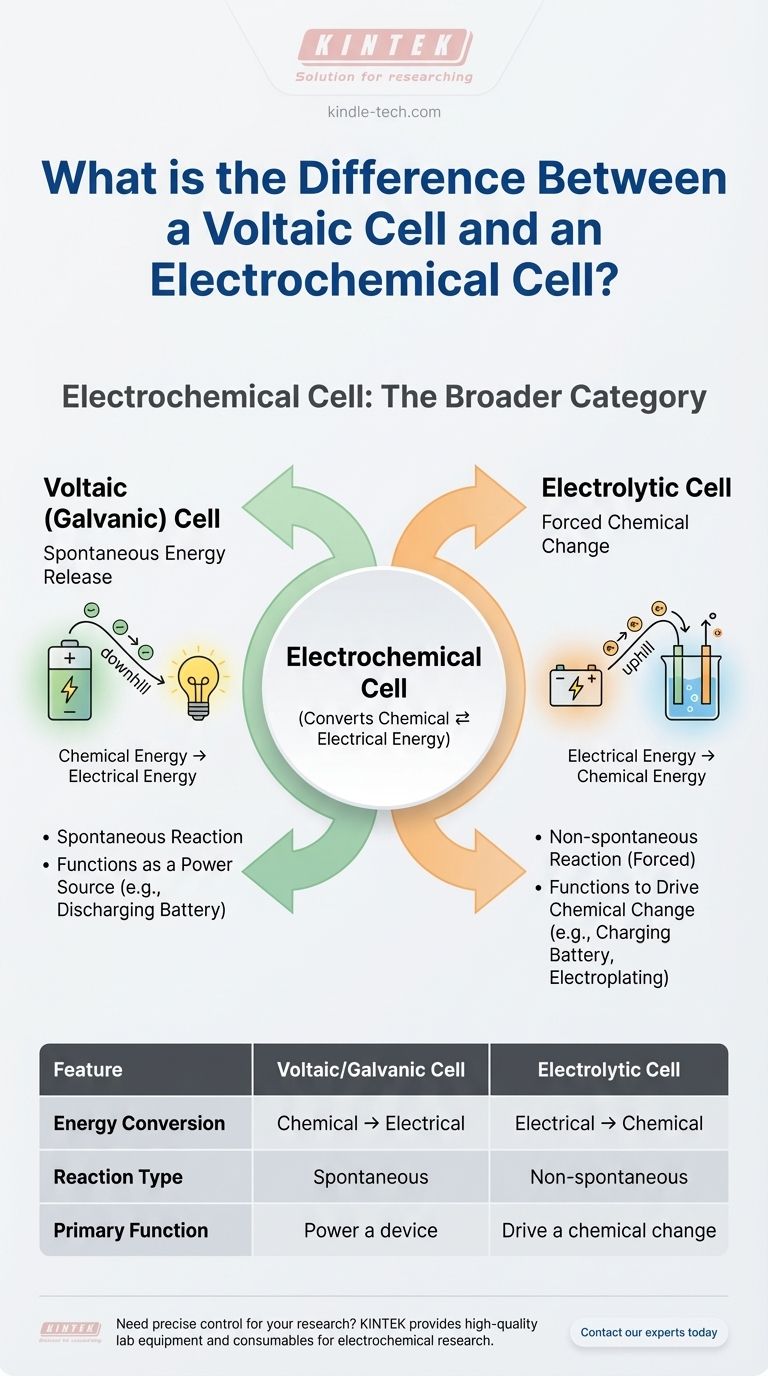
To be direct, a voltaic cell is not different from an electrochemical cell—it is a type of electrochemical cell. The term "electrochemical cell" is the broad category for any device that converts chemical energy into electrical energy or vice versa. A voltaic cell, also known as a galvanic cell, is the specific type that spontaneously generates electricity from a chemical reaction.

The core misunderstanding arises from treating these terms as parallel choices. Instead, think of it as a hierarchy: "Electrochemical Cell" is the family name, and it has two children: the Voltaic Cell (which produces power) and the Electrolytic Cell (which consumes power).
What is the difference between a voltaic cell and an electrochemical cell? Understand the Two Types of Energy Conversion

The Two Paths of Electrochemistry

An electrochemical cell is fundamentally a bridge between the chemical and electrical worlds. All such cells share basic components—two electrodes (an anode and a cathode) and an electrolyte that allows ions to move between them.

The crucial difference lies in the direction of the energy conversion.

Type 1: The Voltaic (Galvanic) Cell — Spontaneous Energy Release

A voltaic cell harnesses a spontaneous chemical reaction to produce electrical energy.

Think of it like a controlled slide. The chemicals are naturally "downhill" in terms of energy, and the voltaic cell provides a path for that energy to be released as a useful electric current.

This is the principle behind a common battery. The chemical reactions inside a AA battery want to happen on their own, and when you complete the circuit, the cell channels the resulting flow of electrons to power your device.

Type 2: The Electrolytic Cell — Forced Chemical Change

An electrolytic cell does the exact opposite. It uses an external source of electrical energy to force a chemical reaction that would not happen on its own.

This is the "uphill" path. You are pushing energy into the system to create a less stable chemical state.

Classic examples include using electricity for electrolysis (like splitting water into hydrogen and oxygen) or recharging a battery. When you charge your phone, you are running its battery as an electrolytic cell, reversing the chemical reactions that occurred when it was powering your device.

Understanding the Critical Differences

The distinction between these two cell types is the most important concept in basic electrochemistry. The direction of energy flow dictates the entire function of the cell.

Energy Conversion

A voltaic cell converts chemical energy into electrical energy. It is an energy source.

An electrolytic cell converts electrical energy into chemical energy. It is an energy consumer.

Reaction Spontaneity

The redox reaction in a voltaic cell is spontaneous. It happens without external intervention once the circuit is complete.

The redox reaction in an electrolytic cell is non-spontaneous. It requires an external power supply (like a battery or DC power source) to proceed.

Practical Function

A voltaic cell's function is to power something. Think of any standard, non-rechargeable battery.

An electrolytic cell's function is to produce a chemical change. Think of electroplating metal or charging a rechargeable battery.

How to Classify Your Cell Correctly

To apply this knowledge, simply ask whether the cell is producing power or consuming it to drive a reaction.

  • If your primary focus is describing any device that interconverts chemical and electrical energy: Use the broad term electrochemical cell.
  • If you are specifically describing a battery that is discharging to power a device: Use the specific terms voltaic cell or galvanic cell.
  • If you are specifically describing a process that uses electricity to force a reaction (like charging a battery or electrolysis): Use the specific term electrolytic cell.

By understanding this simple classification, you can describe any electrochemical process with precision and clarity.

Summary Table:

Feature Voltaic/Galvanic Cell Electrolytic Cell
Energy Conversion Chemical → Electrical Electrical → Chemical
Reaction Type Spontaneous Non-spontaneous (Forced)
Primary Function Power a device (e.g., battery) Drive a chemical change (e.g., electroplating)

Need precise control over your electrochemical processes? KINTEK specializes in high-quality lab equipment and consumables for all your electrochemical research and development needs. Whether you're working with voltaic cells, electrolytic cells, or any other laboratory application, our solutions ensure accuracy and reliability. Contact our experts today to find the perfect equipment for your lab!

Visual Guide
What is the difference between a voltaic cell and an electrochemical cell? Understand the Two Types of Energy Conversion Visual Guide

Related Products

People Also Ask

Related Products

H-Type Double-Layer Optical Electrolytic Electrochemical Cell with Water Bath

H-Type Double-Layer Optical Electrolytic Electrochemical Cell with Water Bath

Double-layer H-type optical water bath electrolytic cells, with excellent corrosion resistance and a wide range of specifications available. Customization options are also available.

Electrolytic Electrochemical Cell for Coating Evaluation

Electrolytic Electrochemical Cell for Coating Evaluation

Looking for corrosion-resistant coating evaluation electrolytic cells for electrochemical experiments? Our cells boast complete specifications, good sealing, high-quality materials, safety, and durability. Plus, they're easily customizable to meet your needs.

Quartz Electrolytic Electrochemical Cell for Electrochemical Experiments

Quartz Electrolytic Electrochemical Cell for Electrochemical Experiments

Looking for a reliable quartz electrochemical cell? Our product boasts excellent corrosion resistance and complete specifications. With high-quality materials and good sealing, it's both safe and durable. Customize to meet your needs.

H Type Electrolytic Cell Triple Electrochemical Cell

H Type Electrolytic Cell Triple Electrochemical Cell

Experience versatile electrochemical performance with our H-type Electrolytic Cell. Choose from membrane or non-membrane sealing, 2-3 hybrid configurations. Learn more now.

PTFE Electrolytic Cell Electrochemical Cell Corrosion-Resistant Sealed and Non-Sealed

PTFE Electrolytic Cell Electrochemical Cell Corrosion-Resistant Sealed and Non-Sealed

Choose our PTFE Electrolytic Cell for reliable, corrosion-resistant performance. Customize specifications with optional sealing. Explore now.

Double Layer Five-Port Water Bath Electrolytic Electrochemical Cell

Double Layer Five-Port Water Bath Electrolytic Electrochemical Cell

Experience optimal performance with our Water Bath Electrolytic Cell. Our double-layer, five-port design boasts corrosion resistance and longevity. Customizable to fit your specific needs. View specs now.

Customizable Swagelok Type Test Cells for Advanced Battery Research Electrochemical Analysis

Customizable Swagelok Type Test Cells for Advanced Battery Research Electrochemical Analysis

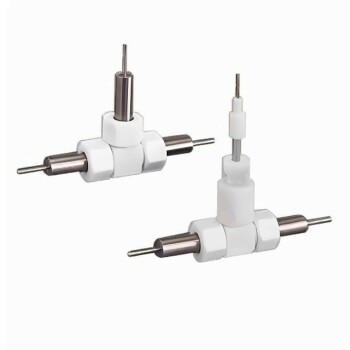
The KINTEK Swagelok-type test cell is a modular, T-shaped device constructed from high-quality, chemically inert materials.

Thin-Layer Spectral Electrolysis Electrochemical Cell

Thin-Layer Spectral Electrolysis Electrochemical Cell

Discover the benefits of our thin-layer spectral electrolysis cell. Corrosion-resistant, complete specifications, and customizable for your needs.

Customizable PEM Electrolysis Cells for Diverse Research Applications

Customizable PEM Electrolysis Cells for Diverse Research Applications

Custom PEM test cell for electrochemical research. Durable, versatile, for fuel cells & CO2 reduction. Fully customizable. Get a quote!

Flat Corrosion Electrolytic Electrochemical Cell

Flat Corrosion Electrolytic Electrochemical Cell

Discover our flat corrosion electrolytic cell for electrochemical experiments. With exceptional corrosion resistance and complete specifications, our cell guarantees optimal performance. Our high-quality materials and good sealing ensure a safe and durable product, and customization options are available.

FS Electrochemical Hydrogen Fuel Cells for Diverse Applications

FS Electrochemical Hydrogen Fuel Cells for Diverse Applications

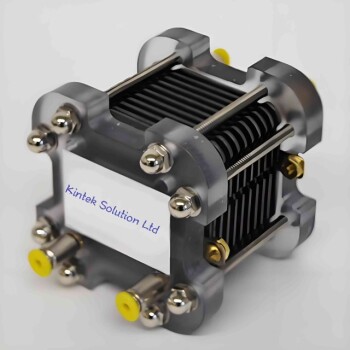
KINTEK's FS Electrochemical Cell: Modular PEM fuel cell stack for R&D and training. Acid-resistant, scalable, and customizable for reliable performance.

Customizable CO2 Reduction Flow Cell for NRR ORR and CO2RR Research

Customizable CO2 Reduction Flow Cell for NRR ORR and CO2RR Research

The cell is meticulously crafted from high-quality materials to ensure chemical stability and experimental accuracy.

Manual button battery sealing machine (digital display)

Manual button battery sealing machine (digital display)

The manual button battery sealing machine is a small device specially used for button battery packaging. It is easy to operate and suitable for laboratories and small batch production to ensure that the battery is firmly sealed and improve production efficiency.

Customizable Fuel Cell Stack Components for Diverse Applications

Customizable Fuel Cell Stack Components for Diverse Applications

Introducing the FS Fuel Cell Stack Components. This modular assembly is designed for ease of use and offers reliable performance for various electrochemical applications, particularly in hydrogen fuel cell research and development, and educational settings.

Platinum Auxiliary Electrode for Laboratory Use

Platinum Auxiliary Electrode for Laboratory Use

Optimize your electrochemical experiments with our Platinum Auxiliary Electrode. Our high-quality, customizable models are safe and durable. Upgrade today!

Aluminum Foil Current Collector for Lithium Battery

Aluminum Foil Current Collector for Lithium Battery

The surface of aluminum foil is extremely clean and hygienic, and no bacteria or microorganisms can grow on it. It is a non-toxic, tasteless and plastic packaging material.

Nickel Aluminum Tabs for Soft Pack Lithium Batteries

Nickel Aluminum Tabs for Soft Pack Lithium Batteries

Nickel tabs are used to manufacture cylindrical and pouch batteries, and positive aluminum and negative nickel are used to produce lithium-ion and nickel batteries.

Laboratory Hybrid Tissue Grinding Mill

Laboratory Hybrid Tissue Grinding Mill

KT-MT20 is a versatile laboratory device used for rapid grinding or mixing of small samples, whether dry, wet, or frozen. It comes with two 50ml ball mill jars and various cell wall breaking adapters for biological applications such as DNA/RNA and protein extraction.

High Purity Zinc Foil for Battery Lab Applications

High Purity Zinc Foil for Battery Lab Applications

There are very few harmful impurities in the chemical composition of zinc foil, and the surface of the product is straight and smooth; it has good comprehensive properties, processability, electroplating colorability, oxidation resistance and corrosion resistance, etc.

Shaking Incubators for Diverse Laboratory Applications

Shaking Incubators for Diverse Laboratory Applications

Precision lab shaking incubators for cell culture & research. Quiet, reliable, customizable. Get expert advice today!


Leave Your Message