Knowledge electrolytic cell What is the difference between an electrolytic cell and an electrochemical cell? Understand the Two Sides of Energy Conversion
Author avatar

Tech Team · Kintek Solution

Updated 2 months ago

What is the difference between an electrolytic cell and an electrochemical cell? Understand the Two Sides of Energy Conversion


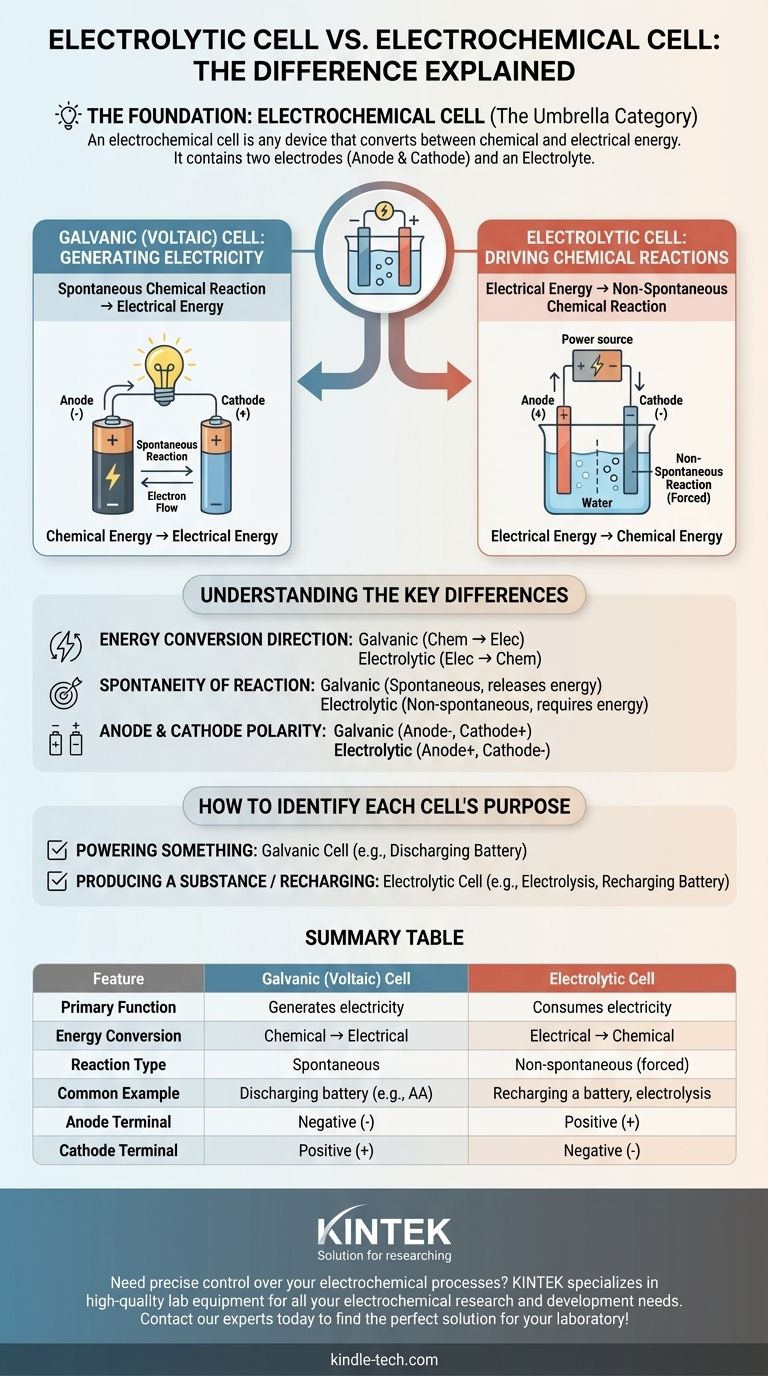
The primary source of confusion is that an electrolytic cell is not a separate concept from an electrochemical cell—it is one of the two main types of electrochemical cells. An electrochemical cell is the broad category for any device that converts between chemical and electrical energy. The real distinction lies between galvanic (voltaic) cells, which generate electricity from chemical reactions, and electrolytic cells, which use electricity to cause chemical reactions.

The term electrochemical cell is the umbrella category. The two specific types under this umbrella are galvanic cells (which create electricity) and electrolytic cells (which consume electricity). Their fundamental difference is the direction of energy conversion.

What is the difference between an electrolytic cell and an electrochemical cell? Understand the Two Sides of Energy Conversion

The Foundation: What Is an Electrochemical Cell?

Core Components

An electrochemical cell is any device containing two electrodes (an anode and a cathode) and an electrolyte. These components work together to facilitate the transfer of electrons, either creating or consuming an electric current.

The Overarching Purpose

The sole purpose of an electrochemical cell is to serve as a bridge between chemical energy and electrical energy. The direction of this energy conversion determines the specific type of cell.

The Two Fundamental Types of Conversion

Galvanic (Voltaic) Cells: Generating Electricity

A galvanic cell, also known as a voltaic cell, harnesses a spontaneous chemical reaction to produce electrical energy.

Think of a standard AA battery. The chemical materials inside it react naturally, releasing energy in the form of an electric current that can power a device. This is a galvanic cell in action.

Electrolytic Cells: Driving Chemical Reactions

An electrolytic cell does the exact opposite. It uses an external source of electrical energy (like a power supply) to force a non-spontaneous chemical reaction to occur.

A common example is electrolysis, such as splitting water into hydrogen and oxygen. This reaction does not happen on its own; it requires a constant input of electricity, which is the function of the electrolytic cell. Recharging a battery is another example of this process.

Understanding the Key Differences

Energy Conversion Direction

This is the most critical distinction. A galvanic cell converts stored chemical energy into electrical energy. An electrolytic cell converts supplied electrical energy into chemical energy.

Spontaneity of the Reaction

The chemical reaction in a galvanic cell is spontaneous—it proceeds naturally and releases energy.

The reaction in an electrolytic cell is non-spontaneous—it requires a constant input of external energy to proceed.

Anode and Cathode Polarity

This is a common point of confusion but follows logically from the energy flow.

In a galvanic cell (discharging battery), the anode is the source of electrons, making it the negative terminal, while the cathode is the positive terminal.

In an electrolytic cell (recharging battery), an external power source reverses the flow. The anode is where oxidation still occurs but is forced to be the positive terminal, and the cathode is the negative terminal.

How to Identify Each Cell's Purpose

Use the cell's primary function as your guide to easily distinguish between the two types.

  • If the primary goal is to power something: You are using a galvanic (voltaic) cell, as a spontaneous chemical reaction is producing electricity.
  • If the primary goal is to produce a substance or recharge a battery: You are using an electrolytic cell, as electricity is being consumed to force a chemical reaction.

Ultimately, both are simply two sides of the same electrochemical coin, defined by whether they generate or consume electrical power.

Summary Table:

Feature Galvanic (Voltaic) Cell Electrolytic Cell
Primary Function Generates electricity Consumes electricity
Energy Conversion Chemical → Electrical Electrical → Chemical
Reaction Type Spontaneous Non-spontaneous (forced)
Common Example Discharging battery (e.g., AA) Recharging a battery, electrolysis
Anode Terminal Negative (-) Positive (+)
Cathode Terminal Positive (+) Negative (-)

Need precise control over your electrochemical processes? KINTEK specializes in high-quality lab equipment for all your electrochemical research and development needs. Whether you are developing new battery technologies or synthesizing materials via electrolysis, our reliable instruments ensure accurate and reproducible results. Contact our experts today to find the perfect solution for your laboratory!

Visual Guide
What is the difference between an electrolytic cell and an electrochemical cell? Understand the Two Sides of Energy Conversion Visual Guide

Related Products

People Also Ask

Related Products

PTFE Electrolytic Cell Electrochemical Cell Corrosion-Resistant Sealed and Non-Sealed

PTFE Electrolytic Cell Electrochemical Cell Corrosion-Resistant Sealed and Non-Sealed

Choose our PTFE Electrolytic Cell for reliable, corrosion-resistant performance. Customize specifications with optional sealing. Explore now.

Super Sealed Electrolytic Electrochemical Cell

Super Sealed Electrolytic Electrochemical Cell

Super-sealed electrolytic cell offers enhanced sealing capabilities, making it ideal for experiments that require high airtightness.

Electrolytic Electrochemical Cell with Five-Port

Electrolytic Electrochemical Cell with Five-Port

Streamline your laboratory consumables with Kintek's Electrolytic Cell with five-port design. Choose from sealed and non-sealed options with customizable electrodes. Order now.

H Type Electrolytic Cell Triple Electrochemical Cell

H Type Electrolytic Cell Triple Electrochemical Cell

Experience versatile electrochemical performance with our H-type Electrolytic Cell. Choose from membrane or non-membrane sealing, 2-3 hybrid configurations. Learn more now.

Electrolytic Electrochemical Cell Gas Diffusion Liquid Flow Reaction Cell

Electrolytic Electrochemical Cell Gas Diffusion Liquid Flow Reaction Cell

Looking for a high-quality gas diffusion electrolysis cell? Our liquid flow reaction cell boasts exceptional corrosion resistance and complete specifications, with customizable options available to suit your needs. Contact us today!

Electrolytic Electrochemical Cell for Coating Evaluation

Electrolytic Electrochemical Cell for Coating Evaluation

Looking for corrosion-resistant coating evaluation electrolytic cells for electrochemical experiments? Our cells boast complete specifications, good sealing, high-quality materials, safety, and durability. Plus, they're easily customizable to meet your needs.

Double Layer Five-Port Water Bath Electrolytic Electrochemical Cell

Double Layer Five-Port Water Bath Electrolytic Electrochemical Cell

Experience optimal performance with our Water Bath Electrolytic Cell. Our double-layer, five-port design boasts corrosion resistance and longevity. Customizable to fit your specific needs. View specs now.

Flat Corrosion Electrolytic Electrochemical Cell

Flat Corrosion Electrolytic Electrochemical Cell

Discover our flat corrosion electrolytic cell for electrochemical experiments. With exceptional corrosion resistance and complete specifications, our cell guarantees optimal performance. Our high-quality materials and good sealing ensure a safe and durable product, and customization options are available.

Double-Layer Water Bath Electrolytic Electrochemical Cell

Double-Layer Water Bath Electrolytic Electrochemical Cell

Discover the temperature-controllable electrolytic cell with a double-layer water bath, corrosion resistance, and customization options. Complete specifications included.

H-Type Double-Layer Optical Electrolytic Electrochemical Cell with Water Bath

H-Type Double-Layer Optical Electrolytic Electrochemical Cell with Water Bath

Double-layer H-type optical water bath electrolytic cells, with excellent corrosion resistance and a wide range of specifications available. Customization options are also available.

Side Window Optical Electrolytic Electrochemical Cell

Side Window Optical Electrolytic Electrochemical Cell

Experience reliable and efficient electrochemical experiments with a side window optical electrolytic cell. Boasting corrosion resistance and complete specifications, this cell is customizable and built to last.

Quartz Electrolytic Electrochemical Cell for Electrochemical Experiments

Quartz Electrolytic Electrochemical Cell for Electrochemical Experiments

Looking for a reliable quartz electrochemical cell? Our product boasts excellent corrosion resistance and complete specifications. With high-quality materials and good sealing, it's both safe and durable. Customize to meet your needs.

Customizable PEM Electrolysis Cells for Diverse Research Applications

Customizable PEM Electrolysis Cells for Diverse Research Applications

Custom PEM test cell for electrochemical research. Durable, versatile, for fuel cells & CO2 reduction. Fully customizable. Get a quote!

Optical Water Bath Electrolytic Electrochemical Cell

Optical Water Bath Electrolytic Electrochemical Cell

Upgrade your electrolytic experiments with our Optical Water Bath. With controllable temperature and excellent corrosion resistance, it's customizable for your specific needs. Discover our complete specifications today.

Multifunctional Electrolytic Electrochemical Cell Water Bath Single Layer Double Layer

Multifunctional Electrolytic Electrochemical Cell Water Bath Single Layer Double Layer

Discover our high-quality Multifunctional Electrolytic Cell Water Baths. Choose from single or double-layer options with superior corrosion resistance. Available in 30ml to 1000ml sizes.

Thin-Layer Spectral Electrolysis Electrochemical Cell

Thin-Layer Spectral Electrolysis Electrochemical Cell

Discover the benefits of our thin-layer spectral electrolysis cell. Corrosion-resistant, complete specifications, and customizable for your needs.

Custom Ion Conductivity Test Fixtures for Fuel Cell Research

Custom Ion Conductivity Test Fixtures for Fuel Cell Research

Custom ion conductivity test fixtures for precise PEM/AEM fuel cell research. High-precision, customizable.

Sample Support Body for Electrochemical Tests

Sample Support Body for Electrochemical Tests

Improve your electrochemical tests with our Sample Support Body. High-quality and reliable for accurate results. Upgrade your research today.

Customizable CO2 Reduction Flow Cell for NRR ORR and CO2RR Research

Customizable CO2 Reduction Flow Cell for NRR ORR and CO2RR Research

The cell is meticulously crafted from high-quality materials to ensure chemical stability and experimental accuracy.

Customizable Swagelok Type Test Cells for Advanced Battery Research Electrochemical Analysis

Customizable Swagelok Type Test Cells for Advanced Battery Research Electrochemical Analysis

The KINTEK Swagelok-type test cell is a modular, T-shaped device constructed from high-quality, chemically inert materials.


Leave Your Message