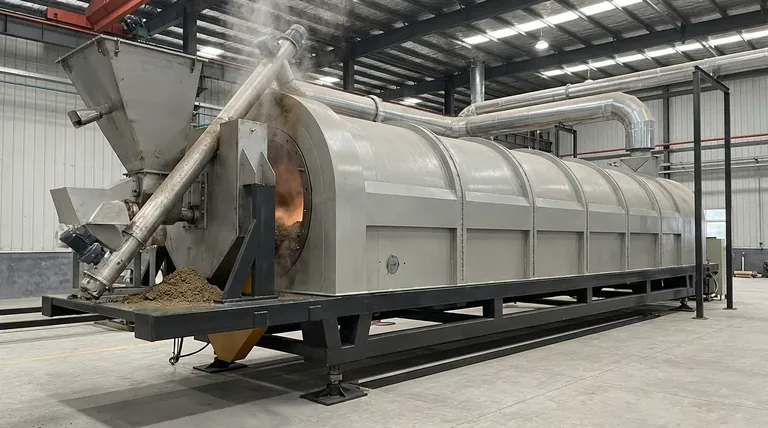
In simple terms, the drying zone is the very first section of a rotary kiln, located at the material feed entrance. Its sole purpose is to use hot gases to evaporate the free moisture from the raw materials as they begin their journey through the kiln. This zone is most prominent in older or "wet process" kilns where the feed material has significant water content.
The core concept to grasp is that while the drying zone is a fundamental stage in material processing, its location—either inside the kiln or in a separate, dedicated piece of equipment—is a critical design choice that separates traditional methods from modern, high-efficiency industrial processes.
The Role and Mechanics of the Drying Zone
The drying zone is the preparatory stage. Before any high-temperature chemical reactions can occur, the water must be removed. This initial phase sets the stage for the entire thermal process that follows.
Primary Function: Moisture Removal
The primary and only function of the drying zone is to heat the raw material just enough to drive off unbound water. As the kiln rotates, the wet feed tumbles into contact with hot exhaust gases flowing in the opposite direction.
The Temperature Profile
This is a relatively low-temperature section of the kiln. The material itself is heated from ambient temperature to around 150°C (302°F). The hot gas flowing through this zone is typically in the range of 250°C to 400°C (482°F to 752°F).
Preparing Material for Reaction
By eliminating the water, the drying zone ensures that the energy in subsequent, hotter zones is used for chemical conversion (like calcination), not for boiling water. This creates a more stable and efficient process downstream.
Why Modern Systems Handle Drying Differently
You will find that many modern, high-efficiency kilns—especially in the cement industry—do not have a distinct drying zone. This is a deliberate design choice driven by the pursuit of thermal efficiency.
The Rise of Pre-Processing
Instead of feeding wet material directly into the kiln, modern systems often use a separate piece of equipment, like a rotary dryer or a preheater tower, to dry the material beforehand.
This approach allows each piece of equipment to be optimized for a single task. A rotary dryer is far more efficient at removing water than a rotary kiln is.
The Inefficiency of In-Kiln Drying
Drying material inside a rotary kiln is not very efficient. Because the material tends to slide along the interior surface, it has limited contact with the hot gas.
In a dedicated rotary dryer, internal structures called "flights" or "lifters" shower the material through the stream of hot gas, maximizing surface area and dramatically improving heat transfer. This makes the drying process faster and more energy-efficient.
Understanding the Trade-offs
Deciding whether to perform drying inside the kiln or externally involves clear engineering trade-offs between capital cost, process complexity, and operational efficiency.
Process Simplification
Integrating the drying zone into the kiln simplifies the overall equipment layout. You have one primary machine instead of two, which can reduce the initial capital investment and physical footprint.
Sacrificing Thermal Efficiency
However, this simplification comes at a cost. Using the kiln for drying means it is performing a task it is not designed for. This lowers the overall thermal efficiency of the system, as more energy and a longer residence time are required to achieve the same result.
Optimizing for Conversion
By moving the drying stage to a separate rotary dryer, the rotary kiln can be dedicated solely to high-temperature material conversion. This allows the kiln to be designed for maximum efficiency in its core function, leading to higher throughput and lower fuel consumption per ton of product.
Making the Right Choice for Your Goal
The correct approach depends entirely on the material being processed and the operational goals of the plant.
- If your primary focus is working with a traditional wet-process system: The integrated drying zone is a critical and non-negotiable first step in your kiln's operation.
- If your primary focus is maximizing throughput and fuel efficiency: You must use an external drying system to prepare the material before it ever enters the kiln.
- If your primary focus is designing a new, modern production line: The standard practice is to separate the drying and thermal reaction stages into dedicated equipment for optimal performance.
Ultimately, understanding how and where drying occurs is key to optimizing the efficiency and output of any rotary kiln system.
Summary Table:
| Aspect | Traditional In-Kiln Drying Zone | Modern External Drying |
|---|---|---|
| Location | Inside the kiln's feed end | Separate equipment (e.g., rotary dryer) |
| Temperature | Material: Up to 150°C; Gas: 250-400°C | Optimized for efficient water removal |
| Efficiency | Lower (material slides, limited gas contact) | Higher (showers material for max heat transfer) |
| Best For | Wet-process systems, simplicity | High throughput, fuel efficiency, modern design |
Ready to optimize your thermal processing efficiency? KINTEK specializes in advanced lab equipment and consumables, including high-efficiency rotary dryers and kiln systems tailored for laboratory and industrial needs. Let our experts help you design a solution that maximizes throughput and minimizes energy consumption. Contact us today to discuss your specific requirements!
Visual Guide

Related Products
- Electric Rotary Kiln Small Rotary Furnace Biomass Pyrolysis Plant
- Electric Rotary Kiln Continuous Working Small Rotary Furnace Heating Pyrolysis Plant
- Electric Rotary Kiln Small Rotary Furnace for Activated Carbon Regeneration
- Electric Rotary Kiln Pyrolysis Furnace Plant Machine Calciner Small Rotary Kiln Rotating Furnace
- Vacuum Sealed Continuous Working Rotary Tube Furnace Rotating Tube Furnace
People Also Ask
- What is the temperature of a rotating kiln? It Depends on Your Material and Process Goal
- What is a rotary kiln reactor? A Guide to Industrial Thermal Processing
- What are the principles of a rotary kiln? Master the Mechanics of High-Temperature Processing
- Is rotary kiln a furnace? Discover the Key Differences for Industrial Processing
- What are the reactors for fast pyrolysis? Choosing the Right System for Maximum Bio-Oil Yield